it’s MUCH more comfortable than other EEG bands. It can vibrate the brain
You’re using the Frenz headband Alex? How long? Benefits with sleep duration or quality?
IDK yet you need 5 days minimum but I can post screenshots (3 phones helps bc one is iPhone, one is Fitbit, etc)
But I found I successfully side sleep most of the time now!!
This is WAY more accurate than oura ring
1 Like
Muse headband is also supposed to increase deep sleep by audio feedback. Also, Elemind headband reduces sleep onset time using audio feedback (not CBT-i) and is supposed to increase deep sleep eventually but that feature has not made it to the headband yet.
I’m fairly sure that Elemind does work for me. But one thing I have to do is reposition the headband so that the side I’m sleeping on has the band above the ear (otherwise irritation and pain results). The Frenz looks nicer in this respect because it looks like is ok being above the ear.
It will be interesting to see how this all shakes out.
Wow
There’s also
1 Like
Very cool. Interested to see your results and how it’s tracking compares to your Fitbit. Which part of your sleep is lacking the most?
Since I started tracking my deep sleep it was horrible, like 30-45 mins a night and rarely an hour. Tart cherry is what helped me consistently get around an 1-1.5 hours of deep sleep each night. Think I could still use more deep sleep though so maybe one of these would be the solution.
Just saw this: Deep Sleep Stimulation | Muse® EEG Mental Fitness & Sleep Headband
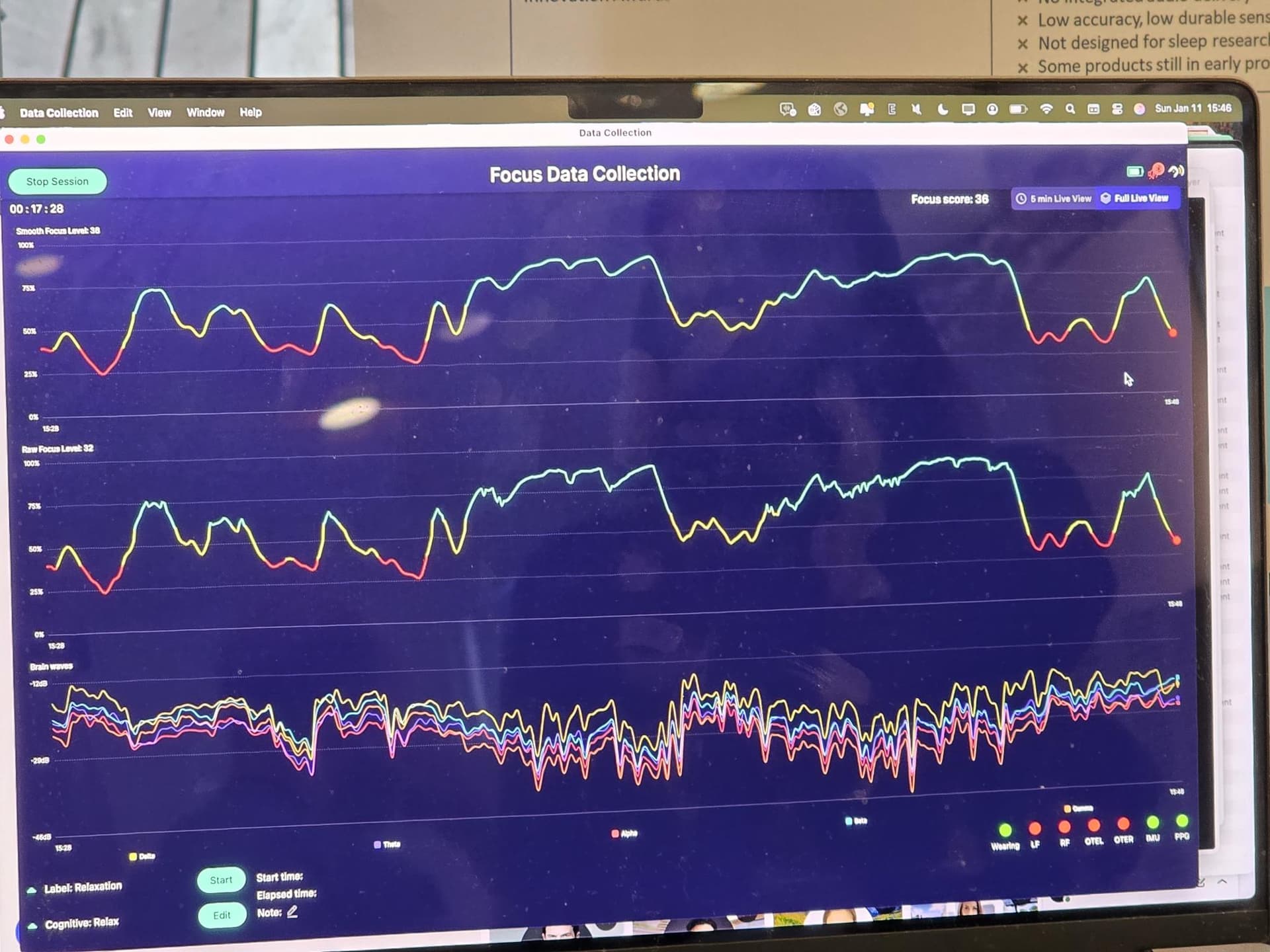
frenz isn’t great at capturing data when ur not sleeping (it autoturns off every 10 minutes)
I guess I average 10% deep sleep? Blah. It doesn’t align super-well with my fitbit deep sleep but I guess that’s expected.
A bit off topic here but may I ask if anyone knows of a wearable device that can measure/quantify REM sleep?
From Gemini Pro:
REM Sleep Wearable Devices: Procurement Overview
Consumer wearable devices estimate Rapid Eye Movement (REM) sleep using a combination of actigraphy (movement), photoplethysmography (PPG for heart rate and heart rate variability), and thermometry.
Scientific Caveats and Knowledge Gaps
While these devices quantify REM sleep, they do not measure it directly. The clinical gold standard for sleep staging is polysomnography (PSG), which utilizes electroencephalography (EEG) to detect cortical brain activity. Consumer wearables infer sleep stages through autonomic nervous system proxies. Peer-reviewed validation studies demonstrate that commercial wearables exhibit variable accuracy, typically showing 60% to 80% agreement with PSG for REM staging. Procurement decisions should account for this margin of error. Additional clinical validation data utilizing multi-channel EEG integrated into consumer form factors is required to establish diagnostic equivalency.
Longevity and Health Application
REM sleep is a physiological requirement for cognitive health, memory consolidation, and neuroplasticity. Tracking REM duration provides actionable data to modify circadian behaviors—such as alcohol cessation, light exposure regulation, and temperature optimization—that directly correlate with extended healthspan, improved metabolic pathways, and neurological longevity.
Market Analysis and Pricing (Q1 2026)
The consumer market is saturated with generic devices, but clinical utility is restricted to established brands with validated algorithms. Below is an itemized procurement list of the primary, market-leading wearables capable of estimating REM sleep.
| Device | Form Factor | Base Retail Price (USD) | Ongoing Subscription | Actionable Longevity Metric | Procurement Link |
|---|---|---|---|---|---|
| Oura Ring 4 | Smart Ring | $349.00 | $5.99/mo | Blood oxygen (SpO2), nighttime HRV, continuous temperature. | Oura Store |
| Whoop 4.0 | Wrist/Apparel Band | $0.00 (Hardware included in sub) | $199.00 - $239.00/yr | Recovery-focused strain metrics, respiratory rate. | Whoop Pricing |
| Apple Watch Series 9 | Smartwatch | $399.00 | None | AFib history, wrist temperature, biphasic sleep schedules. | Best Buy |
| Garmin Venu 3 | Smartwatch | $449.99 | None | “Body Battery” energy monitoring, sleep coach algorithms. | Target |
| Fitbit Charge 6 | Fitness Band | $159.99 | $9.99/mo (Premium) | Electrodermal activity (EDA) for stress, resting heart rate. | Android Authority Review |
| Ultrahuman Ring AIR | Smart Ring | $349.00 | None | Circadian phase alignment, metabolic health tracking. | Live Science Review |
Comparative Analysis: PPG Sensor Accuracy in REM Sleep Classification
Photoplethysmography (PPG) quantifies autonomic nervous system (ANS) activity by measuring microvascular blood volume changes. Because Rapid Eye Movement (REM) sleep is characterized by sympathetic surges—resulting in increased heart rate (HR) and heart rate variability (HRV)—wearable algorithms infer REM stages from these vascular fluctuations rather than direct cortical activity.
Sensor placement dictates raw data fidelity. Digital arteries in the finger yield higher signal-to-noise ratios than the capillary beds of the dorsal wrist. However, algorithmic processing often supersedes raw hardware capabilities in determining final staging accuracy.
Peer-Reviewed Efficacy Data
Recent validation studies utilizing polysomnography (PSG) highlight significant discrepancies between manufacturer-funded and independent analyses. The table below synthesizes findings from recent clinical trials, measuring agreement via Cohen’s Kappa (κ) and specific stage sensitivity.
| Device | Form Factor | Independent REM Sensitivity | Overall Agreement (κ) | Bias / Misclassification Tendencies | Source |
|---|---|---|---|---|---|
| Apple Watch (Series 8/9) | Wrist | 68.6% | 0.53 (Independent) | Overestimates light sleep; underestimates deep sleep. | Schyvens et al., 2025 |
| Whoop 4.0 | Wrist/Bicep | 62.0% | 0.37 (Independent) | High deep sleep sensitivity (69.6%); lower specificity for wakefulness. | Schyvens et al., 2025 |
| Oura Ring (Gen 3/4) | Finger | Not tested in Antwerp | 0.65 (Oura-Funded) | 76.0% REM sensitivity reported in industry-funded trials. | Robbins et al., 2024 |
| Fitbit Charge 5/6 | Wrist | 47.5% - 55.5% | 0.41 - 0.42 (Independent) | Moderate across all stages; tends to under-report REM slightly. | Schyvens et al., 2025 |
| Garmin Venu/Vivosmart | Wrist | 28.7% | 0.21 (Independent) | Poor multi-stage classification; heavily misclassifies REM as light sleep. | Schyvens et al., 2025 |
| Ultrahuman Ring AIR | Finger | Insufficient Data | Insufficient Data | Relies on similar digital artery PPG metrics as Oura, but lacks peer-reviewed PSG validation. | N/A |
Device-Specific Analysis
Apple Watch
In independent multi-center analyses, Apple Watch currently leads in algorithmic REM detection (68.6% sensitivity). The device utilizes a high sampling rate during sleep intervals, effectively capturing the autonomic instability characteristic of REM. However, researchers note a conservative algorithmic bias that defaults ambiguous epochs to light sleep.
Oura Ring
Industry-funded studies (e.g., Brigham and Women’s Hospital, 2024) report a 0.65 κ score and 76.0% REM sensitivity. Independent studies (e.g., Park et al., 2023) assign it a lower “fair” rating (0.2–0.4 κ). The ring form factor indisputably captures superior nocturnal HRV and resting heart rate data (CCC > 0.97) due to less movement artifact than wrist wearables, but the proprietary sleep-staging algorithm remains heavily debated outside of manufacturer-sponsored literature.
Whoop
Whoop prioritizes recovery metrics and demonstrates strong independent validity for deep (slow-wave) sleep detection (69.6%), but falls behind Apple in REM sensitivity (62.0%). It remains clinically useful for tracking cardiovascular strain and respiratory rate, but its sleep staging precision is secondary to its holistic recovery algorithms.
Garmin
Garmin’s algorithms consistently perform poorly against PSG in multi-stage classification (often falling below 30% accuracy for REM and deep sleep). Garmin systematically categorizes REM and wakefulness epochs as light sleep. It is not currently recommended for precise longevity or neuroplasticity interventions dependent on REM quantification.
Knowledge Gaps and Structural Limitations
- Skin Pigmentation Bias: PPG sensors rely on optical light reflection (green and red LEDs). Melanin absorbs these wavelengths, significantly degrading signal quality in individuals with darker skin tones. Most validation studies feature predominantly Caucasian cohorts, representing a critical failure in current device validation.
- “Quiet Wakefulness” Confounding: All commercial PPG devices exhibit high sensitivity (detecting sleep) but low specificity (detecting wakefulness). They frequently misclassify “quiet wakefulness”—when a user is immobile but cortically active—as light or REM sleep due to stabilized heart rates.
- The Interrater Reliability Ceiling: The “gold standard” of polysomnography is scored by human technicians, who maintain an interrater reliability of roughly 83%. Consumer algorithms are therefore trained on imperfect, subjective datasets, creating an absolute ceiling on their theoretical accuracy.
1 Like
nextsense vs frenz vs athena muse s
[nextsense plays pink noise during SWS spindles, but in-the-ear placement can be an issue]
“but that rhythmically modulated pink noise locked to slow oscillation phase (~0.75 Hz) can boost slow-wave sleep and memory consolidation. Ngo et al. and related work showed this with closed-loop auditory stimulation. This is a real, replicable-ish finding. But note: this is not what most “pink noise for sleep” products or studies do. Static pink noise played all night is different from phase-locked slow-oscillation stimulation” what does next sense do
3:09 AM
Validated NextSense implements precise closed-loop slow-wave stimulation technology
Validated NextSense implements precise closed-loop slow-wave stimulation technology
So NextSense is doing exactly the thing I was distinguishing from static pink noise. This is the real deal mechanistically, not the consumer fluff version.
What they actually do:
Smartbuds use 6 clinical-grade EE NextSenseG sensors to monitor brain activity in real time, detect when you’re in N3 deep sleep, and provide audio stimulation to boost slow-wave effects — playing gentle pink noise pulses that sync with the brain’s natural rhythms to deepen slow waves.
So it’s closed-loop, phase-locked, pink noise pulses during N3 — not static pink noise. That maps directly onto the Ngo et al. paradigm. The original Ngo work showed that auditory stimulation in phase with slow oscillation up states enhances the slow oscillation rhythm, phase-coupled spindle activity, and declarative memory consolidation — and crucially, stimulation out of phase remained ineffective. ScienceDirect The phase-locking is load-bearing, not incidental.
The in-ear EEG angle has specific scientific backing too — a 2022 study found that in-ear sensors provide enough information to automatically detect sleep slow oscillations in real time and successfully enhance scalp slow oscillations using auditory closed-loop stimulation based on in-ear signals. Wiley Online Library
Where I’d pump the brakes though:
The “50% slow-wave boost” figure comes from internal and early-trial data rather than peer-reviewed publications. Neurofounders That’s a meaningful caveat. The underlying science from Ngo/Born lab is solid, but whether NextSense’s specific implementation in a consumer earbud form factor replicates lab results is genuinely unknown right now. Going from gel electrodes on scalp at AFz to dry in-ear electrodes is a non-trivial signal quality drop, and peer-reviewed studies found that closed-loop stimulation can modestly improve deep sleep quality — not dramatically. FindArticles “Modest” in the lab → “50% boost” in marketing copy is a gap worth watching.
Also worth flagging: the Ngo driving stimulation work actually found this is a self-limiting process — the brain has mechanisms that counter developing hypersynchronicity during slow oscillations. Journal of Neuroscience So there’s a ceiling effect baked in biologically, which makes the 50% claim additionally suspicious.
Bottom line: NextSense is doing the right thing scientifically — actual closed-loop phase-locked stimulation, not fake pink noise theater. The question is whether consumer-grade in-ear EEG is good enough to do the phase detection reliably, which nobody has published on rigorously yet for their specific hardware.
how many slow wave trains per night
3:18 AM
Synthesized fragmented data to estimate nightly slow wave train frequency
Synthesized fragmented data to estimate nightly slow wave train frequency
The search results don’t give a clean “X trains per full night” number directly, so let me be explicit that what follows is partially computed from first principles rather than a citation.
What we know from the literature:
Spontaneous SOs occur in trains of typically two or three succeeding waves, with roughly 2.5 seconds between trains Nature — that’s the temporal structure the Ngo closed-loop protocol was designed to mimic.
Normal young adults spend roughly 10-25% of total sleep time in SWS PubMed Central, mostly front-loaded into the first two NREM cycles. Call it ~70-90 minutes of SWS for a healthy young adult on an unstressed night.
SWA declines steeply across the night — the first two NREM episodes have roughly 130-140% of mean SWA, while the third and fourth episodes drop to ~50% PubMed Central. So SO density is not uniform — first cycle is much richer than later ones.
Back-of-envelope:
During active SWS, SOs occur at roughly <1 Hz but not continuously — they cluster. If a train is 2-3 SOs + a 2.5s inter-train gap, each train takes roughly 5-6 seconds total. So during dense SWS you’re getting maybe 8-12 trains per minute.
But that’s peak density in the first NREM cycle. Averaging across all SWS including the attenuated later cycles, maybe call it 4-6 trains per minute across SWS as a whole.
Over 70-90 minutes of SWS: rough estimate of ~400-700 discrete SO train events per night for a young healthy adult.
Why this matters for closed-loop stimulation:
That’s actually not a huge number of stimulation windows. The Ngo 2-click protocol delivers two tones per train — so even if you hit every train you’d deliver maybe 800-1400 tone pairs across a whole night. In practice the algorithms miss trains, some occur during N2 not N3, and the self-limiting mechanism kicks in. The Ngo driving stimulation paper explicitly tracked SO trains of one, two, three, or four SO cycles across a 210-minute stimulation interval PubMed — so empirical counts exist in those datasets, I just can’t pull the exact number from what’s returned here.
The decline across the night is also operationally important for NextSense — most of the stimulable SO trains are concentrated in the first 90-120 minutes of sleep. If their battery or algorithm is suboptimal in that window specifically, they’re missing the high-value target.
Do you have access to your own NextSense/Muse data or is this more conceptual curiosity?
Has anyone tried the Bía Smart Sleep Mask?
I’m curious as to what the real reasults are on Deep Sleep (SWS). The recent reviews I’ve seen on Reddit doesn’t sound great, more REM sleep, but I care less about that: https://www.reddit.com/r/BiaNeuroscience/comments/1vyvzfk/my_experience_as_a_current_bía_beta_tester/
Gemini Review of it:
Evidence Analysis: Bía Smart Sleep Mask
An objective review of the scientific and clinical evidence supporting the efficacy of the Bía Smart Sleep Mask reveals a substantial gap between consumer marketing claims and peer-reviewed, device-specific data. The company makes highly specific quantitative claims (e.g., 45% faster sleep onset, 2x more deep sleep, 50% fewer awakenings). However, these figures are derived from general literature on proxy technologies, not from clinical trials of the Bía device itself.
Evidence Ranking and Rating
Using the Oxford Centre for Evidence-Based Medicine (CEBM) Levels of Evidence, the data supporting the Bía Sleep device is rated as follows:
-
Evidence for the specific Bía device: Level 5 (Mechanism-based reasoning / Extrapolation). A search of ClinicalTrials.gov and PubMed yields zero registered, peer-reviewed clinical trials, randomized controlled trials (RCTs), or independent observational studies evaluating the commercial Bía mask.
-
Evidence for underlying mechanisms (fNIRS and Neurofeedback): Level 2 to 3. There is robust literature supporting functional near-infrared spectroscopy (fNIRS) for monitoring cortical hemodynamics and limited but positive data for electroencephalography (EEG)-based neurofeedback in treating insomnia.
Bía Neuroscience relies on a common consumer neurotechnology practice: citing established clinical research on foundational technologies (listed on their Science page) and extrapolating those physiological outcomes to their proprietary, unvalidated hardware.
Analysis of Technological Mechanisms and Scholarly Debate
The Bía mask operates on a closed-loop system utilizing two primary technologies. The scientific consensus on these mechanisms is mixed when applied to a consumer wearable.
1. Functional Near-Infrared Spectroscopy (fNIRS) for Sleep Staging
-
Mechanism: The device uses infrared light to measure blood flow and oxygenation in the prefrontal cortex to identify sleep stages, theoretically bypassing the need for traditional EEG electrodes.
-
Debate: While fNIRS is clinically validated for assessing mental workload and localized cortical activity, its utility as a standalone tool for real-time, highly accurate, full-night sleep staging (differentiating N1, N2, N3/Slow-Wave Sleep, and REM) is debated. Polysomnography (the gold standard) relies heavily on EEG, electrooculography (EOG), and electromyography (EMG). Relying solely on frontal hemodynamic responses risks data latency and staging inaccuracies.
2. Acoustic Neurofeedback and “Neural Soundscapes”
-
Mechanism: Once a sleep stage is detected, the device delivers targeted audio (via bone conduction) to induce or maintain specific brainwave states, theoretically extending Slow-Wave Sleep (SWS).
-
Debate: The concept of closed-loop acoustic stimulation to enhance SWS is well-documented in the literature. Studies demonstrate that timing auditory clicks to the ascending phase of slow waves can enhance SWS. However, scholarly consensus remains fractured regarding whether this consistently translates to improved subjective sleep quality or memory consolidation. Furthermore, poorly timed acoustic stimulation risks causing micro-arousals, thereby fragmenting sleep rather than deepening it.
Health, Longevity, and Lifespan Implications
From a longevity perspective, the core objective of the Bía mask—enhancing deep sleep (N3/SWS)—is a highly relevant biological target.
-
Glymphatic Clearance: SWS is the primary period during which the glymphatic system clears neurotoxic waste products, including amyloid-beta and tau proteins, from the brain. Optimizing this pathway is a critical action for delaying neurodegenerative pathologies and extending healthspan.
-
Metabolic and Endocrine Function: Enhanced SWS correlates with improved insulin sensitivity, optimal growth hormone secretion, and reduced sympathetic nervous system tone, all of which are established pathways for maximizing lifespan.
If the Bía device successfully and predictably doubles deep sleep as claimed, it would represent a significant, actionable intervention for longevity. However, without objective data proving the device achieves this without causing compensatory reductions in REM sleep or increasing micro-arousals, its practical utility for lifespan extension remains theoretical.
Knowledge Gaps and Required Data
To elevate the evidence rating and validate the efficacy of the Bía Smart Sleep Mask, the following independent data are required:
-
Validation of fNIRS Algorithm: A validation study comparing Bía’s fNIRS-derived sleep architecture data against simultaneous clinical polysomnography to determine its sensitivity and specificity for sleep staging.
-
Independent RCTs on Acoustic Stimulation: Double-blind, sham-controlled trials evaluating whether Bía’s proprietary “Neural Soundscapes” objectively increase SWS duration and amplitude without triggering EEG arousals.
-
Longitudinal Habituation Data: Research to determine if the brain habituates to the specific acoustic neurofeedback over time, which would nullify any initial physiological benefits.
I ordered one but will not receive it until January or later. Production delays.
1 Like