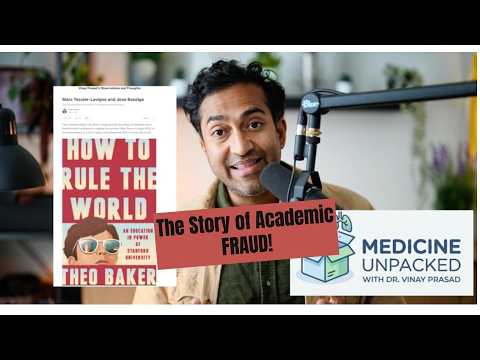
I really like this guy - very nuanced and not at all going in expected directions. Sobering. Personally, it makes me wonder how good can all this LLM based AI be, since it is trained on all this fraud.
How much Medical Science Fraud is out there? A Book Review of How to Rule the World (via Vinay Prasad MD MPH)
I. Executive Summary
Dr. Vinay Prasad’s critique of Theo Baker’s book How to Rule the World [Baker, 2026; Source unverified in live search] frames the resignation of former Stanford University President Marc Tessier-Lavigne not as an isolated ethical failure, but as a symptom of a systemic crisis in biomedical research. The core thesis posits that academic science operates under perverse institutional incentives that reward the fabrication of novel, high-impact results while heavily subsidizing extreme systemic waste. Prasad argues that individual downfalls are treated as closed narrative arcs by the media, which systematically misdiagnoses the structural rot within the broader academic-industrial complex.
The structural vulnerability to fraud detection is highly asymmetric across scientific disciplines. Basic science fields like molecular biology face intense public scrutiny because journal standards require the publication of raw data, such as Western blot images, enabling post-publication peer-review platforms like PubPeer to identify image manipulation. Conversely, fields like epidemiology and clinical trial medicine remain systematically opaque, obfuscating raw patient datasets and statistical processing codes behind proprietary or corporate barriers. Prasad estimates that a mandatory audit of raw epidemiological data would reveal a 60% to 80% rate of flawed or fraudulent findings. Furthermore, investigative journalism fails to act as a systemic cure, as it depends on anonymous tips from professional rivals rather than randomized, objective auditing, leading to arbitrary scapegoating without addressing underlying institutional motives.
Prasad highlights a critical institutional failure: the university president’s true transgression as an executive was a failure to protect academic freedom during the COVID-19 pandemic. By acquiescing to the censure of dissenting faculty whose heterodox positions on school closures and lockdowns were later validated, university leadership prioritized political conformity over collaborative scientific truth-seeking. Referencing John Ioannidis’s foundational assertions that most published research is false or useless [Ioannidis, 2005; Source unverified in live search], Prasad concludes that subsidized science functions with extreme economic inefficiency—destroying immense public resources to generate rare, marginal clinical advancements. To salvage scientific integrity, the system must shift from localized, vindictive punishments toward universal data transparency and rigorous independent replication protocols.
II. Insight Bullets
-
Systemic Framing Failure: Journalistic exposés frame institutional scientific fraud as isolated “bad actor” narratives (Greek tragedies) rather than predictable responses to systemic academic incentives.
-
Asymmetry of Raw Data Presentation: Basic science (e.g., molecular biology) is uniquely vulnerable to fraud detection because researchers are forced to publish raw imagery like Western blots, creating a verifiable audit trail.
-
Data Opacity in Epidemiology: Epidemiological studies routinely withhold raw patient datasets and processing codes, creating an unscrutinized environment highly susceptible to systemic errors or manipulation.
-
Data Secrecy in Corporate Clinical Trials: Commercial clinical trials treat raw patient-level data as proprietary corporate secrets, preventing independent replication or structural audits of clinical conclusions.
-
Estimated Error Rates in Opaque Fields: If raw data publication were mandated for epidemiology, an estimated 60% to 80% of published papers would be exposed as false, fraudulent, or methodologically compromised.
-
Ineffectiveness of Individual Scapegoating: Forcing high-profile figures to resign functions as institutional virtue signaling without altering the systemic research flaws or incentives that produce fraudulent data.
-
Hyper-Competitive Pressures on Junior Staff: Academic structures place extreme pressure on junior lab personnel to generate positive results, directly driving the incentive to manipulate or photocopy images.
-
Principal Investigator Complicity Through Wilful Blindness: Lab directors frequently accept convenient, career-advancing data from subordinates without executing rigorous internal validation, favoring productivity over strict purity.
-
Survival Penalties for Methodological Purists: Principal Investigators (PIs) who rigorously scrutinize every finding and refuse to publish ambiguous data face existential academic penalties, including failure to secure tenure or funding.
-
Arbitrary Nature of Journalistic Audits: Media investigations into scientific misconduct are rarely systematic; they are typically triggered by anonymous tips from professional rivals using journalists as tactical proxies.
-
Inherent Limitations of Scientific Journalism: Generalist journalists lack the deep domain expertise required to evaluate scientific validity independently, forcing them to rely entirely on secondary expert opinions.
-
Superficiality of Financial Disclosures: Conflict of interest (COI) disclosures in medical journals do not mitigate bias; instead, they act as token gestures that can paradoxically induce a false sense of trust in readers.
-
Failure to Enforce Structural Recusals: True mitigation of financial bias requires absolute recusal from clinical decision-making or guideline writing, a practice major medical institutions systematically avoid.
-
The Unidirectional Profit Motive Hazard: A critical conflict of interest occurs when physicians receive financial compensation from pharmaceutical entities while simultaneously advocating for off-label uses of that entity’s drugs.
-
Perverse Professional Rebounds Post-Scandal: Prominent figures ousted over ethical breaches frequently transition into highly lucrative corporate roles, rendering institutional “punishments” financially advantageous [Baselga et al.; Source unverified in live search].
-
Prioritization of Fund-raising Over Rigor: The skillset required to be a successful university president (fundraising and public relations) is entirely decoupled from the skills required for ethical bench science.
-
Erosion of Academic Freedom During Crises: Institutional leadership routinely prioritizes political conformity over academic freedom during public health emergencies, censuring valid dissenting viewpoints to preserve institutional standing.
-
Retrospective Validation of Suppressed Positions: Early pandemic claims regarding the limits of cloth masking, the harms of school closures, and the net-negative impacts of broad lockdowns have demonstrated high retrospective accuracy despite initial institutional suppression.
-
The Pancake Efficiency Metaphor: Modern biomedical research operates with extreme fiscal inefficiency, destroying substantial resources (e.g., public funding, lab materials) to yield rare, single clinical advancements.
-
Insulation from Market Pressures: The astronomical waste in scientific research persists because it is heavily subsidized by government grants, exempting the academic-industrial complex from standard market efficiency pressures.
-
Abysmal Global Replication Rates: Empirical replication efforts across economics, cancer biology, and psychology demonstrate that 40% to 50% (or fewer) of foundational peer-reviewed papers can be independently reproduced.
-
Fallacy of Idiosyncratic Experimental Variables: Researchers frequently defend non-replicable data by citing trivial, unessential experimental conditions, which highlights that the original finding was not a fundamental biological truth.
-
Correlation Between Results and PI Favoritism: Lab directors systematically favor subordinates who produce provocative, positive results, using data output as a flawed surrogate for work ethic and intelligence.
-
Inadequacy of Secondary Literature Reviews: Traditional peer review and secondary aggregators fail to catch deep-seated structural flaws in popular papers until independent critics dissect the methodologies.
-
Resilience of Absolute Scientific Progress: Despite widespread systemic graft, fabrication, and bureaucratic bloat, genuine medical discoveries still occur, though at an unacceptably high public and financial cost.
2 Likes
There are also dangers with research that is conceptually wrong, but not actually fraudulent. Hence it is mainly incompetence, but incompetence where a high level of competence is needed, but only people with a relatively high level of competence can spot this. To what extent an LLM review can spot it is interesting. That will be an interesting test to apply which I will try to do at some stage if I can find the time.
2 Likes