Finnrick Peptide Testing Website:
Gemini AI Summary
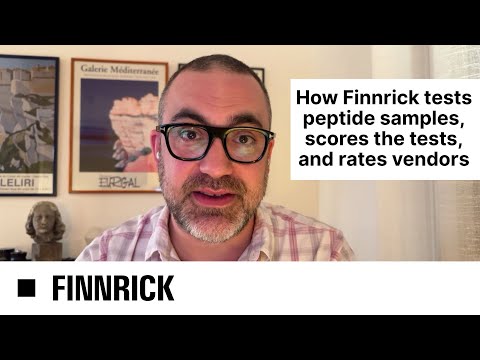
Video Analysis: Finnrick Peptide Testing Methodology
A. Executive Summary
This video outlines the operational methodology used by Finnrick to evaluate and rate peptide vendors, a critical service for consumers in the unregulated or “grey market” research chemical space. The core thesis is that vendor reliability cannot be determined by marketing claims alone but requires third-party analytical verification of three specific vectors: purity, quantity accuracy, and batch traceability.
The process begins with sample acquisition, which is hybrid-sourced: Finnrick places direct orders to simulate the customer experience, and the public submits vials for free testing. These samples are blind-shipped to accredited commercial laboratories for analytical testing (likely HPLC/MS, though not explicitly specified in the text, this is the industry standard). The labs return Certificates of Analysis (CoAs) providing raw data on purity percentages and total milligram content.
Finnrick’s proprietary rating system synthesizes this raw data into a score based on three weighted components. First, Purity: a threshold of 98% is established as the baseline for quality; anything below this figure incurs significant point deductions. Second, Quantity: the system calculates the divergence between the label claim and the actual mass found in the vial. Vendors are rewarded for “batch claims”—explicitly stating the actual yield of a specific batch (e.g., 5.7mg in a 5mg labeled vial) rather than a generic label. Third, Batch Identification: the physical traceability of the product is scored, with the highest marks given for batch numbers printed directly on the vial rather than on loose inserts, emphasizing Good Manufacturing Practice (GMP) standards.
The final “Finnrick Rating” is not a simple average. It creates a risk profile by weighing the average test score against the lowest recorded score to highlight worst-case scenario risks for the buyer. It also factors in the total volume of tests to determine statistical confidence. This system aims to provide a transparent, data-driven heuristic for navigating the risks associated with buying peptides online.
B. Bullet Summary
-
Hybrid Sourcing Model: Samples are obtained via both internal secret shopper orders and crowdsourced submissions from the public.
-
Commercial Verification: Actual chemical analysis is outsourced to independent commercial laboratories to ensure objectivity.
-
Three-Pillar Scoring: Ratings are calculated based on Purity, Quantity Divergence, and Batch Identification.
-
Purity Threshold: A strict cutoff is applied at 98% purity; samples testing below this level receive less than one point (out of four).
-
Quantity Accuracy: Scores favor low divergence between the claimed peptide mass and the actual mass detected in the vial.
-
Batch Specificity: Vendors are rewarded for updating labels to reflect the specific yield of a production batch (e.g., overfill acknowledgments).
-
Traceability Standards: Highest scores for batch identification require the batch number to be printed directly on the vial, not just on a card.
-
Risk-Weighted Aggregation: The final rating considers the lowest score historically recorded for a vendor, not just the average, to account for consistency risk.
-
Confidence Interval: The rating algorithm adjusts based on the total number of tests performed, valuing larger data sets.
-
Public Access: The testing service is offered free of charge to the public to increase data volume and consumer safety.
-
Label Integrity: “Best practice” is defined as vendors who dynamically update labels to match specific batch analytics rather than using generic templates.
-
Divergence Metric: The percentage difference between label claim and actual content is the primary metric for the quantity score.
D. Claims & Evidence Table
| Claim made in video |
Evidence provided |
Assessment |
| We test peptides for free. |
Statement: “Just go on website, fill out the form and mail us some vials. We’ll test them for free.” |
Strong. This constitutes the organization’s core offer and data intake method. |
| Purity below 98% is “not very good.” |
Scoring rubric details: “Anything below 98% we think is not very good and we’ll award less than a point.” |
Standard. In research and pharmaceutical contexts, >98% is the standard acceptance criteria. <98% implies significant impurities (synthesis byproducts, TFA salts). |
| Batch numbers on vials are superior to loose cards. |
Scoring rubric details: “We recommend a batch identification printed on the vial… Some include it in a card… We don’t think that’s very good practice.” |
Strong. In GMP and clinical settings, primary container labeling is mandatory for traceability. Loose cards are easily separated or swapped. |
| Best vendors update labels with actual batch quantities. |
Statement: “The best vendors actually update the label… ‘you bought 5mg, but actually we packed 5.7mg’.” |
Actionable/Valid. This practice reflects transparency regarding the lyophilization process, where precision filling is difficult. |
| Ratings account for the “worst case” scenario. |
Algorithm description: Rating includes “the lowest test score to get the worst that could happen.” |
Prudent. In health-related supply chains, consistency is as important as average quality. One bad batch can be dangerous. |
E. Actionable Insights
-
Prioritize Direct Labeling: When purchasing peptides, look for vendors that print batch numbers directly on the vial glass/label. Avoid those that rely solely on loose paper inserts.
-
Verify the “Overfill”: Check if your vendor adjusts their stated quantity based on batch analysis (e.g., labeling a vial as 5.3mg instead of a generic 5mg). This indicates higher transparency and QC.
-
Utilize Free Testing: If you possess old or questionable vials, utilize the free testing service mentioned to verify integrity before research use.
-
Scrutinize Purity <98%: Treat any CoA showing purity below 98% with extreme caution. In a biological context, the remaining >2% can consist of truncated sequences, deletion sequences, or counter-ions that may alter experimental outcomes.
-
Look for Consistency, Not Just Highs: When evaluating a vendor on the Finnrick platform, look at their lowest score and the number of tests. A vendor with a 99% average but occasional 80% results poses a significant quality control risk.
H. Technical Deep-Dive: Peptide Quality Metrics
-
Purity vs. Content (Quantity): The transcript distinguishes between these, which is a vital technical distinction often missed by laypeople.
-
Purity (HPLC Area %): Refers to the ratio of the target peptide molecule to impurities (truncated peptides, deletion sequences, incompletely deprotected species) in the sample. A 98% purity means 2% of the peptide-like material is incorrect sequences.
-
Content/Net Peptide Content: Refers to the actual weight of the peptide versus the total weight of the powder. Lyophilized peptides contain residual water and counter-ions (like Trifluoroacetic acid or Acetate). A vial may contain 10mg of powder, but only 8mg of active peptide. Finnrick’s quantity metric likely measures the total amount of target peptide detected against the label claim, effectively catching vendors who underfill or sell “salt weight” as “peptide weight.”
-
Batch Identification & GMP: The emphasis on printing batch IDs on the vial aligns with Good Manufacturing Practice (GMP) principles regarding “Traceability.” If a specific batch is found to have endotoxin contamination or degradation, the end-user must be able to identify the specific vials involved. A loose card in a shipping box breaks the “Chain of Identity” once the vials are removed from the box.
I. Fact-Check Important Claims
-
Claim: “Anything below 98%… is not very good.”
-
Fact-Check: Verified/Consensus. For research-grade peptides intended for biological assays, >95% is often the minimum, with >98% being the standard for high-quality synthesis. Impurities can trigger immune responses or off-target binding.
-
Claim: “The best vendors… say ‘you bought 5mg, but actually we packed 5.7mg’.”
-
Fact-Check: Verified. Peptide synthesis and lyophilization are not perfectly precise processes. Reputable manufacturers often target an “overfill” to ensure the customer receives at least the labeled amount. Acknowledging the exact yield (e.g., 5.7mg) allows researchers to calculate molar concentrations accurately, which is critical for dosing.

1 Like
TikTok Peptide Guy Interviews Michael Carter, CEO of Finnrick Analytics.
Gemini AI Summary:
Video Analysis: Michael Carter (CEO, Finnerich) on Disrupting the Peptide Industry
A. Executive Summary
Michael Carter, CEO of Finnerich, outlines his company’s mission to bring transparency and safety to the unregulated “gray market” of therapeutic peptides. A former Silicon Valley engineer and entrepreneur, Carter predicates Finnerich’s existence on the concept of “sovereign health”—the inevitability that individuals, armed with AI and internet access, will increasingly manage their own biology outside traditional medical gatekeepers.
Carter explicitly denies any affiliation with the FDA or pharmaceutical lobby. Finnerich operates as an independent supply chain research entity. Their business model is evolving from self-funded bootstrapping to a system where ethical vendors subsidize testing costs for customers via verified “authenticity keys,” ensuring the samples tested are random customer units rather than vendor-selected “cherry-picked” vials.
A central theme of the analysis is the technical inconsistency of current manufacturing. Carter identifies hand-filled vials as a critical safety failure point, leading to dangerous dosage variance (e.g., a user expecting 2mg might accidentally administer 4mg). Finnerich’s grading system penalizes undeclared overfill/underfill not to be punitive, but to force vendors toward machine-filling precision and accurate labeling.
The discussion extends to the scope of the market (estimated at ~$10 billion US/year), the expansion of testing beyond GLP-1 agonists to compounds like BPC-157 and TB-500, and future plans to test bacteriostatic water—identified as a frequent “weak link” causing adverse reactions. Carter concludes by sharing his personal motivation: a debilitating back injury treated with peptides after rejecting conventional surgery/opioids.
B. Bullet Summary
-
Origin Story: Carter is a software engineer/entrepreneur who pivoted to biotech to solve “sovereign health” logistics.
-
Independence: Finnerich is 100% separate from the FDA and pharmaceutical industry; they do not sell peptides or offer medical advice.
-
Business Model: Currently self-funded/investor-backed. Future revenue will come from vendors reimbursing customer-initiated tests to prove quality, incentivizing “good actors.”
-
Chain of Custody: To prevent vendors from gaming the system with “golden samples,” Finnerich only tests vials sent in by random customers.
-
Market Scale: Estimated at low billions (potentially ~$10B/year) in the US alone; millions of users are bypassing traditional clinical trials.
-
Legal Stance: Finnerich operates legally by classifying their work as supply chain research rather than medical distribution.
-
Transparency over Prohibition: Carter argues that hiding results protects bad vendors; publishing results protects users.
-
Trust Protocol: The company operates on a “Zero Trust” architecture—they trust neither vendors, customers, nor single testing labs, relying instead on data scale to identify anomalies.
-
The Overfill Controversy: Finnerich penalizes unlabeled overfill because it ruins dosage precision. Vendors can overfill if they explicitly label the variance.
-
Manufacturing Flaw: A significant portion of the gray market relies on hand-filling vials, leading to massive week-to-week dosage inconsistency.
-
COA Reality: A Certificate of Analysis (COA) guarantees the purity of a batch but not the quantity in a specific hand-filled vial.
-
Price Impact: Transparency may initially raise prices by forcing investment in filling machinery, or lower them by validating cheaper overseas sources.
-
Bacteriostatic Water: Identified as a critical failure point (infections/allergies); testing protocols for benzyl alcohol content and endotoxins are forthcoming.
-
Multi-Compound Peptides: Currently scoring poorly due to the complexity of mixing; Finnerich advises caution until testing protocols mature.
-
Personal Use: Carter credits peptides (BPC-157, TB-500) for recovering from a severe back injury that seven-figure conventional medical care failed to fix.
D. Claims & Evidence Table
| Claim Made in Video |
Evidence Provided |
Assessment |
| Finnerich is independent of Big Pharma/FDA. |
Carter cites lack of contact/contracts and transparent investor lists. |
Strong (publicly verifiable via investor disclosures). |
| Hand-filling vials leads to dangerous dosage variance. |
Theoretical operational analysis; explanation of inconsistent human measuring vs. machine precision. |
Strong (Basic pharmaceutical manufacturing principle). |
| A COA does not guarantee specific vial dosage. |
Explanation that COAs test a sample of the bulk batch, not the fill weight of every individual unit. |
Strong (Factually correct regarding sampling logic). |
| The US Peptide market is ~$10 Billion/year. |
“Back of the napkin” math based on user volume estimates. |
Speculative (Gray markets are inherently opaque). |
| Bacteriostatic water causes many adverse reactions attributed to peptides. |
Anecdotal reports of allergic reactions and infections due to incorrect benzyl alcohol ratios. |
Plausible (Common issue in compounding, requires data to confirm). |
| Overseas vendors can equal domestic quality. |
Argument that supply chains are global; labeling is the main differentiator. |
Strong (Most “domestic” peptides are re-labeled imports). |
E. Actionable Insights
-
Ignore Single COAs for Dosage: Do not rely on a vendor’s COA to determine the exact milligram strength of your specific vial, especially from gray market sources.
-
Verify Filling Method: Prioritize vendors who use machine-filling processes over hand-filling to ensure week-to-week dosing consistency.
-
Labeling is Critical: If buying from overseas (China), ensure the shipment includes “Kit Labeling” (batch numbers on the box) to avoid testing penalties or identification issues.
-
Test the Water: Exercise extreme caution with bacteriostatic water. If possible, source water from clinical/regulated domestic sources rather than unregulated peptide vendors.
-
Avoid Blends for Now: Steer clear of multi-compound peptides (e.g., “Glow” blends) as they currently show high failure rates in consistency and purity testing.
-
Scan for Authenticity: In the future, look for Finnerich-minted verification keys/QR codes on vendor shipments to verify the product’s supply chain origin.
-
Monitor Batch Consistency: If you are a long-term researcher, buy larger batches once a specific batch has been third-party verified, rather than buying single vials weekly.
-
Understand “Overfill”: If a vial is 10mg but contains 13mg (unlabeled), your dosage protocol is 30% higher than calculated. Adjust research protocols accordingly.
H. Technical Deep-Dive: Peptide Stability & Analysis
1. Quantitative Variance in Hand-Filled Vials
Carter highlights a specific breakdown in Good Manufacturing Practice (GMP). In a clinical setting, lyophilized peptides are filled using automated liquid handling systems that dispense precise aliquots before freeze-drying.
-
The Error: Gray market vendors often use “scooping” or manual liquid filling of raw powder/solution.
-
The Consequence: While Purity (HPLC area %) might remain 99% across the batch, the Content (mg per vial) creates a non-linear dosing curve.
-
Pharmacokinetics: A user titrating a GLP-1 agonist like Tirzepatide relies on steady-state plasma concentrations. An unexpected +30% dose (due to unlabeled overfill) can trigger severe gastrointestinal side effects or hypoglycemia, while a -30% dose leads to loss of efficacy and receptor desensitization issues.
2. The Bacteriostatic Weak Link
-
Mechanism: Bacteriostatic water must contain 0.9% Benzyl Alcohol.
-
Failure Mode A (Low Concentration): <0.9% allows bacterial proliferation (S. aureus, Pseudomonas) after repeated needle entry, risking sepsis or abscess.
-
Failure Mode B (High Concentration): >0.9% or impurities causes injection site pain, tissue necrosis, and systemic allergic reactions often misattributed to the peptide itself.
-
Endotoxins: Cheap water sources may not be depyrogenated, introducing lipopolysaccharides (LPS) which trigger immune responses (fever, inflammation) independent of sterility.
3. Multi-Compound Interference
Testing blends (e.g., BPC-157 + TB-500) presents analytical challenges.
-
Chromatography: Elution times may overlap, making peak integration difficult without advanced method development.
-
Chemical Interaction: Peptides in solution prior to lyophilization may react with one another (dimerization or degradation) if pH buffers aren’t optimized for both compounds simultaneously.
I. Fact-Check: Regulatory & Safety Context
-
Claim: BPC-157 and others have no Phase 3 trials because they are unpatentable generics.
-
Fact Check: True but nuanced. While natural gastric pentadecapeptide BPC-157 is not patentable in its natural form, specific stable salts (e.g., Bepecin/Arg-BPC) can be patented. However, the financial incentive for a full FDA approval pipeline (~$1B+ cost) is absent without market exclusivity. Most data remains preclinical (rat/cell models) or anecdotal.
-
Claim: FDA protects health vs. Vendors hiding.
-
Context: The FDA has recently moved to reclassify many bulk drug substances (including BPC-157) to Category 2 (safety risks), effectively banning them from compounding pharmacies. Finnerich’s stance aligns with transparency, but the “sovereign health” movement is currently in direct conflict with FDA enforcement regarding peptide availability.
-
Claim: Overseas vs. Domestic Quality.
-
Consensus: Most “domestic” US peptide sellers purchase bulk lyophilized powder from Chinese synthesis labs (e.g., in Wuhan or Shanghai) and apply localized branding. Carter’s assertion that there is no fundamental difference in the chemical product source is factually accurate for 90%+ of the market.
2 Likes