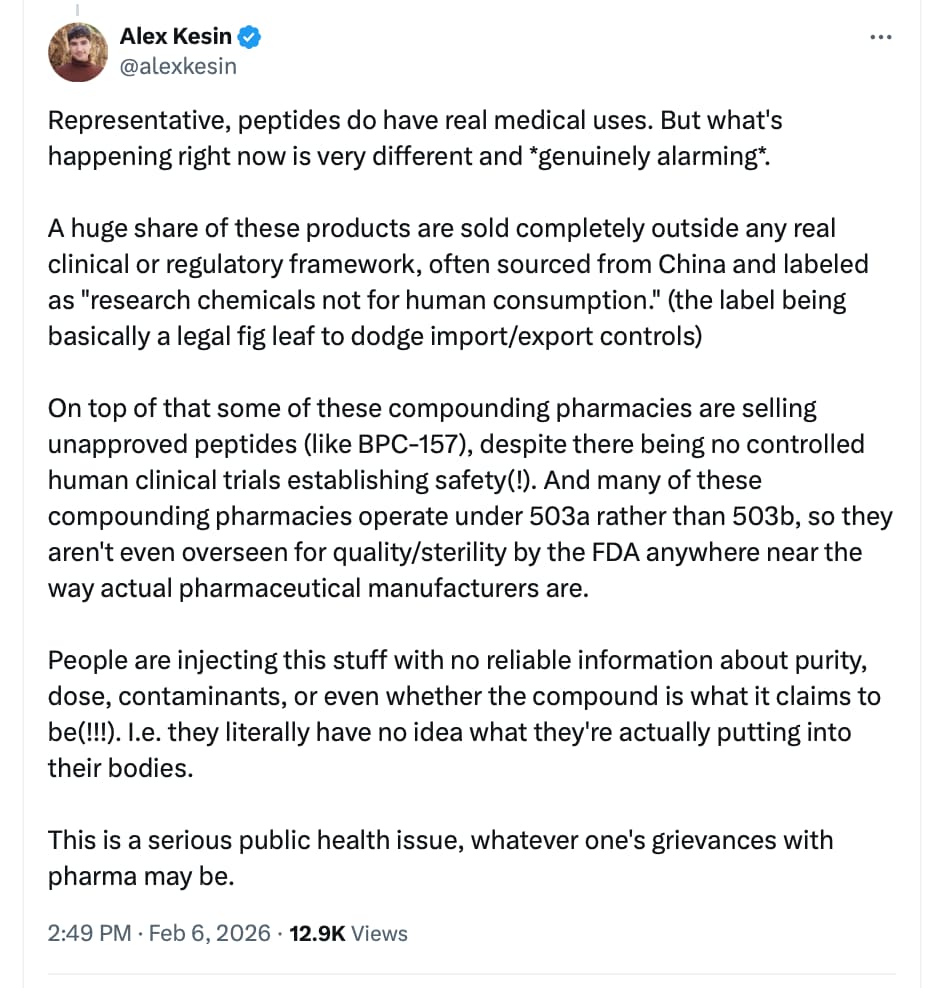
Finnrick Peptide Testing Website:
Gemini AI Summary
Video Analysis: Finnrick Peptide Testing Methodology
A. Executive Summary
This video outlines the operational methodology used by Finnrick to evaluate and rate peptide vendors, a critical service for consumers in the unregulated or “grey market” research chemical space. The core thesis is that vendor reliability cannot be determined by marketing claims alone but requires third-party analytical verification of three specific vectors: purity, quantity accuracy, and batch traceability.
The process begins with sample acquisition, which is hybrid-sourced: Finnrick places direct orders to simulate the customer experience, and the public submits vials for free testing. These samples are blind-shipped to accredited commercial laboratories for analytical testing (likely HPLC/MS, though not explicitly specified in the text, this is the industry standard). The labs return Certificates of Analysis (CoAs) providing raw data on purity percentages and total milligram content.
Finnrick’s proprietary rating system synthesizes this raw data into a score based on three weighted components. First, Purity: a threshold of 98% is established as the baseline for quality; anything below this figure incurs significant point deductions. Second, Quantity: the system calculates the divergence between the label claim and the actual mass found in the vial. Vendors are rewarded for “batch claims”—explicitly stating the actual yield of a specific batch (e.g., 5.7mg in a 5mg labeled vial) rather than a generic label. Third, Batch Identification: the physical traceability of the product is scored, with the highest marks given for batch numbers printed directly on the vial rather than on loose inserts, emphasizing Good Manufacturing Practice (GMP) standards.
The final “Finnrick Rating” is not a simple average. It creates a risk profile by weighing the average test score against the lowest recorded score to highlight worst-case scenario risks for the buyer. It also factors in the total volume of tests to determine statistical confidence. This system aims to provide a transparent, data-driven heuristic for navigating the risks associated with buying peptides online.
B. Bullet Summary
- Hybrid Sourcing Model: Samples are obtained via both internal secret shopper orders and crowdsourced submissions from the public.
- Commercial Verification: Actual chemical analysis is outsourced to independent commercial laboratories to ensure objectivity.
- Three-Pillar Scoring: Ratings are calculated based on Purity, Quantity Divergence, and Batch Identification.
- Purity Threshold: A strict cutoff is applied at 98% purity; samples testing below this level receive less than one point (out of four).
- Quantity Accuracy: Scores favor low divergence between the claimed peptide mass and the actual mass detected in the vial.
- Batch Specificity: Vendors are rewarded for updating labels to reflect the specific yield of a production batch (e.g., overfill acknowledgments).
- Traceability Standards: Highest scores for batch identification require the batch number to be printed directly on the vial, not just on a card.
- Risk-Weighted Aggregation: The final rating considers the lowest score historically recorded for a vendor, not just the average, to account for consistency risk.
- Confidence Interval: The rating algorithm adjusts based on the total number of tests performed, valuing larger data sets.
- Public Access: The testing service is offered free of charge to the public to increase data volume and consumer safety.
- Label Integrity: “Best practice” is defined as vendors who dynamically update labels to match specific batch analytics rather than using generic templates.
- Divergence Metric: The percentage difference between label claim and actual content is the primary metric for the quantity score.
D. Claims & Evidence Table
| Claim made in video | Evidence provided | Assessment |
|---|---|---|
| We test peptides for free. | Statement: “Just go on website, fill out the form and mail us some vials. We’ll test them for free.” | Strong. This constitutes the organization’s core offer and data intake method. |
| Purity below 98% is “not very good.” | Scoring rubric details: “Anything below 98% we think is not very good and we’ll award less than a point.” | Standard. In research and pharmaceutical contexts, >98% is the standard acceptance criteria. <98% implies significant impurities (synthesis byproducts, TFA salts). |
| Batch numbers on vials are superior to loose cards. | Scoring rubric details: “We recommend a batch identification printed on the vial… Some include it in a card… We don’t think that’s very good practice.” | Strong. In GMP and clinical settings, primary container labeling is mandatory for traceability. Loose cards are easily separated or swapped. |
| Best vendors update labels with actual batch quantities. | Statement: “The best vendors actually update the label… ‘you bought 5mg, but actually we packed 5.7mg’.” | Actionable/Valid. This practice reflects transparency regarding the lyophilization process, where precision filling is difficult. |
| Ratings account for the “worst case” scenario. | Algorithm description: Rating includes “the lowest test score to get the worst that could happen.” | Prudent. In health-related supply chains, consistency is as important as average quality. One bad batch can be dangerous. |
E. Actionable Insights
- Prioritize Direct Labeling: When purchasing peptides, look for vendors that print batch numbers directly on the vial glass/label. Avoid those that rely solely on loose paper inserts.
- Verify the “Overfill”: Check if your vendor adjusts their stated quantity based on batch analysis (e.g., labeling a vial as 5.3mg instead of a generic 5mg). This indicates higher transparency and QC.
- Utilize Free Testing: If you possess old or questionable vials, utilize the free testing service mentioned to verify integrity before research use.
- Scrutinize Purity <98%: Treat any CoA showing purity below 98% with extreme caution. In a biological context, the remaining >2% can consist of truncated sequences, deletion sequences, or counter-ions that may alter experimental outcomes.
- Look for Consistency, Not Just Highs: When evaluating a vendor on the Finnrick platform, look at their lowest score and the number of tests. A vendor with a 99% average but occasional 80% results poses a significant quality control risk.
H. Technical Deep-Dive: Peptide Quality Metrics
-
Purity vs. Content (Quantity): The transcript distinguishes between these, which is a vital technical distinction often missed by laypeople.
-
Purity (HPLC Area %): Refers to the ratio of the target peptide molecule to impurities (truncated peptides, deletion sequences, incompletely deprotected species) in the sample. A 98% purity means 2% of the peptide-like material is incorrect sequences.
-
Content/Net Peptide Content: Refers to the actual weight of the peptide versus the total weight of the powder. Lyophilized peptides contain residual water and counter-ions (like Trifluoroacetic acid or Acetate). A vial may contain 10mg of powder, but only 8mg of active peptide. Finnrick’s quantity metric likely measures the total amount of target peptide detected against the label claim, effectively catching vendors who underfill or sell “salt weight” as “peptide weight.”
-
Batch Identification & GMP: The emphasis on printing batch IDs on the vial aligns with Good Manufacturing Practice (GMP) principles regarding “Traceability.” If a specific batch is found to have endotoxin contamination or degradation, the end-user must be able to identify the specific vials involved. A loose card in a shipping box breaks the “Chain of Identity” once the vials are removed from the box.
I. Fact-Check Important Claims
-
Claim: “Anything below 98%… is not very good.”
-
Fact-Check: Verified/Consensus. For research-grade peptides intended for biological assays, >95% is often the minimum, with >98% being the standard for high-quality synthesis. Impurities can trigger immune responses or off-target binding.
-
Claim: “The best vendors… say ‘you bought 5mg, but actually we packed 5.7mg’.”
-
Fact-Check: Verified. Peptide synthesis and lyophilization are not perfectly precise processes. Reputable manufacturers often target an “overfill” to ensure the customer receives at least the labeled amount. Acknowledging the exact yield (e.g., 5.7mg) allows researchers to calculate molar concentrations accurately, which is critical for dosing.