“At higher concentrations” is the keyword here.
3 Likes
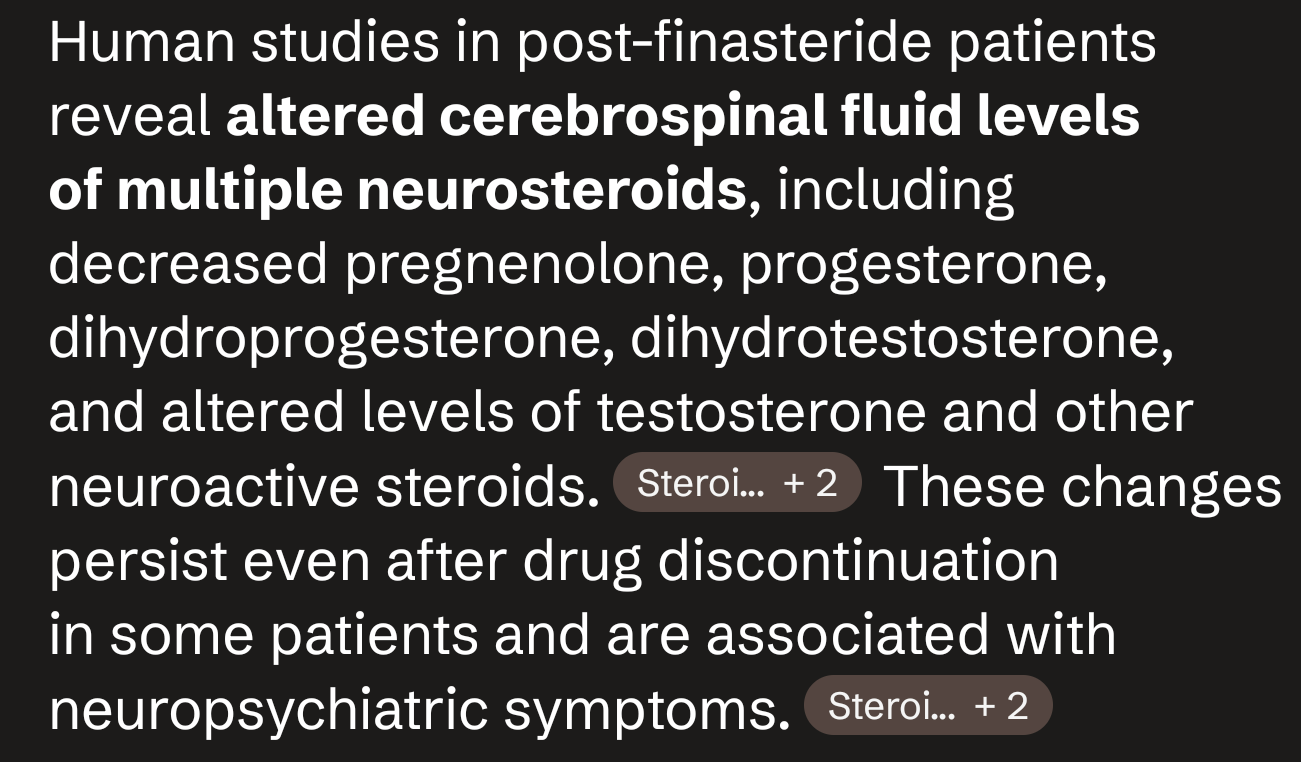
a) They measured serum levels which do not necessarily correlate with brain levels
b) Not placebo-controlled studies so lower pregnenolone could be caused by pre-existing schizophrenia or other causes, not finasteride
c) The PFS Foundation is a litiguous organization so whatever studies they produce should be viewed very critically
1 Like
Cerebrospinal fluid levels, not serum levels. CSF is from the central nervous system.
1 Like
Results: At the examination, the three postfinasteride patients reported muscular stiffness, cramps, tremors, and chronic fatigue in the absence of clinical evidence of any muscular disorder or strength reduction. Severity and frequency of the anxious/depressive symptoms were quite variable; overall, all the subjects had a fairly complex and constant neuropsychiatric pattern. Assessment of neuroactive steroid levels in patients showed some interindividual differences. However, the most important finding was the comparison of their neuroactive steroid levels with those of healthy controls. Indeed, decreased levels of tetrahydroprogesterone, isopregnanolone and dihydrotestosterone and increased levels of testosterone and 17β-estradiol were reported in cerebrospinal fluid of postfinasteride patients. Moreover, decreased levels of dihydroprogesterone and increased levels of 5α-androstane-3α,17β-diol and 17β-estradiol were observed in plasma.
Found it. So they measured both in the CSF and in serum. Overall what you’d expect, low sample size, not a prospective, placebo-controlled stud and the people in question apparently were off of finasteride for quite some time so this study wouldn’t even measure finasteride’s actual impact and the participants weren’t healthy to begin with.
Did you actually read the abstracts in question? There are major flaws in all of them and they overlap.
a) Small sample size of pre-selected people who complained that they had PFS (recruited straight from the organization’s forums)
b) not a prospective study
c) the people were not even on finasteride during the measurements
d) Most people had pre-existing conditions
With such a study design you could connect 5G towers to long covid.
There’s enough mechanistic rationale combined with the published studies (however imperfect) to reasonably conclude that finasteride can cause significant problems in a (thankfully small) minority of users. I take finasteride daily and prescribe it regularly, so I’m definitely not against it altogether, but I always warn of its potential side effects.
4 Likes
The mechanistic reasoning only works with much higher doses. The studies are also not merely imperfect, they are straight up trash. If finasteride really had a significant effect on neurosteroid production, you’d expect that in the dozens of prospective trials on finasteride done so far, people in the treatment group would complain about feeling depressed or suicidal at higher rates than the placebo group but we don’t see such an effect. Observational trials could potentially detect higher rates of depression but they’d have to check both users of finasteride and minoxidil because hairloss by itself can cause depression.
but I always warn of its potential side effects.
If someone is afraid of finasteride then simply don’t take it. They’ll go bald and probably have issues with their prostate down the road but that is the consequence of their decision. It doesn’t make sense though to warn of potential dangers that don’t even make sense from a mechanistic point of view (at reasonable doses lower than the 10g human equivalent dose they give mice).
2 Likes
You seem to have very strong feelings about this topic. Sometimes side effects don’t show up in the original smaller prospective trials that are typically run by the pharmaceutical companies, but only manifest when the drug is released to the masses and post-marketing/pharmacovigilance studies are done.
4 Likes
lol. You’re not going to convince the pro finasteride group of the potential long term side effects of 5AR inhibition. I’ve commented on this before. The effect mechanism is in the literature and I see it in patients not rarely. Fortunately most resolve with discontinuation. Risk to benefit ratio is not favorable in my opinion if using purely for prophylaxis or perceived longevity benefit.
3 Likes
Your extremist view of going bald and surely having prostate problems if you don’t take finasteride is completely flawed. Proof you lack understanding of urologic pathology. If a physician talked like that they’d be accused of being in big pharmas pocket and pushing drugs on patients.
1 Like
My personal bias do not mean that the studies in question weren’t trash.
Sometimes side effects don’t show up in the original smaller prospective trials that are typically run by the pharmaceutical companies, but only manifest when the drug is released to the masses and post-marketing/pharmacovigilance studies are done.
Hence observational studies exist and there it is important to account for cofounding variables. The signal for depression with 5ar inhibitors is weak at best in those.
2 Likes
lol. You’re not going to convince the pro finasteride group of the potential long term side effects of 5AR inhibition.
Because the anti-finasteride groups tend to overlap with the antivaxxers, pro-cholesterol carnivore people.
The effect mechanism is in the literature and I see it in patients not rarely.
The mechanism is inhibition of neurosteroid production by the 5ar type 1 enzyme. But because finasteride at a dose of 1-5mg per day does not significantly inhibit 5ar type 1 in humans, the mechanistic reasoning is void.
Fortunately most resolve with discontinuation
All side effects resolve or finasteride would be a cure for hairloss instead of a treatment. 5ar enzymes keep being produced by your body all the time, even in old age.
Risk to benefit ratio is not favorable in my opinion if using purely for prophylaxis or perceived longevity benefit.
The benefit is keeping your hair and a healthy prostate. The risk is a small increase in sexual side effects that resolve within weeks to months of ceasing treatment.
2 Likes
I’m a meat eating, aggressive APO-B lowering anti-vax person who will probably start Finasteride soon. Tamsulosin is not working for me. Lowering DHT might provide relief and if cancer risk is reduced that’s great. Finasteride may not be right for everyone—we all need to balance risk/reward. Prostate cancer can be devastating even if you survive it.
It really is just like the Covid vax controversy. The various vaccines were not as effective as we hoped , but for people at high risk getting vaccinated was a reasonable decision. Can we live and let live?
3 Likes
1 Like
Three types of 5α-reductases are present in many organs in- and outside the brain where they can be blocked by the two 5ARIs. There is increasing evidence that 5ARIs not only inhibit the conversion of testosterone to 5α-dihydrotestosterone (DHT) in the prostate and the scalp but also in many other tissues. The lipophilic 5ARIs can pass the blood-brain barrier and might block many other neurosteroids in the brain with changes in the neurochemistry and impaired neurogenesis.
So once again the neurosteroid argument…
First let us establish that the human brain primarily, if not exclusively, expresses the type 1 5ar enzyme.
Inhibition experiments with specific inhibitors for 5α-reductase type 1 and type 2 revealed strong evidence for the exclusive activity of the type 1 isoform.
Only 5α-reductase 1 mRNA was expressed in human temporal lobe tissue; 5α-reductase 2 mRNA was not expressed. 5α-Reductase 1 mRNA concentrations did not differ significantly in the cerebral cortex of women [25.9 ± 7.9 arbitrary units (aU); mean ± sem] and men (20.4 ± 2.8 aU) or in the cerebral cortex (23.3 ± 4.4 aU) and the subcortical white matter of adults (32.6 ± 5.6 aU), but they were significantly higher in the cerebral cortex of adults than in that of children (6.4 ± 2.3 aU; P < 0.005).
Expression of 5α-Reductase in the Human Temporal Lobe of Children and Adults1 | The Journal of Clinical Endocrinology & Metabolism | Oxford Academic
Then let us establish that finasteride in humans is a selective 5ar type 2 inhibitor at doses which one can acquire outside of shady Chinese labs.
Finasteride, a specific and potent inhibitor of human Type 2 5alpha-reductase, decreases the formation of DHT from testosterone.
And a selective 5ar type 2 may even cause upregulation of the 5ar type 1 enzyme by backdoor pathways.
Type 2 5-AR is the predominant Isoenzyme within the prostate. Its inhibition by finasteride may lead to an upregulation of type 1 5AR in extraprostatic sites
Cdn_JU28_I2_06_FREE_DrLoughlin.pdf
Because of that, claiming that finasteride causes persistent side effects because of neurosteroid production inhibition is like claiming that 0.01mg rapamycin once weekly will kill your immune system because it inhibits mTORc2.
Even if dutasteride, a dual 5ar inhibitor, crossed the BBB, the brain wouldn’t stop producing 5ar type 1, dutasteride would just end up binding to it as long as it is in the system but not beyond that.
Moreover, given that the PFS crowd had been extremely active in the past decades, wouldn’t the dozens of clinical trials with thousends of people detect those allegedly severe and persistent side effects in the treatment group? It wasn’t just Merck and the cartel of shadowy pharma lizards who did clinical trials on finasteride. Plenty of universities and health organisations researched it aswell.
1 Like
I don’t see how the study you reference establishes this at all, especially when we’re talking about the central nervous system. To show whether or not finasteride inhibits neurosteroid synthesis in the CNS of humans (or at least in a certain % of humans) we’d need a double-blind placebo-controlled prospective clinical trial where both the placebo groups and the active treatment group get multiple spinal taps to look at CSF levels of neurosteroids. Good luck getting that approved by an IRB (institutional review board). We’d also need a large enough sample size to detect the signal in the small % of subjects prone to both the acute effects on mood as well as the even smaller % who might experience lasting effects after drug withdrawal (aka “post-finasteride syndrome”).
The reference you give mentions potential upregulation of 5-AR1 in liver and skin. Nothing about what may or may not be happening in the CNS.
You’re being overly-simplistic in thinking that it’s impossible to have a lasting effect even after all traces of the drug are gone from the system and there’s no longer any inhibition of 5-AR. Epigenetic effects and long-term potentiation (i.e. memory) occurring in neural and enzymatic pathways can persist permanently.
FWIW: Elderly male n=1, taking finasteride for several years for BPH. I have felt nothing but positive effects. Shrinkage of prostate, better peeing. And, yes, it seems to be causing some fuzz to appear in the bald patches of my head. Certainly hasn’t had any negative emotional effects.
3 Likes
We are talking about mechanistic reasoning here. The rcts for finasteride didn’t show any significant effects on depression either, nor did the MR studies. So the burden of proof falls back on the one claiming finasteride does have a significant impact on neurosteroidogenesis.
Good luck getting that approved by an IRB (institutional review board).
You can use outcome studies that look at particular effects like depression or cognition.
We’d also need a large enough sample size to detect the signal in the small % of subjects prone to both the acute effects on mood as well as the even smaller % who might experience lasting effects after drug withdrawal (aka “post-finasteride syndrome”).
And the signal is so weak it is likely not even there as I pointed out in the MR study above.
The reference you give mentions potential upregulation of 5-AR1 in liver and skin. Nothing about what may or may not be happening in the CNS.
Those were examples of extraprostatic sites.
Epigenetic effects and long-term potentiation (i.e. memory) occurring in neural and enzymatic pathways can persist permanently.
Source? Also again finasteride does not affect the 5ar type 1 enzyme, the predominant if not exclusive 5ar enzyme in the human brain.
1 Like