I had a TURP 5 years ago for BPH and now my prostate has regrown to 52cc in size. My GP has prescribed Flomax 0.4mg and Finasteride 5mg. I have some concerns regarding side effects but I’m running out of non-invasive options.
2 Likes
Have him prescribe tadalafil too. If you’re concern about ED. It a solid life extension medication and should put to bed (literally) any performance concerns.
4 Likes
And maybe consider at least low-dose testosterone replacement/optimization which could help to offset potential finasteride side effects on mood, as long as the extra testosterone wouldn’t prevent your prostate from shrinking (if it did, it would be the T itself not DHT since you have that conversion blocked).
If you’re being managed by someone who knows what they’re doing, hopefully you could get it all dialed in and get the positives without the negatives.
3 Likes
Find a good HOLEP surgeon in your area and fix the problem. You won’t regret it.
1 Like
1 Like
This is quite interesting… for prostate health. Has anyone every tried this or heard of it?
For the management of Benign Prostatic Hyperplasia (BPH) and associated Lower Urinary Tract Symptoms (LUTS)
Based on clinical trial data and pharmacognostical reviews, the following dosage protocols for Urtica dioica root (rhizome) have been established for the management of Benign Prostatic Hyperplasia (BPH) and associated Lower Urinary Tract Symptoms (LUTS).
4 Likes
Yes. I am on it. It is part of my polypharmacy to counter BPH and small lesions (benign?). Dutasteride 0.25 mgs is lead actor. Supporting cast - Pygeum extract, Stinging nettle extract, Saw Palmetto berry extract, lycopene, sulphoraphane and black cumin seed extract. Results (most likely due to dutasteride) shrunk my prostate from 39 to 24! Decimated my DHT from 520 to 3.6!! Going to revise my strategy in 2026.
4 Likes
I’m asking myself: what are the countermeasures for known DHT-lowering side effects when taking 5α-reductase inhibitors like finasteride?
Erectile Dysfunction: DHT is more potent than testosterone at activating nitric oxide synthase in penile tissue. Less DHT = less NO = weaker erections. → Tadalafil + L-Citrulline: Tadalafil is FDA-approved in combination with finasteride for BPH; L-Citrulline converts to L-arginine and increases NO production.
Low Libido: DHT activates androgen receptors in the brain controlling sexual desire. Reducing it weakens central arousal signaling. → Zinc: Zinc inhibits aromatase enzyme, preventing testosterone-to-estrogen conversion and maintaining favorable androgen balance.
Depression: DHT reduction depletes allopregnanolone - a neurosteroid that calms the brain via GABA-A receptors. Low levels = mood instability. → Pregnenolone + Magnesium Glycinate: Pregnenolone is the upstream precursor to allopregnanolone; magnesium is a positive allosteric modulator of GABA-A receptors, enhancing their sensitivity.
Gynecomastia: Blocked DHT pathway pushes more testosterone toward estrogen conversion. Elevated estrogen = breast tissue growth. → DIM: DIM shifts estrogen metabolism toward 2-hydroxyestrone (protective) over 16-hydroxyestrone (proliferative), reducing estrogenic tissue stimulation.
Anything else on top?
8 Likes
While this is true, guess which enzyme is responsible for converting pregnenolone to allopregnanolone?
2 Likes
Thank you, @Davin8r, was not obvious for me.
So if you’re on finasteride, adding pregnenolone won’t restore ALLO because the 5α-reductase step is blocked.
A more mechanistic alternative for „depression side effects from finasteride“ could be PEA (palmitoylethanolamide): via PPAR-α it can upregulate steroidogenic machinery (e.g., StAR/P450scc) and has evidence of boosting neurosteroidogenesis/ALLO signaling in glia when 5α-reductase activity is still present (even on finasteride it is not completely inhibited) plus it buffers symptoms through anti-neuroinflammatory “entourage” effects even if ALLO remains partly suppressed ( anti-inflammatory, mast cell calming, endocannabinoid/TRPV1 modulation). Just hypothesis - will try it in my n=1.
2 Likes
That’s an interesting hypothesis! I happened to have just started PEA a couple of days ago for some chronic low back pain.
1 Like
Always important to remember that finasteride, in humans, does not affect 5ar type 1 enzyme to any significant degree so neurosteroid production in the brain will not be affected. Serum allopregnanolone is only affected because apparently the spine also produces allopregnanolone via the 5ar type 2 enzyme.
2 Likes
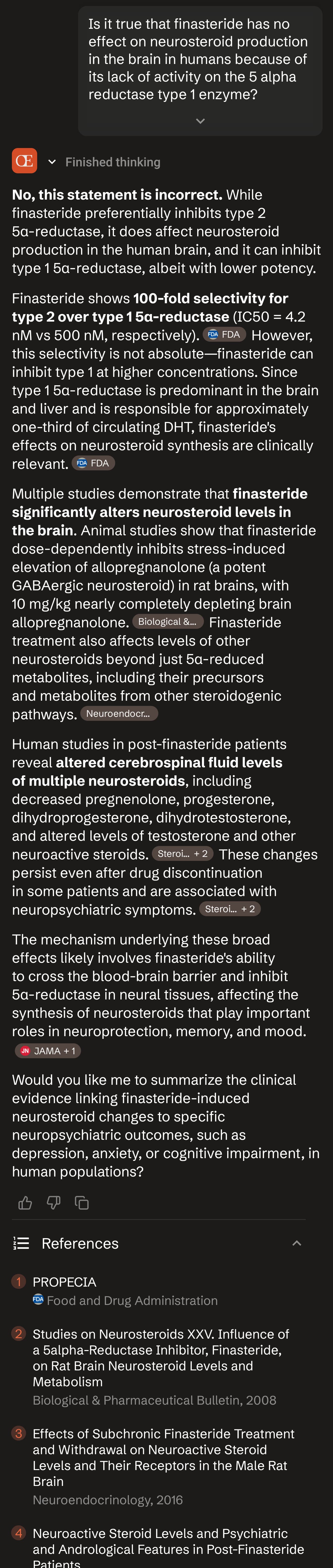
Link to query with full clickable reference list:
“At higher concentrations” is the keyword here.
3 Likes
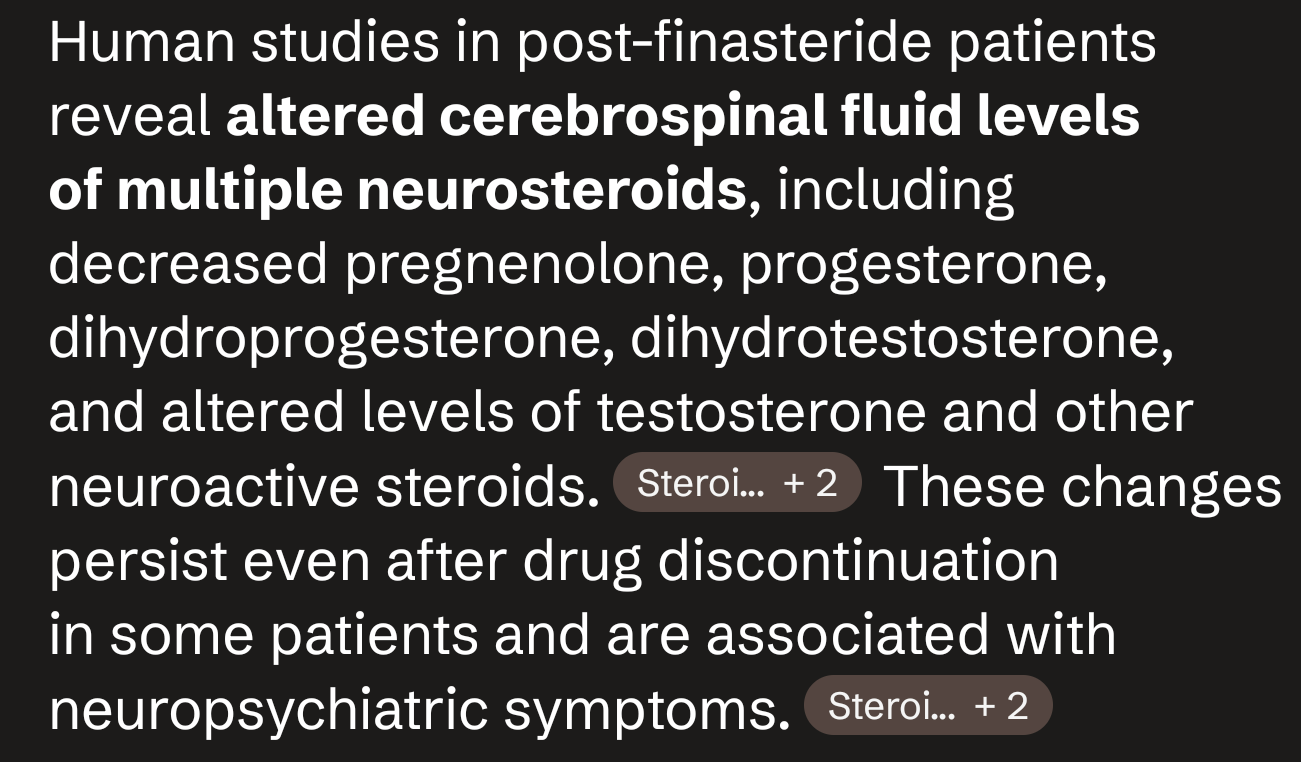
a) They measured serum levels which do not necessarily correlate with brain levels
b) Not placebo-controlled studies so lower pregnenolone could be caused by pre-existing schizophrenia or other causes, not finasteride
c) The PFS Foundation is a litiguous organization so whatever studies they produce should be viewed very critically
1 Like
Cerebrospinal fluid levels, not serum levels. CSF is from the central nervous system.
1 Like
Results: At the examination, the three postfinasteride patients reported muscular stiffness, cramps, tremors, and chronic fatigue in the absence of clinical evidence of any muscular disorder or strength reduction. Severity and frequency of the anxious/depressive symptoms were quite variable; overall, all the subjects had a fairly complex and constant neuropsychiatric pattern. Assessment of neuroactive steroid levels in patients showed some interindividual differences. However, the most important finding was the comparison of their neuroactive steroid levels with those of healthy controls. Indeed, decreased levels of tetrahydroprogesterone, isopregnanolone and dihydrotestosterone and increased levels of testosterone and 17β-estradiol were reported in cerebrospinal fluid of postfinasteride patients. Moreover, decreased levels of dihydroprogesterone and increased levels of 5α-androstane-3α,17β-diol and 17β-estradiol were observed in plasma.
Found it. So they measured both in the CSF and in serum. Overall what you’d expect, low sample size, not a prospective, placebo-controlled stud and the people in question apparently were off of finasteride for quite some time so this study wouldn’t even measure finasteride’s actual impact and the participants weren’t healthy to begin with.