I think you have a good point here and glad you pointed that out. I wondered as well whether the people who train enough to be fit, whether more of them die and are therefore not represented at all in this study because they’re dead and gone.
training risks (in the cardiac context) appear across fitness classes
There aren’t training risks for the bottom 20%, unless walking from the grocery store to the car counts.
Excellent article and review of VO2 max based on " A new commentary in the International Journal of Sports Physiology and Performance , led by Grégoire Millet of the University of Lausanne, marks the 100th anniversary of the landmark paper by A. V. Hill and Hartley Lupton that first described VO2 max."
I found the following intriguing " The reason for all these criteria is that the idealized picture of a steady increase in oxygen consumption followed by a plateau often doesn’t show up in real life. And even when it does, it’s not an invariant number: your VO2 max when kayaking will be smaller than when you’re running, for example, because you’re using smaller muscles that can’t gobble up as much oxygen. (That’s why rowers tend to have some of the highest absolute VO2 max values, because they’re huge and they’re using both arm and leg muscles. Cross-country skiers have some of the highest relative values, because they’re also using arms and legs but are generally much lighter than rowers.)" - I think rowing is the best measuring protocol.
I do not unfortunately. It was some time ago and I read a lot and every day. Have you ever tried a vibrating platform? My sessions are only 10 min, but my leg muscles feel sore as if I had a very intensive workout.
Per ChatGPT 5, power marching on vibration platform
(excellent FMU (fast motor units) stimulus)
10–15 seconds fast march → 30s rest × 5
Vibration increases fast-twitch activation at low joint load.
Should add that the above exercise is part of my weekly program designed (by AI) with taking into account my fitness level, age, and equipment that I have at home. It is 70-year-old–specific adaptation of my motor-unit–centric weekly program. It preserves fast motor units (FMUs), NMJ integrity, firing-rate capacity, explosive ability, and reactive “neural nutrition”, while materially lowering orthopedic, tendon, and cardiovascular risk—the priorities for a 70-year-old, especially one wanting longevity of performance, not wear-and-tear.
I’ve always considered marathons, not to mention ultramarathons, to be extremely destructive to the body’s immediate and long-term health. Some of the more common risks include stress fractures, heat stroke, and dehydration.
This is why I love the hundred-yard dash. It has a lower injury risk while spiking the heart rate and boosting metabolism, which has direct effect on VO2 Max. Plus, the all-out effort floods me with endorphins.
Causality is increasingly in evidence, as in this Phase 3 RCT showing that exercise improved survival in colon cancer patients., as well as the many trials showing that exercise improves glycemia in diabetes and function in frail people and people with advanced ASCVD.
It’s a matter of competing risks, like most things. Keep it in proportion.
between 2010-2023 … Among 29 311 597 [marathon and half-marathon ] finishers, 176 cardiac arrests (127 men, 19 women, 30 sex unknown) occurred during US long-distance running races. Compared with 2000-2009, cardiac arrest incidence remained unchanged (incidence rate, 0.54 per 100 000 participants [95% CI, 0.41-0.70] vs 0.60 per 100 000 [95% CI, 0.52-0.70], respectively). However, there were significant declines in cardiac death incidence (0.20 per 100 000 [95% CI, 0.15-0.26] vs 0.39 per 100 000 [95% CI, 0.28-0.52]) and case fatality rate (34% vs 71%). … Among runners for which a definitive cause of cardiac arrest could be determined (n = 67/128 [52%]), coronary artery disease rather than hypertrophic cardiomyopathy was the most common etiology. https://jamanetwork.com/journals/jama/fullarticle/2832121
The clear dose-response across all quintiles and age groups strongly argues against that.
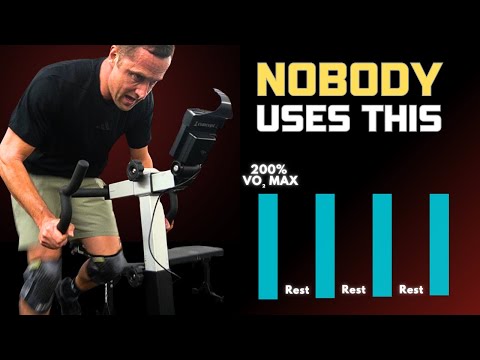
This is a nice video, it suggests a 10 sec sprint with 50 sec active recovery, repeated 10 times.
I tried it on my airbike and this is brutal if you do it right;
Cardiorespiratory fitness represents how efficiently your heart, lungs, blood vessels, and muscles can deliver and utilize oxygen. This physiologic reserve is what allows you to tolerate stress: infection, surgery, day to day demands of living. Often measured with VO2 Max tests. The oxygen demands of activities stay the same but capacity to deliver and utilize oxygen decreases by 10% per decade (VO2 Max), which means eventually capacity for certain activities won’t be possible unless e.g training:
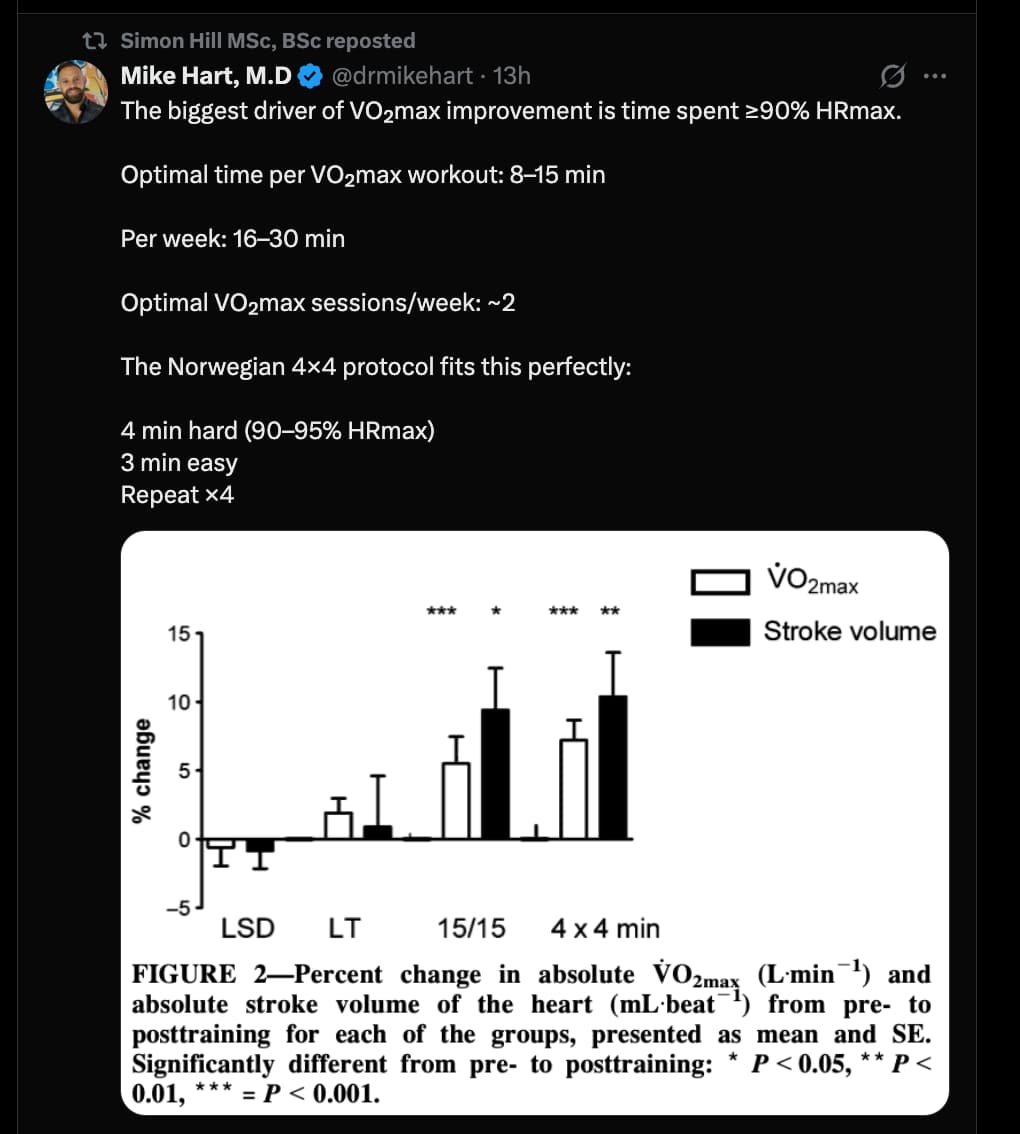
Training zones are DESCRIPTIVE not prescriptive, you don’t need to do "vo2max " workouts to improve vo2max, in fact doing low intensity training is far more effective for improving vo2max because it increases cardiac preload which is a driver for cardiac remodelling https://academic.oup.com/eurheartj/advance-article/doi/10.1093/eurheartj/ehaf1018/8416519
Interesting, it seems to counter the study I just posted. But, given we all have limited amount of time for training, perhaps it comes down to an issue of the marginal increase in Vo2Max per hour of training, that really matters. If you only have X hours of time per week to train, what is the most efficient allocation to maximize your increase in Vo2 max?
Exercise Duration, Not Intensity, Is the Primary Driver of Cardiac Remodeling in Endurance Athletes
The Big Idea: Historically, the cardiovascular adaptations observed in endurance athletes—specifically the enlargement of ventricular volumes and increased cardiac mass—have been attributed to a combination of exercise duration and high-intensity efforts. However, previous assessments relied heavily on subjective questionnaires and metabolic equivalent (MET) estimations, which are notoriously inaccurate and fail to capture the physiological nuances of elite training. This study disrupts that paradigm by utilizing objective, chest-strap heart rate monitor data collected over a three-month period from 151 male endurance athletes.
The primary finding is unambiguous: the total duration of exercise, particularly the time spent in low-intensity heart rate zones (Zones 1 and 2, representing 50-69% of maximum heart rate), is the dominant variable driving structural cardiac remodeling, including increased left and right ventricular end-diastolic volumes (LVEDVi, RVEDVi) and left ventricular mass (LVMi). Contrary to prevailing hypotheses, high-intensity exercise (Zones 4 and 5) demonstrated minimal impact on these specific macroscopic structural adaptations, largely because the absolute time spent in these zones is comparatively brief, even in elite competitors.
Furthermore, the data reveal a significant discrepancy between absolute speed-based intensity (METs) and internal physiological load (heart rate). Well-trained athletes routinely sustain speeds classified as “high intensity” (>9 METs) while remaining entirely within low physiological heart rate zones. Consequently, traditional MET-based risk stratification and training load assessments in sports cardiology are fundamentally flawed for highly conditioned populations. For longevity and healthspan optimization, these findings reinforce the structural superiority of high-volume, low-intensity (Zone 2) aerobic base training for cardiac morphological adaptation [Confidence: High].
Context: * Institutions: KU Leuven (Belgium), Baker Heart and Diabetes Institute (Australia), among other international consortium members.
Country: Belgium, Australia.
Journal Name:European Heart Journal. Impact Evaluation: The impact score of this journal is 39.3, evaluated against a typical high-end range of 0–60+ for top general science, therefore this is an Elite impact journal.
The big boring conclusion is probably that you need both training modalities. And the harsh truth could be well be that if you only have time for one, you need to find the time to do both.
Probably but you propably also need far less intensity than you think you need and far more easy z1/2 than you think you need.
Also the most effective vo2max intervals are probably the 2:1 work:rest micro-intervals with work intervals around 30-60s long. These allow you to get more time in zone, keep heart rate low and you train neuromuscular recruitment with each micro-interval
I think 1 intense session once every 5-10 days is enough. Easy days I prefer keeping easy, though what I do do is throwing in a few 6-12s all out sprints, so really short so they don’t cause fatigue but keep your neuromuscular connections sharp.
Anyway it has been known in endurance coaching for decades that hiit yields fast results but also a fast plateau, the workouts add a lot of fatigue and it is hard to maintain that peak fitness for long. Easy z2 gives slow results but virtually without plateau, the fitness is long lasting and workouts do not add a lot of fatigue
Identical Twins, Drastically Different Outcomes: The Twin Who Trained Built a Younger Body at 52, and the Science Behind It Is Jaw-Dropping
A groundbreaking twin study is shaking up how we think about fitness, health, and aging — and it just might change how you approach your workouts forever.
In a new study published in the European Journal of Applied Physiology, researchers from San Francisco State University, CSU Fullerton, and Cal Poly Pomona followed a pair of 52-year-old identical twins who lived radically different lives for over 30 years.
One twin became an Ironman triathlete and high school coach. The other?
A long-haul truck driver with a largely sedentary lifestyle.
Despite sharing 99.9% of their DNA, the two men diverged sharply in terms of physical health — offering a real-world glimpse into the power of lifestyle over genetics.
“This study gave us a unique opportunity to cut out the genetic part completely,” explained Dr. James Bagley, assistant professor of kinesiology at SF State.
“Any difference between them should be related to environment, exercise, or nutrition.”
The results? Startling. And inspiring.
Bagley and his team ran a battery of tests to assess cardiovascular health, muscle composition, metabolic markers, and VO₂ max — the gold standard for aerobic fitness.
The trained twin, who has logged nearly 40,000 miles of running over three decades, exhibited:
55% more slow-twitch muscle fibers (built for endurance)
8.6% lower body fat
12.4 ml/kg/min higher VO₂ max (comparable to a fit 30-year-old)
Lower blood pressure, blood sugar, cholesterol, and triglycerides
Better aerobic capacity and endurance
In contrast, his sedentary brother had physiological metrics that were typical for his age — but significantly worse than his twin. His VO₂ max, for instance, placed him much closer to the “dependency threshold” often seen in older adults.
VO₂ max is critical because it measures how efficiently the body uses oxygen during exercise — a strong predictor of both cardiovascular health and independence in older age.
“As VO₂ max drops with age, you’re more likely to become dependent on others,” said Bagley. “Keeping it high is key to maintaining health span — not just lifespan.”