This is really helpful @Davin8r
I’ll look into the Scosche Rhythm 24. How accurate do you think it is vs a chest band?
(And I’ll also weigh potentially getting two - that is exactly the optimized, minimum friction type of set-ups I strive for)
This is really helpful @Davin8r
I’ll look into the Scosche Rhythm 24. How accurate do you think it is vs a chest band?
(And I’ll also weigh potentially getting two - that is exactly the optimized, minimum friction type of set-ups I strive for)
Anyone know what heart rate band Attia is wearing here?
@Davin8r does this look like the Scosche Rhythm 24?
I think it is the Rhythm 24, but it might be the Wahoo, its hard to see well in the video.
I like the lights that show the zone you’re in!
The PC Mag review notes this:
The Scosche Rhythm24 uses an optical sensor whereas most chest straps use electrical pulse technology, which is typically more accurate and reliable. Optical sensors get the job done, but they may from time to time lose their read on your pulse or report a bad number. If you’re a stickler for flawless performance, a chest strap HRM will be a better match for you.
and
Accuracy
I wore the Rhythm24 to the gym and liked being able to glance at my pulse during an interval class, which is designed to put your heart rate through its paces. The class involves burpees, jumping on and off a step, abdominal work, and more. The band slid around a little when I first started to sweat, and I had to stop to tighten it. Other than that, it held up well. I never saw it lose my pulse.
From time to time, I’d peer at my arm and see the light flashing red (zone 5), holding a steady red (zone 4), and in the few moments I had time to catch my breath, glowing green (zone 2). That quick look is better than having to open an app to see my heart rate, but not as useful in some circumstances as seeing a numeric heart rate readout on a watch.
You can view your current heart rate in real time and in numeric form if you open the Rhythm Sync app and connect the HRM to your phone. I did that while at rest to compare the readings with those coming from the Wahoo TickrX chest strap, which is known for its high accuracy. Both were consistently within a few beats of one another, giving me strong confidence in the Rhythm24’s accuracy.
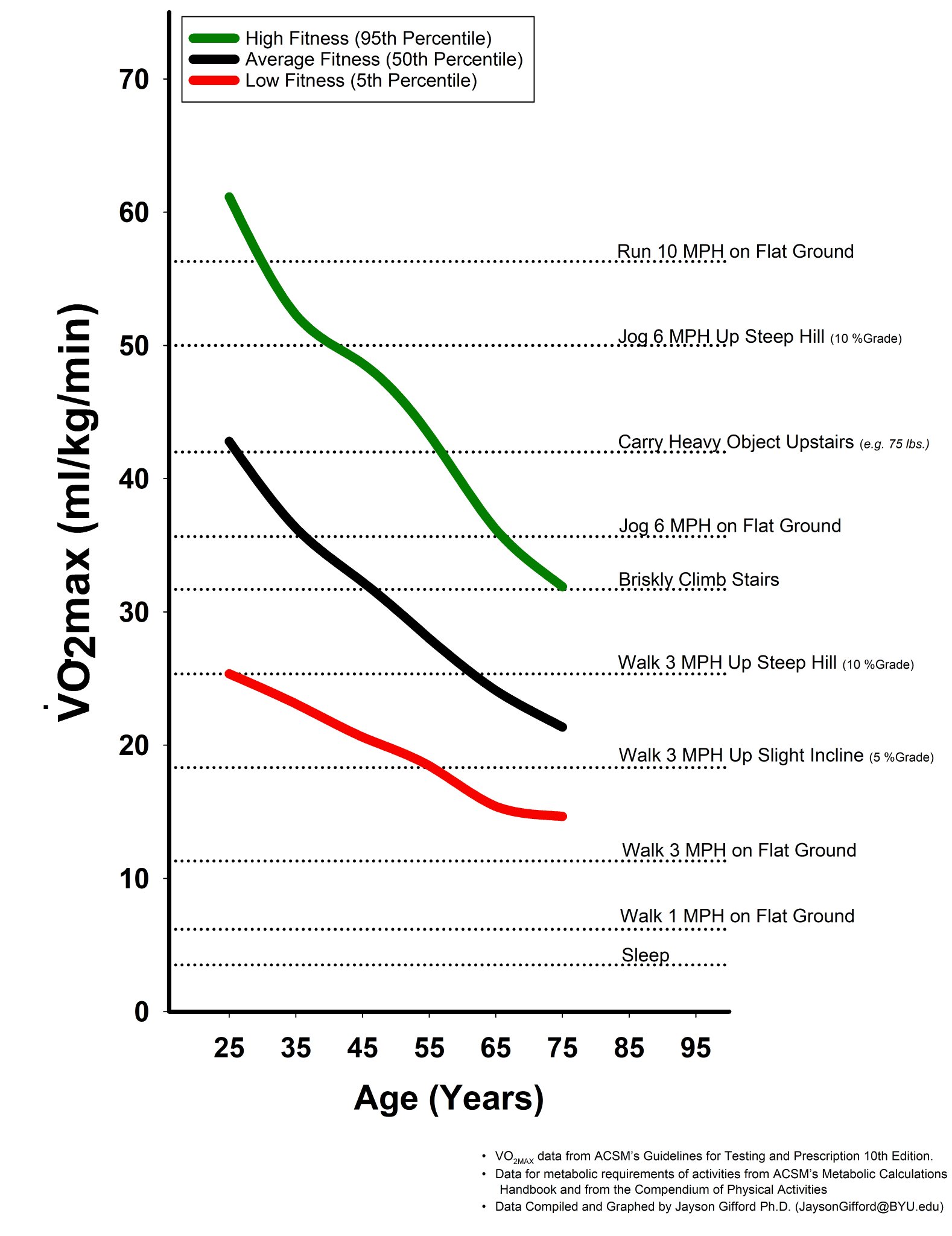
Here is a corrected version. - A person’s fitness level influences how infeasible tasks of daily living become as they age.#StayFitStayFunctional
Source: https://x.com/JaysonGifford/status/1572279059371151361?s=20
Yeah that’s pretty persuasive. I don’t want to ruin my joints jogging to try and get that V02Max.
However I think Zone 2 capacity complicates things quite a bit, some of those things can be a person’s Zone 2 exercise. How does zone 2 capacity change with age?
There is always biking, Rucking, elliptical trainers, stair master, rowing machine… Cross country skiing for you, etc
For the cyclists, this promises to work with Zwift or other trainers using a Ramp Test
I love this graph, it makes me look extremely healthy. 95th percentile easily. I love competing against the general public.
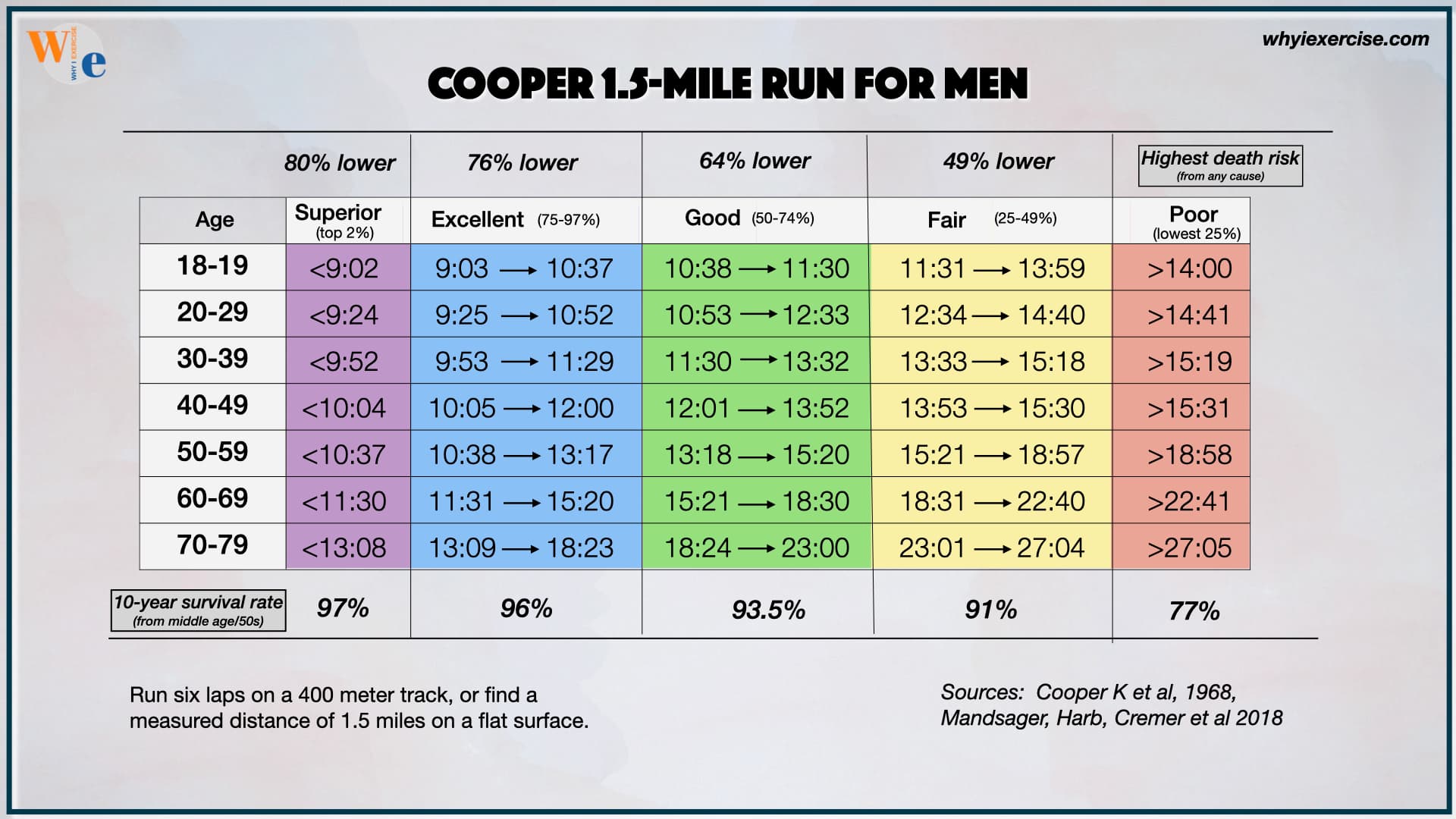
Me too. I may not be in the top 1% - but the top 2% is within reach.
Wonder what top 99th looks like 


There was an exchange between Peter and Rhonda in her recent podcast with him where Peter seems to convey in a compelling way that
This is an area of hyperbole. Here’s my rant.
A ton of effort has gone into figuring out how to maximize aerobic athletic performance of elite athletes (who are younger than me). —-> which can “sorta” be measured by vo2max (which declines during aging) —-> and low vo2max is associated with sedentary lifestyles and metabolic disease. —> “obviously” increasing vo2max is a good thing.
How maximizing vo2max became the most important thing is hard to understand. I think it’s bull. Have a decent vo2max is a good goal. If it’s low, raise it. If it’s okay, keep it there and focus on other stuff: maintaining speed, strength, balance,
It takes a long time to build the base cardio ability to produce power using fat. This is important because that’s your all day pace. You never run out of fuel (body fat). You never overwhelm your ability to clear lactate and hydrogen ions, so your muscles don’t fail. This is the important part.
You need some HIIT to push the system out of its comfort zone but only a little. What’s too much? You can’t recover in time to do your zone 2 work, your HRV is low, your sleep is poor, etc.
Off the top of my head I’d say:
Vo2max is good because it captures:
Vo2max is bad because it encourages less weight:
Even if you eliminate the weight part of the formula, I still don’t think maximizing oxygen utilization is a good goal. Get it to an athletic level and then put your efforts on where you are weak.
It’s the weak link in the chain that matters, not the strongest link.
I do about 5 minutes a week of max (175 bpm) HR work. About an hour of sweetspot (145-150). About 5-6 hours of zone 1 & 2. I also do 3 x 1 hours of weightlifting weekly and I spend 15 min a day on core and mobility.
What’s my vo2max? I’ve never tested it. Maybe I’m wrong but that’s my bet.
Excellent rant. Not quite up there with @desertshores rant wise, but up there
There is a sort of fetish-sizing of these things like VO2 max or hang time etc. In some ways it distracts people from focusing on easy and sustainable exercise. I like reading about Peter Attias’ views on this - but it seems silly how he applies it to his patients.
I tend to agree with both of you that when these measurements are made into targets they have less value as a measurement.
Speaking personally I last went to the Gym on Monday and I think it pushed up my RHR which is not necessarily a bad thing on a temporary basis, but I have stopped going to the gym until it comes down a bit further. Until I started the metabolic boost linked to going to the gym my rhr was around 49-50 and it seemed to be trending slowly down and in fact I started a mild concern about bradycardia. However, with the metabolic boost it went around 60 and has now come down to 57.
In the end if I have souped up my mitochondria (which is what the objective was) then I am pleased even though it has pushed up my RHR and BP.
If you do all that your VO2 max is most likely very good. I didn’t measure mine as well besides getting it estimated by Apple Watch. I assume that mine is pretty good because I can clean 1 foot of snow on my driveway with a snowblower (it’s “push and pull” resistance training) for 30 min with bmp between 90 -140. It’s an excellent work out. I could do it when I was 40 and at 69 I can still do it. My goal is to be able to do the same things now as I did at 40.
Thanks for sharing these reflections @Joseph_Lavelle
What is your protocol for the 5 min max? I’m asking because after a while of only having focused on zone 2 (+ hiking / walking / rucking) and resistance training, I was thinking to add a little bit of max cardio once a week.