Thought I’d create a new thread just focused on exercises tips and hacks.
I’ve never done a farmer’s carry but keep hearing about it so thought I’d look into it a bit.
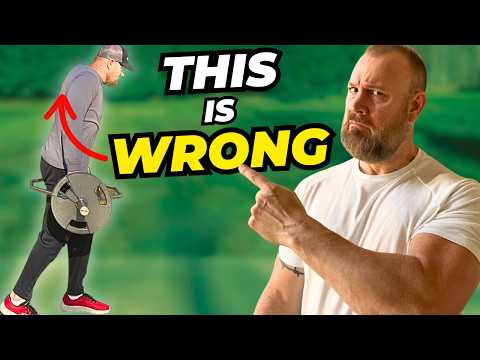
I don’t know if this guy is necessarily an expert, but seems like some reasonable ideas:
Gemini Pro AI Summary and Analysis:
Here is the rigorous summary and adversarial peer review of the provided transcript.
A. Executive Summary
The video argues that the Farmer’s Carry is an essential, high-ROI exercise for individuals over 50, effectively targeting grip strength, core stability, and posture. However, the speaker contends that its benefits are frequently negated by poor execution. The core thesis is that the Farmer’s Carry should be treated as a “controlled strength skill” rather than a cardio or ego-lifting event.
The content outlines four primary failure points: rushing (momentum), poor breathing mechanics (locking the core too tight), elevated shoulders (trap dominance), and excessive loading (postural collapse). The recommended protocol prioritizes “quiet feet” (slow, deliberate steps), spinal integrity, and moderate weights held for 30–60 seconds. The speaker emphasizes that for aging populations, the goal is to resist gravity with perfect posture, not to move the heaviest possible object from A to B at the expense of joint health.
B. Bullet Summary
- High-Value Investment: Farmer’s Carries offer a high return on investment for the >50 demographic by simultaneously training grip, core, and posture.
- Momentum is the Enemy: Rushing with fast steps turns the exercise into a momentum-based movement, stripping away the tension required for adaptation.
- The “Quiet Feet” Cue: Steps should be slow and deliberate; if you are stomping or bouncing, you have lost control.
- Breathing Mechanics: Bracing the core does not mean holding your breath; you must maintain a “brace” while breathing calmly to stabilize the spine under load.
- Anti-Shrug: Shoulders must be packed “down and back” (away from ears) to load the lats rather than the upper traps and levator scapulae.
- Ego Lifting Risk: The most common error is selecting a weight that forces postural collapse (forward lean, side sway) before muscle fatigue sets in.
- Failure Metric: The set ends the moment posture breaks, not when the grip fails or the distance is covered.
- Dosage: Recommended frequency is 1–2 times per week, with 1–2 sets of 30–60 seconds per workout.
- Strength Skill: The movement should be practiced with the focus of a skill (precision) rather than a brute-force effort.
D. Claims & Evidence Table (Adversarial Peer Review)
Role: Longevity Scientist & Peer Reviewer.
| Claim from Video | Speaker’s Evidence | Scientific Reality (Best Available Data) | Evidence Grade | Verdict |
|---|---|---|---|---|
| “Farmer’s carries build grip strength, which is vital after 50.” | General exercise physiology claims. | True. Grip strength is a top-tier biomarker for all-cause mortality and cardiovascular health in older adults. Bohannon, 2019; Soysal et al., 2021 | A (Meta-Analysis) | Strong Support |
| “Going too heavy wrecks shoulders/backs.” | Biomechanical logic (compensation patterns). | True. Carrying loads beyond postural capacity shifts torque to the lumbar spine and causes sheer stress. Heavy loading is beneficial for bone density (Wolff’s Law), but only with neutral spine maintenance. | C (Biomechanics/Expert) | Strong Support |
| “Slow steps make the movement safer and more effective.” | “Quiet feet” cue. | True. Slowing gait during loaded carries increases “Time Under Tension” for the core musculature and minimizes momentum, reducing shear forces on the spine. | C (Mechanistic) | Plausible |
| “Shoulders should be down, not shrugged.” | Prevents neck/joint irritation. | True. “Packing the lats” (scapular depression) stabilizes the glenohumeral joint. Shrugging under heavy load exacerbates compressive forces on the cervical spine and limits thoracic stability. | B (Physiotherapy Consensus) | Strong Support |
| “It builds core strength.” | Claims brace/stability benefit. | True. Loaded carries (especially unilateral) elicit high EMG activity in the Quadratus Lumborum (QL) and external obliques, superior to static planks for functional stability. McGill et al., 2009 | B (EMG Studies) | Strong Support |
E. Actionable Insights (Pragmatic & Prioritized)
Top Tier (High Confidence)
- The “Check-In” Protocol: Before taking a single step, stand still with the weight for 5 seconds. Ensure glutes are squeezed, ribs are down, and shoulders are away from ears.
- Duration over Distance: Instead of walking for distance (which encourages rushing), walk for time. Set a timer for 45 seconds. The distance covered is irrelevant; the time under tension with perfect posture is the goal.
- Frequency: Add this to the end of your strength workouts 2x per week. It is low-impact on joints but high-fatigue for the CNS (central nervous system), so do not overdo it.
Experimental (Synergistic Optimization)
- Suitcase Carry Variant: Carry weight in only one hand to massively increase lateral core (anti-lateral flexion) demand. This specifically targets the Quadratus Lumborum, a common source of lower back pain in the elderly.
- Grip Variation: Use “Fat Gripz” or wrap a towel around the handle to further bias the forearm and grip strength adaptation, directly targeting the longevity biomarker (grip force).
Avoid
- The “waddle”: If your hips are swaying side-to-side, the weight is too heavy or your glute medius is weak. Drop the weight immediately.
- Holding Breath: Utilizing the Valsalva maneuver (holding breath) for 45-60 seconds can dangerously spike blood pressure, which is a contraindication for older adults with hypertension. Breathe behind the brace.
H. Technical Deep-Dive
Biomechanics of the “Loaded Carry”
The Farmer’s Carry is unique because it applies Axial Loading (compressive force down the spine) while the body is in motion.
- The Benefit: This compression stimulates osteoblasts (bone-building cells), crucial for resisting osteopenia/osteoporosis in the >50 demographic.
- The Risk: If the spine is not neutral (i.e., if the user is leaning forward or arching), that compressive force turns into Shear Force, particularly at the L4/L5 lumbar segments. This validates the speaker’s heavy emphasis on “posture before weight.”
The Grip-Longevity Correlation
The speaker mentions grip strength. Scientifically, this is one of the most robust biomarkers we have.
- Data: A 2015 study in The Lancet involving 140,000 adults found that grip strength was a better predictor of all-cause mortality than systolic blood pressure.
- Mechanism: Grip is not just forearm muscle; it is a proxy for overall neural drive and total body protein reserves. Failing to train it is a missed opportunity for longevity diagnostics and maintenance.
I. Fact-Check Important Claims
Claim: “Farmer’s carries effectively train posture.”
Fact Check: True.
Unlike static posture drills, Farmer’s Carries force the user to maintain posture dynamically against a load that wants to pull them out of alignment. This trains the proprioceptive loops required to maintain an upright torso in daily life.
Claim: “Walking fast destroys the benefit.”
Fact Check: Context Dependent.
For cardiovascular health, brisk walking is superior. However, in the specific context of a loaded strength exercise, the speaker is correct. Speed introduces momentum, which offloads the muscles and increases impact forces on joints. “Slow” optimizes the strength-to-risk ratio.