Massive Chinese Cohort Identifies 75-Minute “Longevity Floor” and L-Shaped Mortality Curve
In a massive prospective cohort study of 109,407 Chinese adults, researchers have pinpointed a precise “minimum effective dose” for lifespan extension: 75 minutes of total physical activity (TPA) per week. Unlike previous assumptions of a linear “more is better” relationship, this data reveals a distinct L-shaped dose-response curve. Significant mortality risk reduction (11-23%) kicks in immediately at this low threshold, deepening with increased volume until it plateaus at approximately 2,400 minutes per week. Beyond this “ceiling,” no further statistical mortality benefit was observed, challenging the utility of extreme endurance volumes for longevity purposes.
Crucially, this study adjusts for the “healthy user bias” by excluding participants with major comorbidities (stroke, heart failure, etc.) at baseline, isolating the effect of movement itself. The findings provide a critical “floor” for the sedentary biohacker: achieving just 10.7 minutes of activity per day is sufficient to trigger the initial survival advantage. This aligns with, and refines, the 2020 WHO guidelines by offering a lower, more accessible entry point for significant biological ROI.
Source:
Open Access Paper: Dose‒response relationship between physical activity and all-cause mortality in Chinese adults
Context: Scientific Reports (Nature Portfolio), China, 2025. Impact Evaluation: The impact score of this journal is ~3.9 (JIF 2024), evaluated against a typical high-end range of 0–60+ for top general science, therefore this is a Medium impact journal. It is a high-volume, peer-reviewed mega-journal that validates methodological soundness rather than perceived novelty.
Biohacker Analysis (Technical & Critical)
Study Design Specifications
- Type: Level C - Prospective Observational Cohort Study.
- Subjects: 109,407 Chinese adults (78.9% Men, 21.1% Women; Mean Age: 53.3 ± 13.6 years).
- Follow-Up: Median 6.99 years; 4,571 all-cause deaths recorded.
- Controls: Physically inactive group (0 min/week TPA).
Lifespan Analysis & Findings
- The “Floor” (Minimum Effective Dose): Participants performing 75–360 min/week of TPA saw an 11% reduction in all-cause mortality (HR: 0.89) compared to the inactive group.
- The “Sweet Spot” (High Volume): The highest quartile (>720 min/week) achieved a 23% reduction in mortality (HR: 0.77).
- The “Ceiling” (Point of Diminishing Returns): The benefit curve flattens (plateaus) after ~2,400 min/week(approx. 5.7 hours/day). Activity beyond this point showed widened confidence intervals and no statistically significant additional survival benefit.
Mechanistic Deep Dive
The observed L-shaped curve suggests distinct biological pathways:
- Immediate Metabolic Rescue (0 → 75 min): The sharp initial drop in mortality likely stems from the reversal of sedentary pathology—activation of AMPK, improved glucose disposal (GLUT4 translocation), and shear-stress-induced nitric oxide production in the endothelium.
- Mitochondrial & Cardiac Adaptation (75 → 2400 min): The progressive risk reduction aligns with improved VO2 max, mitochondrial biogenesis (PGC-1$\alpha$), and reduced systemic inflammation (hs-CRP).
- The Plateau (>2400 min): The lack of further benefit supports the concept of a biological “saturation point” where cardiovascular remodeling may balance out metabolic gains, or simply where the risk of accidental death/injury rises.
Critical Limitations
- Recall Bias: Physical activity was self-reported via the IPAQ short form, which historically overestimates activity compared to accelerometer data.
- Gender Imbalance: The cohort was 78.9% male, severely limiting the generalizability of the specific dose thresholds to females.
- Reverse Causality: While baseline comorbidities were excluded, subclinical disease could still drive inactivity in the control group (the “sick sedentary” effect).
- Low-Resolution Intensity Data: “Total Physical Activity” (TPA) lumps together walking, moderate, and vigorous activity. The study lacks the granularity to distinguish if 75 minutes of sprinting is superior to 75 minutes of walking.
Claims & Verification
Claim 1: “75 minutes of weekly physical activity significantly reduces all-cause mortality.”
- Verification Status: Verified (Consensus High).
- Evidence Hierarchy: Level A (Meta-Analysis).
- Search Confirmation: Independent meta-analyses confirm that even volumes below the standard 150-minute guideline provide substantial protection. A seminal Lancet study found 15 min/day (90 min/week) reduced mortality by 14%.
- Source: Minimum amount of physical activity for reduced mortality (2011)
- Translational Gap: None. Direct human outcome data.
Claim 2: “Dose-response curve is L-shaped (nonlinear) with a plateau at high volumes.”
- Verification Status: Verified (Consensus Medium-High).
- Evidence Hierarchy: Level A (Meta-Analysis).
- Search Confirmation: Current consensus supports an L-shaped or curvilinear relationship where benefits plateau. The “U-shaped” curve (where extreme exercise increases mortality) is largely debunked for all-cause mortality, though atrial fibrillation risk does rise.
- Source: Dose-Response Relationship of Physical Activity with All-Cause Mortality (2023)
- Note: The plateau at 2,400 min/week in this study is higher than the ~3-5x guideline plateau seen in Western cohorts, possibly due to lower intensity of “Total Physical Activity” in this Chinese cohort.
Claim 3: “Age modifies the association; benefits strengthen with age.”
- Verification Status: Verified.
- Evidence Hierarchy: Level A (Systematic Review).
- Search Confirmation: Activity in older adults (>60y) shows stronger absolute risk reduction because their baseline mortality risk is higher. Even low-dose activity (below guidelines) reduces mortality by ~22% in the elderly.
- Source: Even a low-dose of physical activity reduces mortality in adults aged ≥60 (2015)
Actionable Intelligence: The “Longevity Floor” Protocol
-
The Protocol: The “11-Minute Minimum”.
- Goal: Hit the 75 min/week floor immediately to secure the ~11% mortality risk reduction.
- Frequency: 11 minutes of deliberate movement daily, or ~25 minutes 3x/week.
- Type: The study defines TPA broadly. Mix of brisk walking (Zone 1) and moderate effort (Zone 2).
-
Safety & Toxicity (The “Overdose” Check):
- Threshold: >2,400 min/week (approx. 5.7 hours/day).
- Risk: No increased mortality found, but “diminishing returns” and potential overuse injury.
- Contraindications: Uncontrolled hypertension or severe aortic stenosis should preclude vigorous activity, but light TPA is generally safe. [Safety Data: Physical Activity Guidelines for Americans (2018)]
-
Biomarker Verification Panel (Proof of Efficacy): To validate if your 75+ minutes are working, monitor:
- hs-CRP: Target < 1.0 mg/L (Reduction indicates systemic anti-inflammatory effect).
- Resting Heart Rate: Downward trend (Indicates improved vagal tone/stroke volume).
- HbA1c: Target < 5.4% (Indicates improved insulin sensitivity/GLUT4 activity).
- VO2 Max: The “vital sign” of longevity. Even a 1-MET increase corresponds to 12% survival improvement.
-
Feasibility & ROI:
- Cost: $0.
- ROI: Infinite. 75 minutes/week is arguably the highest leverage intervention available, surpassing most pharmacological agents (e.g., Metformin) in absolute mortality risk reduction for healthy adults.
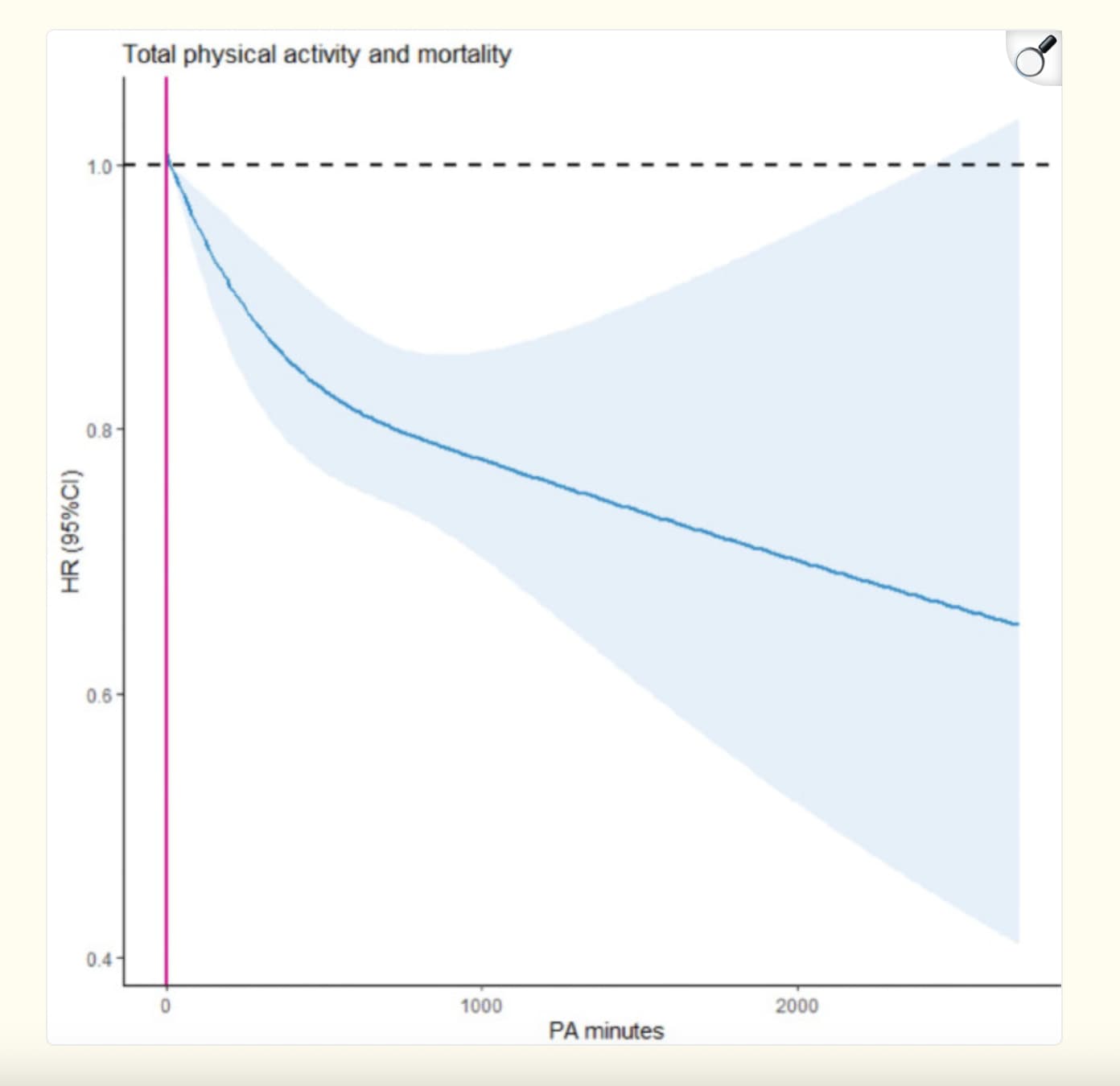
Dose-response association between total physical activity per week and all-cause mortality. The y-axis with the shared area representing hazard ratios and 95%CIs. The reference group is physically inactive participants (no PA).