Excessive exercise impairs cognitive function, but the underlying mechanism remains unclear. Here, we show that excessive vigorous exercise-induced lactate accumulation stimulates muscles to secrete mitochondria-derived vesicles (MDVs), driving cognitive impairment. These MDVs (named otMDVs) are characterized by high mtDNA levels and the surface marker PAF. They tend to migrate into hippocampal neurons, substituting endogenous mitochondria and triggering a synaptic energy crisis. Mechanistically, otMDVs release mtDNA, which activates cGAS-STING-dependent inhibition of kinesin family member 5, preventing hippocampal mitochondria from transporting to synapses. Simultaneously, the otMDV marker PAF cooperates with syntaphilin to occupy mitochondrial anchoring sites, impairing synaptic energy supply. Blocking otMDVs migration into the hippocampus with a PAF-neutralizing antibody alleviates excessive vigorous exercise-induced synapse loss and cognitive dysfunction. Notably, human studies link high circulating otMDV levels to cognitive impairment. Together, our findings reveal that a unique muscle-derived MDV subpopulation, which displaces hippocampal mitochondria and disrupts their function, causes cognitive decline.
The post described “excessive vigorous exercise” and the mechanism by which it impairs cognition. The summary on the page uses the phrase vigorous and excessive vigorous exercise, but it does not give a specific workload, VO₂max percentage, heart‑rate zone, duration, or weekly volume. Does it say something about this in the paper? Can somone here go behind the paywall and have a peak?.
I prefer not to get a peek, because it confirms my bias and prejudice against exercise, so I want to call “excessive” as soon as possible. OK, joking aside, this is a very interesting idea, but if this were a common thing, then wouldn’t we have reports of people who exercise a ton (athletes etc.) as exhibiting statistically significant effects? I’m not aware of such reports.
HIIT can be very supportive for the brain, but I wonder what dose distinguishes beneficial HIIT from the kind of chronic, excessive, vigorous volume being criticized on that paper.
HIIT is often beneficial, Short, well‑recovered intervals activate several brain‑relevant pathways that tend to be adaptive rather than damaging. HIIT provides a BDNF surge, High‑intensity intervals create transient, pulsatile increases in blood flow.
I am curious about the threshold when HIIT might do more damage than good.
I think there are studies out there that show best effects of HIIT sessions like 2 or 3 max a week, and you do worse with more. You need recovery. FWIW, I did 2 a week, and felt it would be pushing it with more. Of course you have to look at which special HIIT protocol we’re talking about, I did the very intense SIT.
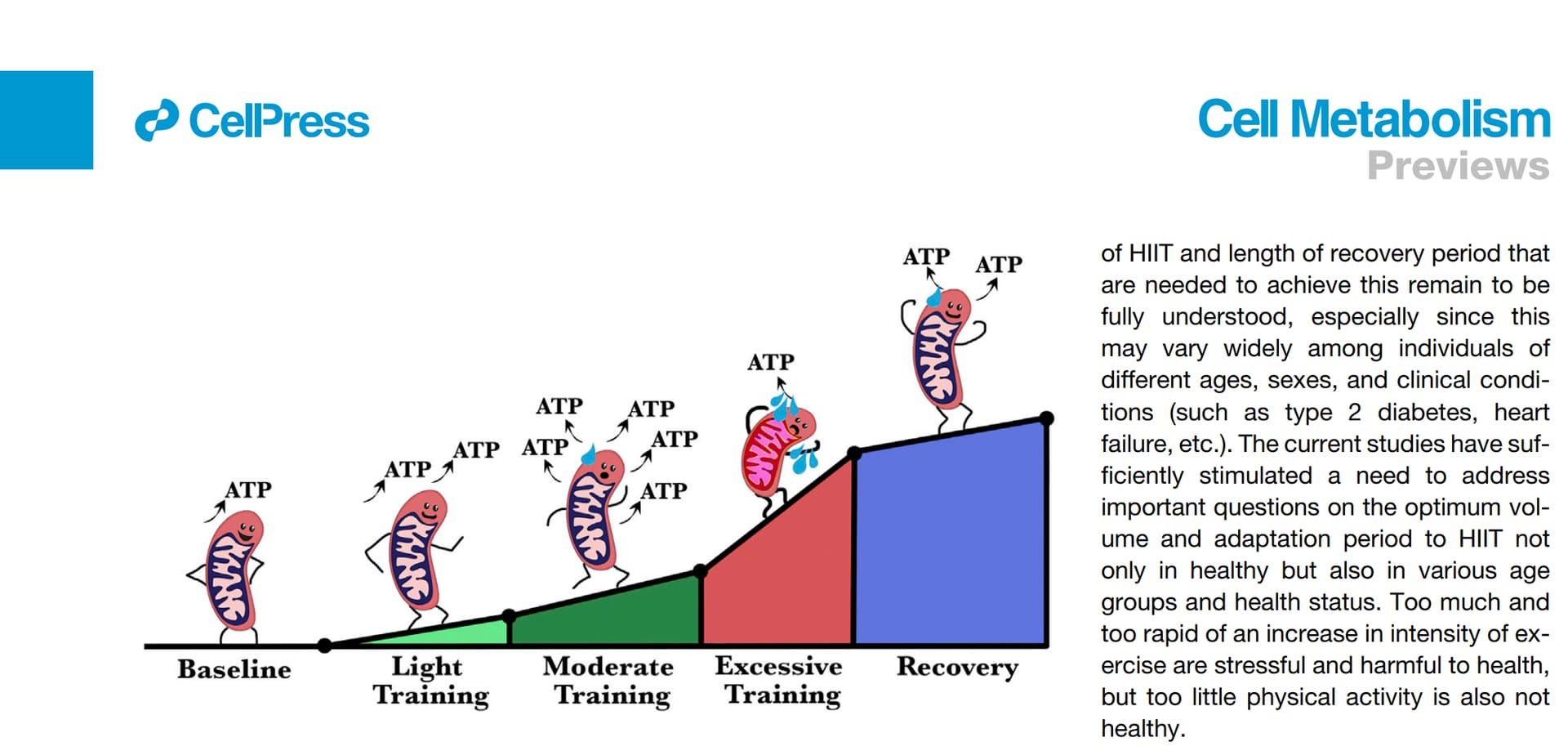
A similar article was published in 2021. The full transcript is available. Too much of a good thing: Excess exercise can harm mitochondria
Mark W. Pataky1 and K. Sreekumaran Nair1,
1Division of Endocrinology and Metabolism, Mayo Clinic, Rochester, MN, U
I wonder if SS-31 (elamipretide/Forzinity) could play a role in protecting against this effect? Also an important question, would we want it to protect against this effect? Only if it helped prevent overtraining while allowing greater “gains” for those who really want to push things to the limits.
[quote=“Davin8r, post:9, topic:23455”]
for those who really want to push things to the limits.
In high school I belonged to the Forensics (debate) Club.
We were assigned random topics and a side to defend or attack.
This taught me that there is always more than one side to a story.
In the Rapamycin News threads, most of the topics have pros and cons.
This incudes this topic. It is not hard to find other papers disputing the moderate (U-shaped) exercise protocol.
From the paper: “For subsequent mechanistic studies, we defined moderate exercise as moderate-intensity activity at 281–563 MET-min/week and excessive vigorous exercise as vigorous-intensity activity exceeding 450 MET-min/week.”