chatGPT5.5 paid:
Tidy transcript
1. Understanding myostatin
In 2004, a baby was reported in Germany who, by any normal measure, seemed extraordinary. Within days of birth he had unusually visible muscles: his thighs and upper arms looked unusually well developed.
Doctors checked for disease but did not find an explanation. Genetic testing pointed to the cause: both copies of a gene affecting myostatin function were disrupted. Myostatin is a protein whose role is to restrain muscle growth. In simple terms, it acts as a brake on muscle formation. In this child, that brake was effectively absent.
The myostatin gene had only been identified a few years earlier, in 1997, and once scientists understood its role, the implications were obvious. If myostatin could be safely inhibited, it might be possible to treat conditions where muscle is progressively lost, such as muscular dystrophy, spinal muscular atrophy, or sarcopenia.
The problem was that, for nearly three decades, nobody had found a way to inhibit myostatin cleanly and safely enough for broad clinical use.
2. The problem created by modern weight-loss drugs
Modern weight-loss drugs have changed the landscape. Older drug treatments produced relatively modest weight loss. Semaglutide, sold as Ozempic or Wegovy depending on indication and market, raised that to roughly the mid-teens percentage range. Tirzepatide pushed weight loss into the 20% range. Retatrutide, a newer triple agonist, has recently produced about 28% body-weight loss in a large late-stage trial.
For someone starting at around 110 kg, that scale of loss can mean more than 30 kg lost, approaching the range previously associated with bariatric surgery.
But the catch is that some of the lost weight is not fat. Some is lean mass, including muscle. The video argues that the panic over “GLP-1 drugs melting muscle” needs context. Lean-mass loss is not unique to GLP-1 or incretin-based drugs. In many forms of weight loss, including dieting and bariatric surgery, a substantial minority of lost weight is lean tissue. The transcript states a rule of thumb of roughly one quarter of total weight loss being lean mass.
The practical aim is therefore not just weight loss, but high-quality weight loss: losing fat while preserving as much muscle and function as possible.
3. Why myostatin is attractive
The myostatin story began with dramatic mouse experiments. In 1997, researchers deleted the myostatin gene in mice, producing animals with very large muscles. The effect resembled “double-muscled” cattle.
That made myostatin an obvious target. If blocking it could increase or preserve muscle in humans, it might help with muscle-wasting diseases, ageing-related sarcopenia, and now the lean-mass loss associated with major pharmacological weight reduction.
The natural human myostatin-deficiency case seemed reassuring: a person could have very low myostatin activity and be unusually muscular without obvious severe developmental failure. But that did not mean that drugging the pathway would be easy.
4. Why earlier attempts struggled
The video explains that many early efforts used monoclonal antibodies against active myostatin. The problem is that active myostatin resembles other members of the TGF-beta / activin family. Blocking the wrong related proteins can create off-target effects.
So the field had a strong biological target, but poor selectivity. That is why many myostatin approaches generated enthusiasm but limited clinical success.
5. Apitegromab: the more selective approach
The newer drug discussed in the video is apitegromab. Its key distinction is that it does not mainly target active myostatin. Instead, it binds the pro- and latent forms of myostatin, before activation. This precursor form is more specific to myostatin, allowing more selective inhibition. Scholar Rock describes apitegromab as a fully human monoclonal antibody that inhibits myostatin activation by selectively binding pro- and latent myostatin in skeletal muscle.
Apitegromab has also been studied in spinal muscular atrophy. Published phase 2 evidence reported improved motor function in later-onset type 2 and 3 SMA, supporting further randomized testing.
6. Combining weight-loss drugs with muscle-preserving drugs
The video contrasts two strategies.
The first is apitegromab, the more selective myostatin inhibitor.
The second is bimagrumab, which blocks activin type II receptors more broadly. That is a more forceful intervention in the pathway. Bimagrumab has shown the ability to reduce fat mass while preserving or increasing lean mass, and a phase 2 study of bimagrumab with semaglutide reported preservation of lean mass with greater fat-mass reduction.
However, the broader mechanism may carry more concern about side effects. The video mentions muscle spasms, acne, LDL cholesterol increases, and programme pauses. Reuters reported in September 2025 that Lilly terminated one mid-stage bimagrumab/tirzepatide trial in people with type 2 diabetes for strategic reasons, while another non-diabetic obesity study continued; that report did not clearly say the trial was stopped because of safety signals.
7. The EMBRAZE trial
The main study discussed is EMBRAZE, a randomized, double-blind, placebo-controlled phase 2 trial of apitegromab added to tirzepatide in adults with overweight or obesity.
The design was simple: 102 adults received tirzepatide, and they were randomized to receive either apitegromab or placebo. After 24 weeks, the investigators measured total weight loss and body composition.
The trial found that apitegromab preserved lean mass compared with placebo. The published result was about 1.9 kg less lean-mass loss with apitegromab, representing about 54.9% retention of lean mass relative to placebo, despite similar overall weight loss.
The video’s key caution is important: preserving lean mass on a scan is not the same as proving better physical function. The transcript says the apitegromab group was not measurably stronger on grip strength or chair-stand tests. That distinction matters: body composition is a surrogate; strength, mobility, falls, frailty and quality of life are the clinically meaningful outcomes.
8. Practical advice given in the video
The video ends with the practical advice that, at present, the proven ways to reduce muscle loss during GLP-1 or tirzepatide-associated weight loss are still ordinary ones:
resistance training, adequate protein intake, and possibly creatine.
It also warns against grey-market SARMs and “muscle-preserving peptides”, such as YK11, arguing that they lack proper randomized human evidence and may carry risks including liver injury.
Summary
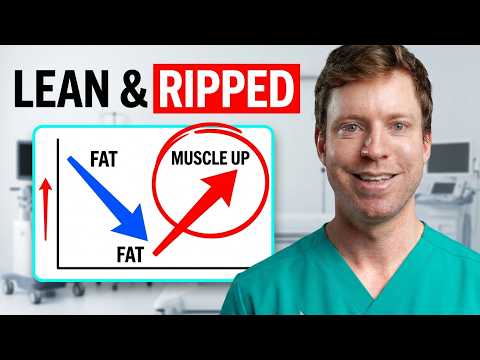
The video argues that modern obesity drugs are now powerful enough to create a new clinical problem: large weight loss can include meaningful lean-mass loss. It then presents myostatin inhibition as a possible solution.
The central claim is that apitegromab, a selective antibody that blocks activation of myostatin, may preserve lean mass during tirzepatide-induced weight loss. The EMBRAZE phase 2 trial supports that claim at the body-composition level: people receiving apitegromab plus tirzepatide lost a similar amount of total weight but lost less lean mass than those receiving tirzepatide plus placebo.
The video is strongest when it distinguishes between lean mass on a scan and functional benefit. It correctly warns that the trial does not yet prove better strength, mobility, or frailty outcomes.
Critique
The video is broadly plausible and based on a real, timely paper, but it has several weaknesses.
First, the transcript appears to contain an error: it says the German myostatin-deficient baby was born in 2024, but later correctly refers to the case as 2004. The famous human myostatin-deficiency report was from 2004, not 2024. That is probably a transcription or narration error, but it matters because the video frames the story historically.
Second, the video slightly overdramatises the “nearly 30 years nobody could switch off myostatin safely” point. It is fair that earlier approaches disappointed, but the history is not simply failure followed by one breakthrough. There have been multiple attempts across myostatin, activin receptors, follistatin-related approaches and ligand traps, with mixed efficacy, target-specific issues and endpoint problems.
Third, the bimagrumab section needs caution. The video says a programme was paused because of safety signals. The Reuters report I found says Lilly terminated one bimagrumab/tirzepatide trial in people with type 2 diabetes for “strategic business reasons”, while another study continued; that does not prove safety was the reason.
Fourth, lean mass is not identical to useful muscle. DXA lean mass includes water, organs and non-fat soft tissue, not just contractile muscle. If a drug preserves DXA lean mass but does not improve grip strength, chair-stand performance, walking speed or frailty outcomes, the clinical value remains uncertain.
Fifth, the EMBRAZE trial was small and short: 102 participants over 24 weeks. That is useful proof of concept, not proof of long-term safety or benefit. The key future questions are whether apitegromab preserves function over 1–2 years, whether it prevents sarcopenia in older adults, whether it improves outcomes after stopping tirzepatide, and whether long-term myostatin inhibition has tendon, cardiac, metabolic or malignancy-related signals.
Sixth, the practical advice is sensible. Resistance training and adequate protein are still the most evidence-grounded recommendations. Creatine is reasonable for many people, although in people with kidney disease or complex medication regimens it should be discussed with a clinician rather than treated as automatically harmless.
Bottom line
The video’s core message is sound: apitegromab plus tirzepatide appears to preserve more lean mass than tirzepatide alone, and this is a genuinely important development. The main caveat is that the study shows better body composition, not yet better strength, mobility, frailty or long-term health outcomes.