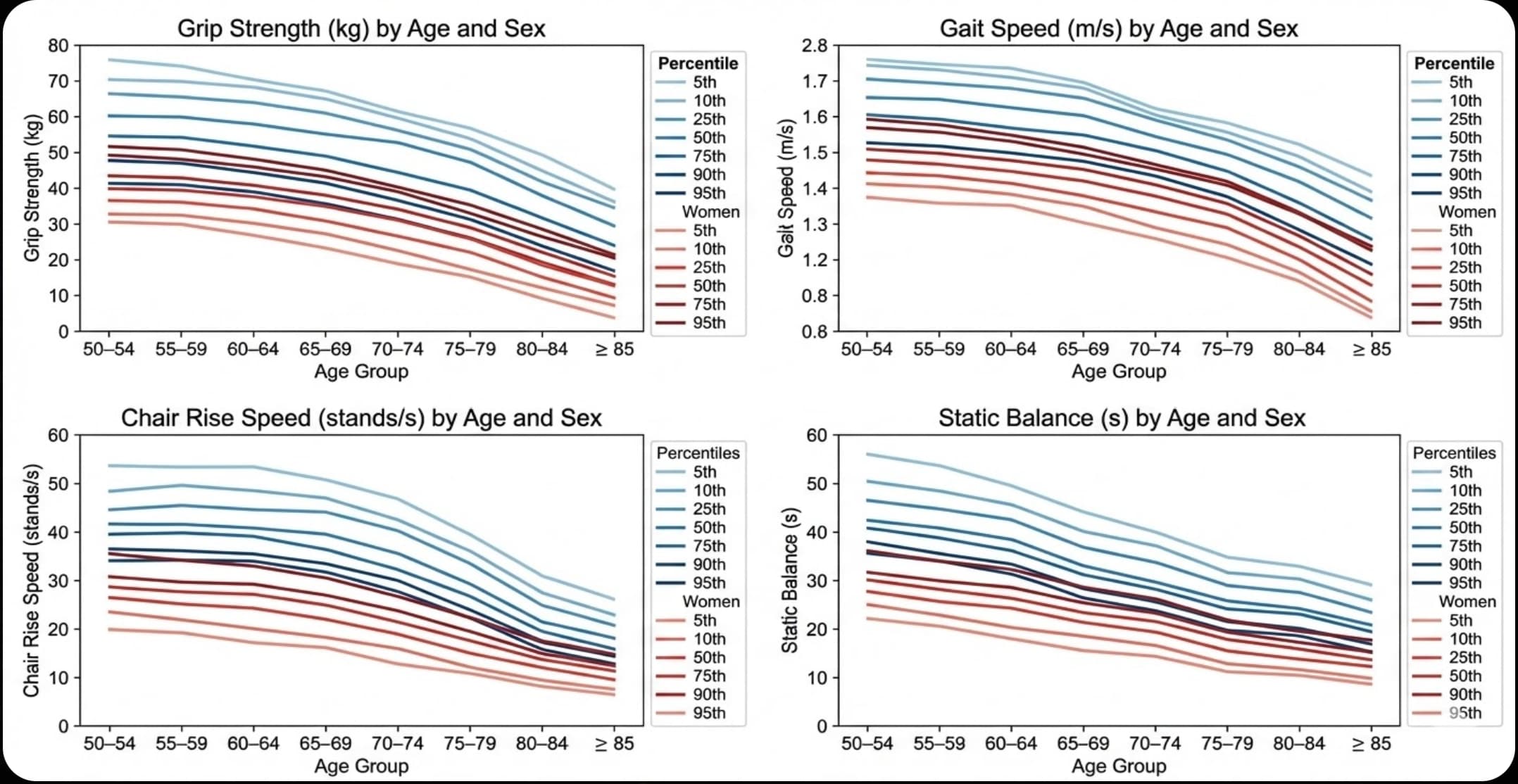
Maintaining physical function is a primary objective in longevity medicine, directly correlating with morbidity and all-cause mortality. A new retrospective analysis leverages the English Longitudinal Study of Ageing (ELSA) to establish high-resolution, age- and sex-specific reference percentiles (5th to 95th) for key functional biomarkers: habitual gait speed, the Five-Times-Sit-to-Stand Test (FTSST), balance, and handgrip strength.
Analyzing 7,658 non-institutionalized adults aged 50 and older, the data provides a definitive benchmarking tool for clinical and biohacking applications. Peak physical performance generally localized to the 50–59 or 60–64 age brackets, followed by a predictable, progressive decline that severely accelerates in individuals 85 and older. For instance, the 50th percentile for male handgrip strength drops from 47 kg at ages 50–54 to just 27 kg at 85+.
Crucially, the study identifies distinct geographic and population variances in aging trajectories. When comparing the English cohort to recent Singaporean datasets, the researchers noted a significantly steeper age-related decline in gait speed among the English population. While Singaporean females aged 60 to 80+ experienced a minor gait speed drop of 0.06 to 0.12 m/s, English females exhibited a substantial 0.31 to 0.48 m/s reduction across the same chronological span. This suggests environmental, lifestyle, or baseline healthcare variables drastically impact the preservation of functional mobility in Western populations compared to their Asian counterparts [Confidence: High].
For longevity practitioners, these standardized percentiles eliminate reliance on basic population averages. By benchmarking an individual against the 95th percentile of their chronological age group, clinicians can accurately quantify biological age discordance and stratify risk for sarcopenia and frailty before catastrophic functional failure occurs.
Source:
- Open Access Paper: Reference values for gait speed, five-times-sit-to-stand test, balance, and handgrip strength: analysis of data from the English Longitudinal Study of Ageing
- Institution: The Chinese University of Hong Kong; National University of Singapore; The University of Melbourne; University of Alcalá.
- Country: Multi-national authorship analyzing a United Kingdom (England) cohort.
- Journal: GeroScience. Impact Evaluation: The impact score of this journal is 5.3, therefore this is a Medium impact journal.