I’m continuing my deep dives into the genetic pathways to get actionable insights as the previous ones have been incredible precise and useful. This time I’m looking at endurance training genetic pathways.
Here is the general description of the pathways and their variants. I will put the finding about my own genome below it as an example of what useful and actionable insights you can get.
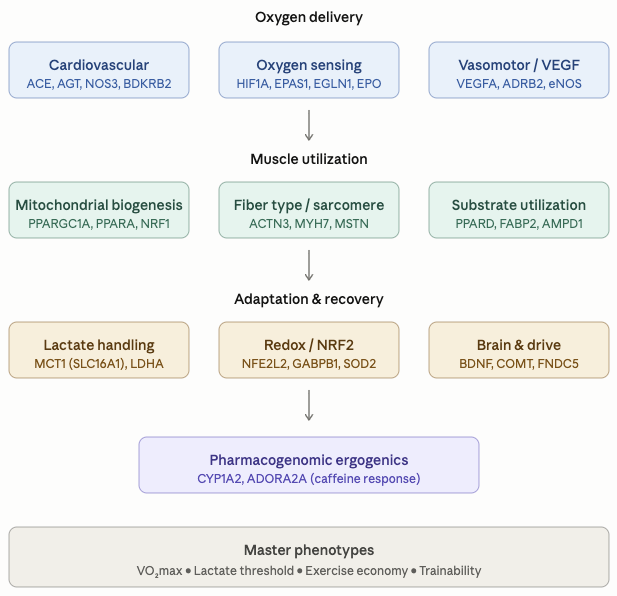
Endurance_Training_Genetic_Pathway_Reference.pdf (420.0 KB)
The pdf report above is valid for everybody but here is the summary of the findings I get when I apply it to my own genome.
Endurance Training — Top 10 Findings & Action Items
The headline
The endurance-genetics profile is favorable on the strongest replicable signals (PPARGC1A likely Gly/Gly, AMPD1 likely C/C, ACTN3 likely R/R, no HFE C282Y, no Tibetan EPAS1 risk variants, BDNF likely Val/Val) but carries three consequential homozygous risk findings — SLC16A1 (MCT1) E490D, TMPRSS6 V736A, and now-confirmed NFE2L2 −617 promoter homozygous loss-of-function — that together shape training, supplementation, and monitoring strategy.
1. Sulforaphane is now the most genetically aligned single supplement — consider dose increase
The confirmed NFE2L2 −617 homozygous variant (rs6721961 + rs4243387 both 1/1, every read calls alt allele) reduces master antioxidant transcription factor promoter activity by approximately 30–60% (Marzec et al., FASEB J 2007). Sulforaphane bypasses this by acting at the KEAP1 cysteine-modification step, sustaining longer NFE2L2 protein half-life once translated. Current Avmacol Extra Strength 1 cap/day yields ~10–15 mg sulforaphane equivalents; doubling to 2 caps/day or adding a separate stabilized sulforaphane source brings total intake into the 30–60 mg range used in cardiometabolic and oxidative-stress randomized trials (Ahn et al., Free Radic Biol Med 2022; Sedlak et al., Mol Neuropsychiatry 2018).
2. Add ferritin, TSAT, sTfR, and reticulocyte hemoglobin to the next routine draw
TMPRSS6 V/V homozygous (rs855791 G/G) raises hepcidin set-point and lowers duodenal iron absorption. Combined with the IL6 G/G high-IL-6-producer genotype that adds an exercise-induced acute hepcidin spike, the iron-absorption window is genetically narrow. Iron status is the single most modifiable upstream determinant of oxygen-carrying capacity. Reticulocyte 1.4% on Labcorp 01/21/2026 is at the low end of reference for an endurance athlete; baseline ferritin should be established BEFORE any training-volume escalation.
3. Add β-alanine 4–6 g/day (divided 1.6 g × 4) for 4–10 weeks loading
SLC16A1/MCT1 E490D HOMOZYGOUS (rs1049434 T/T) is the second-largest endurance-relevant negative finding. MCT1-mediated lactate import into oxidative tissues is constitutively reduced — biologically unmodifiable at the transporter level. β-alanine drives muscle carnosine accumulation for intramuscular H+ buffering, partly compensating for the impaired inter-tissue lactate shuttle. Best-evidenced ergogenic for efforts 1–4 minutes; modest but real benefit for longer efforts.
4. Bias the training distribution toward zone-2 (polarized 80/20)
The MCT1 limit means at-source mitochondrial lactate oxidation matters more than inter-tissue shuttling. Zone-2 expands mitochondrial density within all fiber types, partly substituting for the impaired shuttle. Combined with the favorable PPARGC1A Gly/Gly, high zone-2 volume is the single training adaptation most amplified by this genetic profile. The 80/20 polarized model — 80% zone-2, 20% concentrated higher-quality intervals — fits this profile particularly well. Important caveat from the NFE2L2 finding: the adaptation slope per unit of training stress is mechanistically shallower than for an NFE2L2-reference athlete, because the inducible mitohormetic response (the mechanism by which acute exercise ROS drives long-term capacity gain) is dampened from the master regulator down. Recovery between hard sessions matters more, not less.
5. Maintain (or push toward upper end) the GSH-supporting stack
The NACET 200 mg + glycine 6 g + Avmacol stack provides cysteine, glycine, and Keap1-bypass NRF2 activation — three different layers of compensation for the upgraded NRF2 axis loss-of-function. The Integrated Regimen Analysis already flagged moving NACET toward the upper 300 mg end of its recommended range; the confirmed NFE2L2 finding doubly supports this direction.
6. The strong cross-report favorable convergence: PGC-1α / FOXO3 / IRS1 / FNDC5 stack
PPARGC1A likely Gly/Gly (this report) + FOXO3 longevity haplotype heterozygous at all six tag SNPs including both fine-mapped causal variants (IGF-1 report) + IRS1 homozygous protective rs2943641 C/C (Glucose report) + FNDC5 favorable. The same physiological inputs amplify all four: endurance training, caloric restriction or fasting, AMPK activation, and mTORC1 inhibition. Current regimen has all four levers active (rapamycin 12 mg q2w, tirzepatide-mediated caloric restriction, training volume, presumably overnight fasting). PPARD rs2016520 resolved as the common-allele homozygous (T/T forward strand) — NOT the rare Eynon CC, so the OR 8.32 combined haplotype is not in play. PPARGC1A Gly/Gly stands alone as the favorable mitochondrial signal.
7. If pre-event caffeine is used, keep it low (100–200 mg, ≥60 min before)
CYP1A2 rs762551 A/C (slow metabolizer) + ADORA2A rs5751876 T/C (intermediate sensitivity) falls in the literature’s null-to-mild ergogenic zone. In Guest et al. (MSSE 2018, n=101 cyclists), AC genotype showed no caffeine performance benefit at 2 or 4 mg/kg, and CC was harmed at 4 mg/kg. Caffeine is unlikely to be a meaningful ergogenic; higher doses carry sleep-architecture penalty (slow metabolizers retain caffeine longer).
8. Sodium bicarbonate 0.2 g/kg pre-event is rational for short efforts (<60 min)
Direct extracellular buffer compensating for the MCT1 lactate-clearance limit. Best-evidenced for repeated high-intensity bouts. Loaded over 60–90 minutes pre-event; GI upset is the practical limiter. Situational use only, not daily.
9. Tadalafil 10 mg + L-citrulline 9–13 g is the key cardiovascular-endurance pairing
NOS3 G894T heterozygous + ACE I/D heterozygous + AT1 receptor het — directly addressed by tadalafil (PDE5 inhibition, raises cGMP downstream of NO) and L-citrulline (NO substrate amplification). This pairing is also documented in the Endothelial report; the endurance-specific value is exercise-induced flow-mediated dilation. No change recommended; the current pairing is optimally aligned.
10. Track lactate threshold and GGT trend over time
A graded exercise test with serial lactate measurement provides much richer information about the practical impact of the SLC16A1/MCT1 finding than any genetic interpretation. Lactate threshold expressed as a fraction of VO₂max is the single most actionable quantitative output for pacing strategy. Separately, GGT (γ-glutamyl transferase) trend over time is the most accessible peripheral readout of glutathione turnover — particularly relevant given the upgraded severity of the NRF2 axis finding. Both are inexpensive additions to routine monitoring.