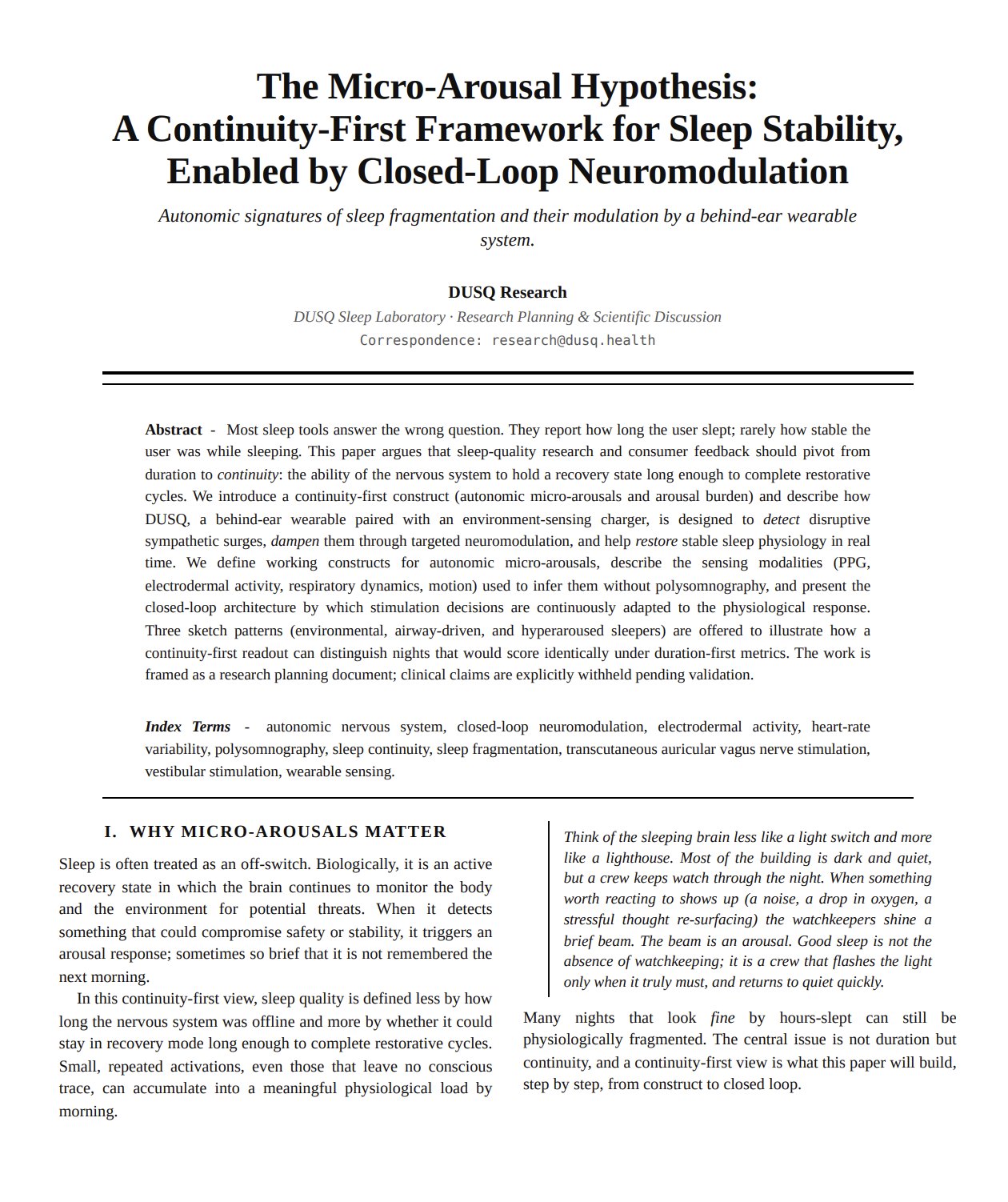
Interesting if it works.
Currently sold out.
I asked Claude Opus 5 Extra:
How likely is this product to work? https://dusq.com/products/trackers-track-dusq-repairs
Short version: the evening/pre-bed half of this is plausible and partially borrowed from something that actually has a sham-controlled trial. The overnight closed-loop half — the part the marketing sells hardest — is unproven, rests on a sensing claim that contradicts the EDA literature, and has a low base rate of success. I’d put maybe 10–15% on “measurably improves PSG sleep architecture vs. sham in an independent trial,” and 40–60% on “user feels better and credits the device,” which are very different questions.
Factual problems on their science page
The FDA claim is borrowed. Their vestibular section says “FDA cleared — 95% of participants experienced improved sleep within four weeks.” That is not DUSQ’s clearance. It’s Neurovalens’ Modius Sleep, which got 510(k) clearance on October 27, 2023 for insomnia, based on a 149-subject sham-controlled trial in people with ISI ≥ 15 using it 30 minutes daily for four weeks. That device is a prescription headset worn for 30 minutes each evening, delivering current through pads behind the ears. A 510(k) clearance covers one device, one design, one indication, one dose — it is not a license for “the modality.” DUSQ’s own coverage confirms it: the company holds CDSCO certification in India and “uses an FDA-cleared stimulation modality,” with one completed trial and one underway — i.e., DUSQ itself is not FDA-cleared. Same pattern as Pulsetto, which independent reviewers criticized for using imagery from unrelated studies in its marketing.
FDA Clears Neurovalens’s Modius Sleep for Insomnia Treatment | Knobbe Martens +4
“Signal quality is highest here” is backwards. EDA amplitude tracks eccrine sweat gland density. Palmar and finger sites remain the gold standard precisely because of high eccrine density; alternative wearable sites generally produce lower-amplitude signals and reduced sensitivity. The mastoid is a low-density site. It may still be workable, but the specific claim that it’s the best site is the load-bearing premise of the whole product and it’s the one most at odds with the literature.
IOPscience
Worse: EDA in slow-wave sleep is famously non-specific. Skin conductance during N3 produces large spontaneous “SCR storms” that are not arousals at all. Their detector is “a rapid rise in conductance signals an Autonomic Surge.” The single best-documented EDA phenomenon in sleep is exactly the confound that would make that detector fire during the deep sleep it’s supposed to protect.
“20–30 surges a night” doesn’t match how arousals are counted. Arousals are scored per hour, and as few as five per hour can produce chronic sleepiness while severe cases reach 100 or more. Healthy adults typically run roughly 10–20/hour — 70–140 per night. So “Autonomic Surge” is either a proprietary construct they defined themselves (undefined and unvalidated) or a marketing-friendly number.
Sleephealth
“No wearable could detect them” is false. An autonomic arousal index from peripheral arterial tonometry was validated against PSG in 2002. WatchPAT has shipped this commercially for two decades.
Oxford Academic
The engineering problem nobody’s marketing addresses
There’s a squeeze: a stimulus salient enough to shift autonomic tone during sleep is plausibly salient enough to cause an arousal. If it’s sub-perceptual, the effect size question gets hard. Closed-loop acoustic stimulation (Dreem, Philips SmartSleep) spent years threading exactly this needle, got real slow-wave-amplitude effects, and still couldn’t demonstrate next-day benefits convincingly. Both products are effectively dead. Somnee, with an actual EEG sensor and a stronger academic pedigree, is still niche.
DUSQ is attempting the harder version: closed-loop control with no EEG ground truth, using the noisier of the two available signals, at a suboptimal site, under an adhesive patch, on a side sleeper.
Secondary concern: undiagnosed OSA is extremely common. Apnea-driven arousals would light up an EDA detector. The device would then stimulate rather than address the airway. They disclaim apnea in the FAQ, which is appropriate, but self-selection won’t catch most undiagnosed cases.
Company/execution risk
$2.65M seed round, first hardware product, Kickstarter-funded, retail was announced at $499 with August 2026 shipping; the page you sent now says $399 and ships October. Trials are in-house at their own lab, unpublished, and I found nothing on ClinicalTrials.gov. “Almost full. Last few spots left.” on a preorder page for a device that doesn’t exist yet is standard scarcity theater. None of this is disqualifying for a seed-stage hardware startup, but $399 prepaid is a loan to a company, not a purchase.
Tracxn
Digital Journal
My probability estimates
Ships functional hardware to US backers by mid-2027: ~70%
Behind-ear EDA detects arousals with clinically useful specificity, no EEG: ~15–25%
Overnight closed-loop stimulation beats sham on objective PSG endpoints in an independent trial: ~10–15%
Evening pre-bed stimulation helps sleep onset (the Modius-adjacent claim): ~40% — this is the defensible part
You subjectively feel better and credit the device: ~40–60%
Still wearing it nightly at 6 months: ~20–30%
That fifth line is doing a lot of work. Putting a device on at 7pm and treating the next four hours as wind-down is itself a real behavioral intervention, independent of whether any current flows. Add placebo response (large in sleep, and largest in the fragmented-sleep complaints this targets), regression to the mean, and an app that scores you — and you get a product that will generate genuinely enthusiastic testimonials whether or not the neuromodulation does anything.
One thing I should check: are you asking as a potential buyer, or evaluating it as an investment/technical bet? The answers diverge — as a $399 consumer purchase the downside is bounded and the wind-down ritual has some value; as a technology thesis the sensing claim is the crux and I think it’s weak.