The Reproductive Clock: Late Childbearing, Not Family Size, Dictates Female Lifespan
The classical evolutionary “disposable soma” theory posits a fundamental biological trade-off: energy dedicated to early reproduction is diverted away from long-term cellular maintenance and longevity. However, a seminal epidemiological study of the Old Order Amish community in Lancaster County, Pennsylvania, challenges this paradigm by demonstrating a positive correlation between family size and lifespan under specific environmental conditions.
By analyzing extensive genealogical records of 2,015 individuals born between 1749 and 1912 who survived to at least age 50, researchers eliminated modern confounding variables like birth control, variable socioeconomic status, and disparate healthcare access. The data revealed that paternal lifespan increased linearly by 0.23 years for every additional child fathered. For mothers, an identical positive linear trend occurred, yielding an extra 0.32 years of life per child up to their 14th offspring. Crucially, an inflection point occurs at ultrahigh parity: women who bore more than 14 children suffered a severe lifespan penalty of 4.01 years for each additional child past that threshold.
Note: “Parity” is defined as the number of times a female has given birth to an infant reaching viable gestational age.
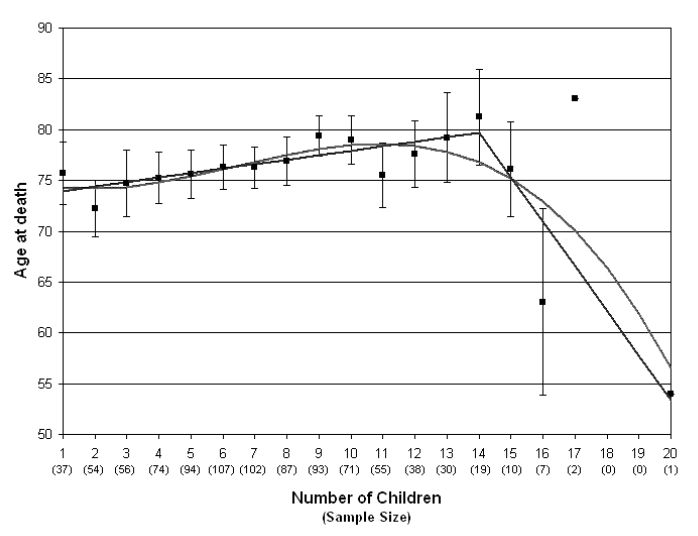
The most profound revelation of the study lies in the divergence of underlying drivers between sexes. In men, the absolute number of children, rather than the timing of births, remains the superior predictor of life extension. In women, however, adjusting the statistical models to account for the “age at last birth” completely eradicated the correlation between parity and longevity for families of fewer than 14 children. This strongly indicates that high parity in women is a secondary byproduct of a prolonged reproductive window. Rather than childbearing itself extending a mother’s life, a late age at last birth serves as a highly accurate proxy for delayed menopause and a fundamentally decelerated rate of systemic biological aging.
Actionable Insights
-
Reproductive Longevity as a Primary Biomarker: For women, a naturally late age at last birth (extending up to age 50) is an exceptional phenotypic marker for superior somatic maintenance and slow aging. Each additional year of continued reproductive capacity correlates to an average increase in lifespan of 0.29 years.
-
The Ultrahigh Parity Threshold: Longevity biohackers and clinicians must recognize the physiological boundary of human reproductive tolerance. While moderate-to-high parity correlates with extended lifespan, ultrahigh parity (greater than 14 children) inflicts a massive metabolic penalty, accelerating mortality by 4.01 years per child. This implies that the biological toll of repeated gestational stress eventually overwhelms innate anti-aging mechanisms.
-
Paternal Social and Biological Buffering: For men, the linear increase of 0.23 years of life per child suggests that the survival benefit is tied either to robust baseline vitality or to the compounding expansion of intergenerational social support networks in old age.
Source:
- Open Access Paper: Does having children extend life span? A genealogical study of parity and longevity in the Amish, Published 2006 Feb
- Institutions: Department of Epidemiology and Preventive Medicine, University of Maryland School of Medicine, Baltimore, Maryland, USA; National Institutes of Health (NIH), Bethesda, Maryland, USA.
-
Journal Name: Journal of Gerontology: MEDICAL SCIENCES.
Impact Evaluation: The impact score of this journal is approximately 5.5, evaluated against a typical high-end range of 0–60+ for top general science, therefore this is a Medium impact journal. It is highly respected and specific to the field of biogerontology and age-related medicine.