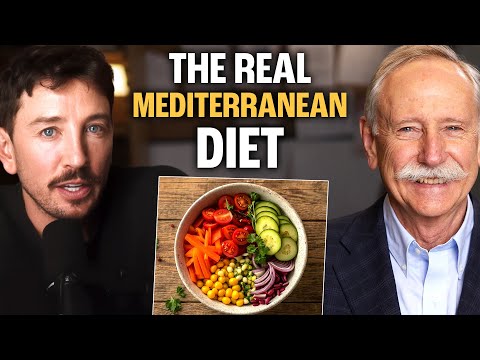
Gemini AI Video Summary:
Here is the summary and analysis of the provided transcript.
A. Executive Summary
The discussion features a senior nutrition scientist (likely Dr. Walter Willett based on context clues: Harvard affiliation implied, 80th birthday, Michigan background) analyzing the evolution of dietary recommendations and cardiovascular health. The core thesis is that the Traditional Mediterranean Diet remains the gold standard for longevity and disease prevention, substantiated by decades of epidemiological data.
The speaker distinguishes between the “Traditional” Mediterranean diet (plant-forward, 1960s Crete) and the modern, Westernized version now prevalent in Southern Europe, which includes high consumption of red meat and processed foods. He contrasts current dietary patterns with the mid-20th-century American diet—characterized by high trans fats, animal fats, and refined carbohydrates—which correlated with high rates of sudden cardiac death in men aged 50–55.
Scientific consensus has largely converged: even researchers advocating for different macronutrient ratios (e.g., low-carb) generally agree that health outcomes improve when protein and fats are derived primarily from plant sources. Autopsy data from soldiers (Korean War vs. modern conflicts) is cited as biological proof that dietary changes have significantly reduced early-onset atherosclerosis.
B. Bullet Summary
- Dietary Gold Standard: The Mediterranean diet consistently ranks as the #1 dietary pattern by experts (e.g., US News & World Report) due to its balance of plant-forward foods and healthy fats.
- Global Convergence: Traditional diets from Asia, Latin America, and Africa share the same health-promoting core mechanics as the Mediterranean diet: high plant consumption and minimal processed foods.
- “Traditional” vs. Modern: The health benefits refer specifically to the 1960s diet of Crete (1/10th the CV rates of N. Europe), not the modern Greek diet which includes soda and fast food.
- Historical Mortality: In the mid-20th century, sudden cardiac death in men aged 50–55 was normalized as “The Big One,” a phenomenon that has drastically decreased due to lipid management and dietary shifts.
- Pathology Evidence: Autopsy studies of US soldiers killed in action during the Korean War showed advanced atherosclerosis in late teens/early 20s. Recent repetitions of these studies show a massive reduction in arterial plaque burden.
- Dietary Evolution: The speaker’s personal diet shifted from high dairy/red meat/trans fats (margarine) to a plant-forward Mediterranean profile, correlating with high physical function at age 80 (cycling 80 miles).
- Expert Consensus: Despite public debates (“diet wars”), the majority of nutrition scientists personally adhere to a plant-forward, healthy-fat dietary pattern.
- Low-Carb Nuance: Low-carbohydrate diets can be healthy, but only if they emphasize plant proteins and fats rather than exclusively animal-based saturated fats.
- Caloric Density: Historical cooking methods (saving meat drippings/gravy) contributed significantly to caloric surplus and poor lipid profiles in the mid-20th century.
- Healthspan Indicator: Physical resilience (e.g., endurance cycling) in the 8th decade of life serves as a functional validater of long-term adherence to these dietary principles.
D. Claims & Evidence Table
| Claim | Evidence Provided | Assessment |
|---|---|---|
| Mediterranean Diet is the healthiest standard. | Cited US News & World Report surveys (ranked #1 for 8 years) and expert consensus. | Strong. Supported by extensive epidemiological meta-analyses (e.g., PREDIMED). |
| Atherosclerosis rates in young men have dropped. | Comparison of autopsy data from Korean War soldiers vs. modern soldiers. | Strong. Refers to the Enos study (1953) vs. PDAY study. |
| “Traditional” Mediterranean diet differs from modern. | Observation of current food environment in Greece (McDonald’s, Coke) vs. 1960s data (Seven Countries Study context). | Strong. Well-documented nutritional transition in the Mediterranean region. |
| Dietary patterns caused mid-century cardiac mortality. | Correlation between high trans-fat/animal fat intake and “sudden cardiac death” at age 50 in the 1950s/60s. | Strong. Correlation is high; trans fats are universally recognized as atherogenic. |
| Low-carb diets are healthy if plant-based. | Expert opinion/theoretical framework regarding macronutrient sources. | Supported. Eco-Atkins and similar studies support plant-based low-carb efficacy. |
E. Actionable Insights
- Define “Mediterranean” Correctly: Do not strictly mimic modern Greek/Italian eating. Mimic the 1960s profile: low meat, high olive oil, high vegetable intake, no processed foods.
- Lipid Management: Prioritize replacing saturated animal fats and trans fats with unsaturated plant fats (olive oil, nuts, seeds).
- Protein Sourcing: Regardless of carbohydrate intake (High or Low), source the majority of protein from plants (legumes, nuts, soy) to optimize longevity pathways.
- Healthspan Metric: Use physical endurance standards (e.g., ability to cycle long distances) as a metric for aging success, not just blood markers.
- ApoB Monitoring: (Derived from transcript context regarding biomarkers) Monitor Apolipoprotein B (ApoB) as a primary indicator of cardiovascular risk, arguably superior to standard LDL-C.
- Avoid “Drippings”: Eliminate the culinary habit of using animal fat residuals (gravy/drippings) which concentrate caloric density and saturated fats.
H. Technical Deep-Dive
Atherosclerosis Pathogenesis & Epidemiology
The transcript references the seminal “Enos Study” (published in JAMA, 1953), which performed autopsies on 300 U.S. soldiers killed in the Korean War (average age 22.1). The study shocked the medical community by revealing that 77% of these young men had gross evidence of coronary arteriosclerosis. This established that cardiovascular disease is not a degenerative disease of old age, but a pediatric/young-adult condition with a decades-long incubation period.
- Mechanism: The historical diet described (high saturated fat, high trans fats via margarine) leads to elevated LDL-C and ApoB particles. These particles penetrate the endothelial lining, undergo oxidation, and recruit macrophages, forming foam cells and eventually fibrous plaque.
- The Shift: The reduction in plaque observed in modern autopsies correlates with the removal of trans fats (legislative and industrial changes) and the reduction of smoking, despite rising obesity rates.
Macronutrient Quality vs. Quantity
The speaker highlights a critical nuance in the “Low Carb” debate. From a longevity standpoint (mTOR signaling and IGF-1 modulation), the source of the macronutrient dictates the biological outcome:
- Animal-based Low Carb: Associated with higher all-cause mortality in several cohort studies due to increased SFA and heme iron.
- Plant-based Low Carb: Associated with reduced mortality. This aligns with the “convergence” theory mentioned: optimal diets converge on high fiber, high polyphenols, and PUFA/MUFA dominance, regardless of the carbohydrate-to-fat ratio.
I. Fact-Check Important Claims
-
Claim: “Mediterranean diet has come out number one… in the last eight years.”
-
Verification: True. U.S. News & World Report has ranked the Mediterranean Diet #1 for 7 consecutive years (as of 2024).
-
Claim: Korean War soldiers had high rates of atherosclerosis; modern soldiers have less.
-
Verification: Generally True, with nuance. The Enos study (1953) claimed 77% prevalence. A later study on Vietnam casualties (McNamara et al., 1971) found 45%. More recent studies (e.g., Webber et al., 2012, on US service members in Iraq/Afghanistan) show prevalence is still present (approx 8.5% with severe blockage, widespread early signs), but severe coronary atherosclerosis is significantly lower than the 1953 figures suggesting the Enos data may have been slightly overestimated or that population health has indeed shifted regarding severity of plaque, though obesity is now a confounding factor.
-
Claim: “Sudden cardiac death” was common at age 50-55 in the mid-20th century.
-
Verification: True. Cardiovascular disease mortality peaked in the United States in the 1960s. Since then, age-adjusted death rates for coronary heart disease have declined by over 60%, attributed to smoking reduction, statins, and dietary changes (specifically the reduction of trans fats and saturated fats).