chatGPT:
Tidy transcript — cleaned and structured
Introduction — David / BSRA host
Good evening, and welcome. The British Society for Research on Ageing is a charity representing scientists who study the biology of ageing. Its aim is to support research that helps people age as healthily as possible. Public engagement is central to that mission, not a side activity.
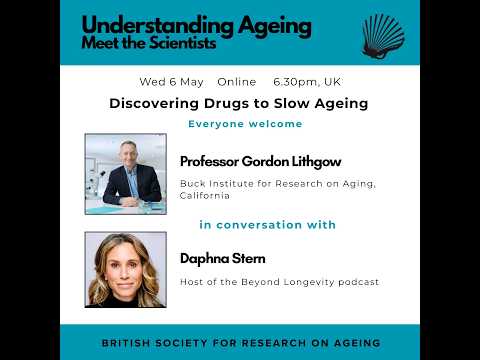
Tonight’s guest is Professor Gordon Lithgow of the Buck Institute in California, one of the leading institutes for ageing research. Gordon has worked in ageing biology for many years and was an early pioneer in using the nematode worm C. elegans to understand ageing and to search for compounds that might slow it.
The discussion will not be a traditional lecture. It will be a conversation, moderated by Daphna Stern, a podcast host who has interviewed many people in the ageing field. Audience questions are encouraged. The speakers note that they are not giving personal medical advice.
Opening — Daphna Stern
Daphna thanks David and says she is looking forward to asking questions, including basic ones, because simple questions are often the most useful.
Gordon Lithgow — background and early-life environment
Gordon begins by showing a photograph of his primary school class in Scotland. The children in the photo are now in their early 60s, an age when chronic disease and the effects of ageing start to become more visible.
He explains that the school was in a rural-looking area but close to the Ravenscraig steelworks, a major industrial complex. As children, they were exposed to the smell of iron from steelmaking. At night, slag would be poured and the sky would light up red. Iron was in the air and soil.
This leads to his first major theme: environmental exposures may not merely be risk factors for disease, but may actually cause or accelerate ageing. He presents a map of Scotland showing higher rates of age-associated disease and death in parts of central Scotland. He acknowledges the obvious explanations: deprivation, healthcare access, diet, smoking, alcohol and other social factors. But he asks whether industrial exposures such as iron might also contribute by accelerating biological ageing.
He introduces the idea of the exposome: the total set of environmental exposures across life, including childhood and possibly parental exposures, that shape health and ageing.
Why use worms to study ageing?
Gordon describes entering ageing research more than 30 years ago, when ageing biology was under-studied. He cites the physicist Leo Szilard’s idea that if several people are already studying something, one should find another important problem.
At that time, ageing was biologically profound but poorly understood. There were few textbooks and relatively few researchers.
He then describes the work of Tom Johnson, who chose the nematode worm C. elegans as a simple model organism for studying ageing. The worm is useful because:
- it is about 1 mm long;
- it is transparent, allowing researchers to see internal changes;
- it ages quickly, with a lifespan of around 20 days;
- large numbers can be studied efficiently;
- its biology is sufficiently conserved to teach us something about more complex animals.
Johnson discovered that mutations in single genes, particularly age-1, could substantially extend lifespan. This was surprising because ageing had been assumed to be too complex to be altered by one gene. That discovery helped launch modern genetic ageing research.
Gordon argues that this was one of the major biological breakthroughs of the late 20th century because it showed that ageing is modifiable.
Ageing as a cause of disease
Gordon then introduces the central geroscience idea: ageing is the main cause or major risk factor behind many age-related diseases, including Alzheimer’s disease, Parkinson’s disease, cancer, cardiovascular disease and diabetes.
Rather than treating each disease as a separate silo, geroscience asks whether intervening in ageing itself could delay or prevent several diseases at once.
He stresses that this is not just about extending lifespan for its own sake. The aim is to preserve health and reduce the burden of chronic disease.
The Buck Institute is presented as an institution built around this idea: studying ageing as a root biological driver of disease.
Science versus pseudoscience in longevity
Gordon says the field has created genuine hope, but that hope is surrounded by a large amount of pseudoscience. Many products and clinics claim to already intervene in ageing, often without adequate evidence.
He distinguishes between:
- serious ageing science, which is rigorous and comparable to other fields of biomedical research; and
- commercial longevity hype, which may exaggerate preliminary findings or sell unproven interventions.
He says even scientists can find it hard to separate credible claims from exaggerated ones.
Compounds that extend lifespan in worms
Gordon explains that his group has studied chemical compounds that mimic some of the effects of age-related genetic interventions. They have identified hundreds of compounds that slow ageing in worms. Some have gone into mouse studies, and some are being discussed for human trials.
He gives the example of Azure B, a blue compound discovered in screening. He then discusses methylene blue, a related compound with a long medical history.
He connects methylene blue to Paul Ehrlich, who developed the concept of the “magic bullet”: a chemical that targets a harmful process while sparing the host. Gordon says methylene blue extends lifespan in worms and may have effects in neurological disease models, but he treats it as one candidate among many, not as a proven anti-ageing treatment.
Question: how much of ageing is set early in life?
Daphna asks how much of ageing trajectory is determined by genes or childhood exposures, and how much remains editable later.
Gordon’s answer is cautious: we do not know yet. He says early-life environmental exposures clearly contribute to later disease, and evidence is emerging that they may influence ageing itself. However, it is not yet known how reversible such effects are.
He returns to biomarkers: to know whether an intervention changes ageing in humans, researchers need measurements that respond over months rather than decades.
He is optimistic that some interventions discovered in laboratory models may translate into humans, but he avoids claiming that early-life damage can simply be reversed.
Question: how do worm discoveries become human treatments?
David asks how promising compounds from worms can be developed into interventions for humans.
Gordon says the challenges are awareness, resources and translation. Basic scientists often publish papers but lack the funding or infrastructure to move discoveries into drug development. Government funding has helped ageing research, especially in the US, but drug development usually requires much larger investment.
He says big pharma’s interest in ageing comes and goes, and biotech investment is difficult because investors often want quicker returns than ageing biology can provide. Companies can help raise capital, but development remains difficult.
Question: does longevity science have a PR problem?
Daphna asks whether longevity science is harmed by being seen as a luxury pursuit: living longer for people who already have enough, rather than preventing disease.
Gordon agrees that the field has an image problem. Hype, wealthy investors and “longevity” branding can make it look like a luxury market. He argues that this is the wrong framing.
His view is that studying ageing may be one of the best ways to prevent or treat diseases such as cancer and Alzheimer’s. Ageing research should therefore be understood as mainstream disease-prevention research, not as a vanity project.
He uses the example of geriatric psychiatric wards to emphasise that preventing dementia and late-life disease is not a luxury.
Question: can we test ageing interventions in humans?
Daphna notes that human lifespan is too long to use death as an endpoint in trials.
Gordon agrees but says human trials can still be done if they use biological endpoints: changes in DNA, proteins, inflammatory markers or other ageing-related biomarkers. He argues that interventions with known safety profiles, such as metabolites or nutritional compounds, could move relatively quickly into human studies.
He also says that moving from worms to mice is not hopeless. In his experience, about half of worm lifespan hits may show some relevant effect in mice, though he notes that some of this is unpublished and that mouse studies are very expensive.
Question: why do age-related diseases occur at different ages?
An audience member asks why, if ageing causes disease, people develop diseases such as diabetes at different ages.
Gordon says the answer is not yet known. Young people generally do not get many age-related diseases, so ageing is clearly a major background factor. But individual variation remains hard to explain.
David adds that ageing may be a stochastic breakdown of complex systems. Even genetically identical worms in the same environment die at different times and show different patterns of decline. In people, different systems may be more vulnerable in different individuals. That could explain why one person develops diabetes, another dementia and another cancer.
Question: can C. elegans test early-life exposures?
An audience member asks whether worms can be exposed only early in life to test whether early exposures affect later ageing.
Gordon says yes, this can be done, although his lab has more often exposed worms throughout life. He says more work is needed on timing: early exposure, late exposure and reversibility. One complication is measuring how much of a compound actually gets into a worm.
Question: can animal models capture positive mental attitude?
An audience question asks how animal models can simulate the human idea of a positive mental attitude in ageing.
Gordon says this points to a limitation of animal research. Laboratory mice live artificial lives: same-sex cages, little exercise, little stimulation. But researchers can study environmental enrichment by adding running wheels, objects and more stimulating environments. Limited evidence suggests enrichment can have positive effects, especially on neurological ageing measures.
Question: what are the biggest obstacles to ageing research?
Daphna asks what most hinders progress, apart from money.
Gordon says longevity clinics may not help the broader scientific picture. He does not necessarily criticise the motives of doctors running them, but says they often collect data without rigorous study design or publication.
He identifies several broader obstacles:
- better animal models are needed, especially for diseases such as Alzheimer’s;
- ageing researchers and disease specialists need to work together more;
- scientists need to leave their silos;
- ageing needs to be studied explicitly as a causal factor in chronic disease.
He calls this “joining the dots.”
Question: telomeres and ageing
An audience member asks how important telomere shortening is in ageing, and Daphna adds a question about epitalon and claims around telomere extension.
Gordon says telomeres generated enormous excitement in the late 1990s and 2000s. His view is that telomere length is not necessarily a general measure of ageing, but it can be a useful measure of health status and stress. Telomeres are part of the broader issue of DNA integrity, which may sit high in the hierarchy of ageing mechanisms.
However, he says he is not aware of successful ageing therapies based on preserving telomere length.
Question: do ageing biomarkers capture biological ageing?
An audience member asks whether biomarkers, including epigenetic clocks and inflammatory markers, really capture biological ageing.
Gordon says they probably do capture something real, but not all of ageing. A DNA methylation clock may work well in one tissue but not another, or in one species but not another. There is no single perfect biomarker that captures ageing across all tissues and systems.
He says biomarkers matter because clinical trials need endpoints that can detect whether an intervention has an effect in months rather than decades.
Question: should consumers use biological age tests?
Daphna asks whether it is helpful that people can now buy biological age tests.
Gordon says there is some truth behind these tests, but they are often wrapped in hype. He is especially cautious about claims that a single test can prove that a supplement or lifestyle change has altered all of ageing.
For example, correcting vitamin D deficiency may be medically sensible, but claiming that a methylation test proves vitamin D has reversed ageing would go too far.
Final question: what interventions are most hopeful?
Daphna asks Gordon to name treatments or interventions that excite him.
He first gives a cautious answer: compounds with existing safety data, such as natural products, nutrients and metabolites, may reach trials sooner than entirely new drugs. He mentions vitamin D as an example of something with evidence in animal models and a strong safety profile when used appropriately.
Pressed further, he names:
- methylene blue, because it has a long history as a drug and could move relatively quickly into trials, though he stresses it is not risk-free;
- ketone bodies or ketone metabolites;
- vitamin D, especially avoiding deficiency;
- possible cocktails of such interventions.
He repeatedly stresses that he is not giving medical advice.
He ends by raising an ethical question: should health systems intervene in currently healthy people to prevent future disease by slowing ageing? He thinks this should be pursued, but recognises it is a major ethical and policy question.
Closing — David
David thanks Gordon and Daphna. He says the discussion illustrates why the BSRA engages with the public: ageing research raises scientific, medical, ethical and political questions. More public understanding is needed to create the will and resources for serious trials.
Summary
The video is a public-facing BSRA discussion with Professor Gordon Lithgow, hosted by Daphna Stern and introduced by David Gems. Its central message is that ageing biology has moved from a speculative field to a rigorous science showing that ageing can be modified in laboratory organisms. Lithgow uses his own childhood near the Ravenscraig steelworks to introduce the idea that environmental exposures, such as iron, may influence ageing itself rather than merely causing isolated diseases.
The discussion explains why C. elegans became a powerful model for ageing research: it is simple, transparent, short-lived and genetically tractable. Tom Johnson’s discovery that single-gene mutations such as age-1 could extend worm lifespan is presented as a turning point because it showed that ageing is biologically regulable.
The main scientific framework is geroscience: the idea that ageing is a root driver of many chronic diseases. Instead of treating Alzheimer’s, cancer, diabetes and cardiovascular disease as wholly separate problems, geroscience asks whether targeting ageing mechanisms could delay several of them together.
The conversation is also strongly concerned with hype. Lithgow repeatedly distinguishes serious ageing science from commercial longevity claims, biological age tests, longevity clinics and supplement marketing. He is optimistic, but deliberately cautious.
The most concrete possible interventions discussed are methylene blue, ketone metabolites, vitamin D, and combinations of relatively safe compounds. However, Lithgow emphasises that none should be treated as proven human anti-ageing therapies.
Main claims made in the video
| Claim | Assessment |
|---|---|
| Ageing is modifiable in laboratory organisms | Strongly supported in general; lifespan extension in worms, flies and mice is well established. |
| C. elegans is useful for ageing research | Strong; it is one of the foundational ageing models. |
| Ageing is a major cause of age-related disease | Plausible and central to geroscience, but “cause” needs careful wording because diseases also have specific mechanisms. |
| Environmental exposures may accelerate ageing | Plausible and important, but the specific iron example needs more direct human evidence. |
| Worm discoveries can translate to mammals | Sometimes true, but the claimed ~50% translation rate needs published context and may reflect selection bias. |
| Longevity science is surrounded by pseudoscience | Strong and well argued. |
| Biomarkers are useful but incomplete | Balanced and credible. |
| Methylene blue and vitamin D are hopeful candidates | Reasonable as research hypotheses, but not proven human anti-ageing treatments. |
Critique
Strengths
The strongest feature of the video is its clear framing of ageing as a biological process rather than an inevitable black box. Lithgow explains well why the discovery of lifespan-extending mutations in worms changed the field. That historical explanation is useful because it shows how ageing biology became experimentally tractable.
The video is also good at separating healthspan research from fantasies of immortality. Lithgow repeatedly returns to the practical aim: reducing dementia, cancer, frailty and late-life disease. That makes the field seem medically serious rather than indulgent.
Another strength is the repeated warning about pseudoscience. The discussion does not simply promote longevity science; it also criticises biological-age marketing, overconfident supplement claims and private longevity clinics that collect data without necessarily producing rigorous evidence.
The sections on biomarkers are particularly balanced. Lithgow does not dismiss epigenetic clocks or inflammatory markers, but he correctly treats them as partial measures of ageing biology rather than definitive “age meters.”
The discussion also does well in acknowledging uncertainty. “We don’t know yet” is used repeatedly, which is appropriate for a field where animal evidence is far ahead of human intervention evidence.
Weaknesses and overstatements
The most important weakness is the phrase “iron causes ageing.” As a provocative research idea, it is interesting. But as a public-facing statement, it risks overstating the evidence. Iron can contribute to oxidative stress, ferroptosis and tissue damage, and industrial exposure may plausibly affect health. But showing that childhood iron exposure specifically accelerates human biological ageing would require much more: exposure measurement, confounder control, biomarkers, longitudinal follow-up and disease outcomes.
Similarly, the statement that ageing is the single cause of many diseases is rhetorically powerful but too simple. Ageing is a dominant risk factor for many diseases, and may be upstream of several mechanisms, but cancer, Alzheimer’s, diabetes and cardiovascular disease also have disease-specific causes. A more precise formulation would be: ageing is a major causal background condition that increases vulnerability to multiple diseases.
The discussion of genes contributing less than 10% to lifespan is also compressed. Heritability estimates depend on whether one is discussing ordinary lifespan, exceptional longevity, specific populations, family structure, shared environment and statistical method. The general point — environment matters greatly — is sound, but the number should be treated cautiously.
The claim that about 50% of worm hits translate to mammals is intriguing but not fully substantiated in the discussion. Lithgow notes that some of this is unpublished. That makes it weaker as a public claim. It may also be affected by selection bias: only the most promising worm hits are likely to be tested in mice.
The section on vitamin D is sensible when framed as avoiding deficiency, but “vitamin D slows ageing” is too strong for humans. Vitamin D deficiency should be corrected, but that is different from proving vitamin D is a general anti-ageing intervention in non-deficient people.
The comments on methylene blue are appropriately cautious, but the video could have emphasised more clearly that it has dose-dependent risks and drug-interaction concerns. Its long medical history does not automatically make it safe as a chronic longevity intervention.
Scientific gaps
The video repeatedly says that biomarkers are needed, but does not deeply address the problem that a biomarker can change without the organism actually becoming healthier or longer-lived. This is a major issue in human geroscience: a biomarker must be not only age-associated, but intervention-responsive and clinically meaningful.
The discussion also does not distinguish enough between:
- lifespan extension;
- compression of morbidity;
- improved late-life function;
- delayed disease onset;
- reversal of existing damage;
- slowed biological ageing.
These are related but not identical. A compound that extends worm lifespan does not necessarily preserve human cognition, prevent frailty or reduce cancer risk.
There is also limited discussion of negative or failed translation. Many interventions that look promising in simple organisms do not become useful human therapies. The video’s optimism is reasonable, but a stronger critique would include why translation fails: dosing, metabolism, toxicity, model mismatch, publication bias and endpoint selection.
Communication critique
As a public engagement event, the video works well because it is conversational and accessible. Daphna’s basic questions help make the science less intimidating. Lithgow is engaging, modest and careful. David’s contributions help ground the discussion in broader ageing biology.
However, the structure is loose. The talk moves from childhood exposure, to worms, to geroscience, to pseudoscience, to methylene blue, to biomarkers, to ethics. That makes it lively but sometimes unfocused. A viewer unfamiliar with the field might have benefited from a clearer roadmap:
- What is ageing biology?
- Why worms?
- What has been proven?
- What might translate to humans?
- What should the public be sceptical of?
- What trials are needed next?
The video is also somewhat short on concrete evidence. It contains many interesting claims, but few named studies, effect sizes or examples of successful and failed interventions. For an expert audience that may be fine; for a public audience, a few anchored examples would make the argument more persuasive.
Overall judgement
This is a thoughtful and credible public discussion of geroscience. Its main value is not in presenting new data, but in explaining the logic of the field: ageing is experimentally modifiable, ageing contributes to multiple diseases, and serious science must be separated from commercial longevity hype.
The strongest scientific message is that ageing research should be treated as disease-prevention research, not as a luxury quest for life extension. The weakest parts are the more compressed causal claims, especially around iron exposure, “single cause” language, and specific candidate interventions.
A fair one-sentence assessment would be:
The video is an engaging and scientifically serious defence of geroscience, strongest when explaining why ageing matters as a disease driver, but it occasionally uses broader causal language than the current human evidence can fully support.