This is a really interesting preprint. I will be writing a blog post about this which I will link to in a later reply on this topic.
chatGPT(5.6max):
Paper assessment
Title: Declines in mRNA synthesis set the rate of organismal aging
Status: bioRxiv version 2 preprint, posted August 13, 2026. It has not yet undergone peer review. The v2 record notes revisions to Figures 1 and 4 and the supplement. (bioRxiv)
Overall assessment
This is a strong and conceptually original C. elegans study. It provides persuasive evidence that:
- Total cellular mRNA declines substantially with age.
- Somatic RNA polymerase II abundance declines in parallel.
- Experimentally accelerating polymerase II loss lowers mRNA and shortens lifespan.
- Long-lived insulin-signaling interventions preserve polymerase II and mRNA.
The paper therefore establishes polymerase II abundance as a plausible limiting component of transcriptional aging.
However, its strongest claim is not fully demonstrated. The experiments show that artificial polymerase II depletion is sufficient to accelerate aging, but they do not show that natural polymerase II loss is necessary for normal aging or that it independently sets the aging rate. The title is somewhat stronger than the evidence.
Summary
Central question
The authors ask why total mRNA production declines during aging and whether that decline is simply a consequence of aging or a causal determinant of lifespan.
They focus on RPB-2, an essential subunit of RNA polymerase II, and propose that young adult worms contain a developmental surplus of polymerase II. During adulthood, reduced synthesis and continued degradation allow that surplus to disappear, progressively limiting mRNA production and accelerating aging.
Main findings
-
Total mRNA declines strongly with age
Absolute RNA measurements indicate that young adult worms contain roughly 700 million mRNA molecules. Total mRNA falls approximately two-fold by day 9 and much further by day 21.
This decline is largely hidden by conventional RNA-seq normalization because relative normalization assumes that total RNA abundance is approximately constant.
-
The decline is broadly distributed
The decrease is not restricted to a small group of genes. Most transcripts decline in absolute abundance.
The authors report similar behavior after germline ablation and after accounting for body size. Native long-read RNA sequencing provides an orthogonal confirmation.
-
Related declines appear in published mammalian data
Reanalysis of mouse single-cell data suggests that mRNA abundance falls with age in many cell and tissue types. The largest reported decreases occur in the aorta and parts of the brain.
This supports potential conservation, although the mammalian evidence is observational and based on secondary analysis.
-
The rate of mRNA loss correlates with lifespan
Across 13 worm conditions, the rate of mRNA decline is strongly associated with lifespan, with a reported correlation of about -0.96. Conditions with slower mRNA loss tend to live longer.
-
RNA polymerase II abundance declines in somatic cells
An endogenous fluorescent RPB-2 reporter shows an age-dependent decline in somatic tissues. The germline is relatively protected, and different tissues decline at different rates.
-
The ubiquitin-proteasome system contributes to polymerase loss
RNA interference against the ubiquitin-activating enzyme UBA-1 or proteasome components reduces the decline in RPB-2. Autophagy-related interventions do not produce the same result.
-
Manipulating insulin signaling changes polymerase abundance
Reduced DAF-2 insulin-like signaling preserves or increases RPB-2 abundance and slows the loss of mRNA. Graded DAF-2 depletion produces graded effects.
-
Polymerase synthesis and degradation both change with age
Dendra2 photoconversion is used to estimate RPB-2 degradation, while fluorescence recovery after photobleaching is used to estimate synthesis.
Both synthesis and degradation slow during adulthood. From these measurements, the authors infer that young worms begin adulthood with approximately four times more polymerase II than the level predicted by adult synthesis and degradation rates.
-
A simple kinetic model predicts later polymerase levels
Early measurements of synthesis, degradation, and abundance are used to predict the later population distribution of RPB-2. The reported agreement supports the idea that adult polymerase decline is a passive relaxation from a developmental surplus.
-
Artificial polymerase depletion accelerates aging
An auxin-inducible degradation system lowers RPB-2 in a dose-dependent manner. This reduces total mRNA, lifespan, and healthspan.
Even transient depletion early in adulthood has effects that persist across much of the remaining lifespan. Lifelong depletion compresses survival and hazard curves in a manner consistent with faster aging.
-
Polymerase depletion partly resembles natural transcriptomic aging
Gene-expression changes after RPB-2 depletion correlate with changes observed during normal aging. However, the reported Spearman correlation is approximately 0.52, so the resemblance is meaningful but only moderate.
What is genuinely novel
1. Absolute measurement of transcriptome size during aging
Prior aging transcriptomics has usually compared the relative proportions of transcripts. This study emphasizes that relative normalization can miss a global decrease affecting nearly every gene.
The demonstration of a large reduction in absolute mRNA abundance is therefore an important methodological and biological contribution.
2. The developmental surplus model
The most original idea is that adulthood begins with excess transcriptional machinery produced during development.
According to the model, aging is not initially a drift away from an adult equilibrium. Instead, adult organisms slowly approach a lower-capacity state because polymerase II synthesis is insufficient to maintain the youthful surplus.
This reframes at least one component of aging as the loss of inherited developmental reserve.
3. Linking polymerase kinetics to organismal lifespan
The study combines:
- Endogenous polymerase tagging
- Measurements of synthesis and degradation
- Absolute mRNA quantification
- Tunable protein depletion
- Lifespan and healthspan measurements
- A quantitative model
That integration is more novel than any single observation.
4. Transient polymerase loss has long-lasting effects
The finding that temporary RPB-2 depletion can produce lifespan-scale consequences is particularly interesting. It suggests that early adult transcriptional capacity may influence the subsequent aging trajectory.
5. Normal-aging proteasomal loss of polymerase II
Polymerase II degradation is already known in contexts such as DNA damage and stalled transcription. Proposing that regulated proteasomal removal contributes to ordinary organismal aging is a potentially novel extension.
The responsible recognition mechanism, however, remains unidentified.
Major strengths
- Absolute RNA normalization addresses a major weakness of conventional RNA-seq.
- The authors use multiple independent RNA-measurement methods.
- Germline and body-size controls address important compositional explanations.
- RPB-2 is tagged at its endogenous locus rather than overexpressed.
- The degron system provides dose and timing control.
- Molecular changes are connected to lifespan, movement, and hazard dynamics.
- The model makes quantitative predictions rather than remaining purely descriptive.
- Tissue-specific differences prevent the model from being merely a whole-animal averaging argument.
Critique
1. Sufficiency is shown more clearly than necessity
Artificially reducing an essential polymerase subunit predictably lowers transcription and organismal fitness. This demonstrates that polymerase II loss is sufficient to shorten lifespan.
It does not establish that spontaneous RPB-2 loss is the endogenous event that determines normal aging.
The most important missing experiment is a polymerase-specific rescue, such as:
- Preventing endogenous RPB-2 degradation without broadly inhibiting the proteasome
- Expressing a degradation-resistant but functional RPB-2
- Restoring RPB-2 in midlife
- Testing whether preserved RPB-2 maintains mRNA and extends lifespan
Without such an experiment, polymerase decline could still be an important downstream consequence of another aging process.
2. Polymerase abundance is not the same as transcriptional flux
The fluorescent reporter measures nuclear RPB-2 abundance. It does not directly measure the number of actively elongating polymerases or the rate of nascent RNA synthesis.
Total mRNA abundance is jointly determined by:
- Transcription initiation
- Elongation
- RNA processing
- RNA degradation
- Cell size and physiological state
Direct nascent-transcription measurements and mRNA half-life measurements would be needed to establish that reduced mRNA is primarily caused by lower synthesis rather than altered RNA stability.
3. The kinetic model relies on strong assumptions
The model treats RPB-2 as a relatively homogeneous pool with simple synthesis and first-order degradation.
Possible complications include:
- Free versus assembled polymerase
- Nuclear import and export
- Tissue-specific turnover
- Polymerase sequestration
- Feedback regulation
- Fluorescent-protein maturation
- Changes in cellular volume
- Age-dependent changes in the measured rate constants
The inferred equilibrium level is a model-derived quantity, not an independently observed biological set point. Calling it a steady state is more defensible than implying a thermodynamic equilibrium.
4. The synthesis and degradation measurements need orthogonal validation
Fluorescence recovery after photobleaching can reflect movement of unbleached protein as well as new synthesis. Dendra2 signal loss can be influenced by redistribution and photophysical effects in addition to degradation.
The experiments are suggestive, but quantitative proteomic pulse-labeling or another independent turnover method would make the four-fold surplus estimate substantially more secure.
5. The endogenous degradation pathway remains unresolved
Broad interference with UBA-1 or proteasome components affects thousands of proteins and many aspects of aging. These interventions do not demonstrate that RPB-2 is selectively targeted during normal aging.
The study does not identify:
- An RPB-2-specific E3 ubiquitin ligase
- The relevant ubiquitination sites
- Increased endogenous RPB-2 ubiquitination with age
- The signal that marks RPB-2 for degradation
The auxin degron shows what happens when RPB-2 is forcibly degraded, but that synthetic pathway is not evidence for the identity of the natural pathway.
6. The lifespan correlation is not based on 13 independent mechanisms
Many of the 13 conditions come from related DAF-2 dose manipulations, temperature conditions, and DAF-16 backgrounds. They should not be interpreted as 13 fully independent biological tests.
Insulin signaling and temperature can jointly alter metabolism, developmental timing, transcription, and lifespan. Consequently, both mRNA decline and lifespan could be responding to a shared upstream variable. The high correlation alone does not establish that one causes the other. The public analysis code confirms the clustered composition of these conditions. (GitHub)
7. The transcriptomic phenocopy is incomplete
The correlation between natural aging and RPB-2 depletion is approximately 0.52. That supports overlap but leaves considerable variation unexplained.
Moreover, a broad reduction in transcription could generate a positive correlation with almost any condition involving global mRNA loss. More specific enrichment and mediation analyses are needed before concluding that polymerase loss recreates the molecular program of aging.
8. Protein production is assumed rather than measured
The paper motivates mRNA abundance as a ceiling on protein production, but it does not directly measure:
- Translation rates
- Ribosome occupancy
- Protein abundance
- Protein turnover
- Whether specific functional proteins actually become limiting
Cells might partially compensate through increased translation efficiency or protein stability. The connection from polymerase to mRNA is much better supported than the connection from mRNA to proteome failure.
9. The mammalian evidence is preliminary
The mouse analysis supports the possibility that mRNA decline is conserved, but it does not establish that mammalian aging is controlled by polymerase II loss.
There are no corresponding mouse measurements of:
- Polymerase II abundance
- Polymerase synthesis or degradation
- Polymerase ubiquitination
- Causal effects of polymerase preservation
Cell pooling and subsampling also require careful animal-level statistical treatment so that individual cells are not mistaken for independent biological replicates.
10. Persistence does not necessarily imply an irreversible ratchet
A transient polymerase deficit could recover extremely slowly under the authors’ own low-turnover model. If the recovery time exceeds the worm’s remaining lifespan, an effect will appear permanent even when no irreversible molecular memory exists.
Distinguishing these possibilities requires measurements of recovery kinetics and of whether the intervention permanently changes synthesis, degradation, or the proposed steady state.
11. Reproducibility could be improved
The public code is valuable, but the repository currently contains a single early commit, several notebooks depend on hard-coded internal paths, and some workflows rely on data not packaged with the notebooks. The current bioRxiv record also says that v2 figures and supplementary material were revised, while the public repository does not clearly provide a corresponding v2 release. (bioRxiv)
The uploaded 14-page PDF is the main manuscript and refers to separate supplementary information. Some methodological concerns may be addressed there, but the main causal limitations would remain.
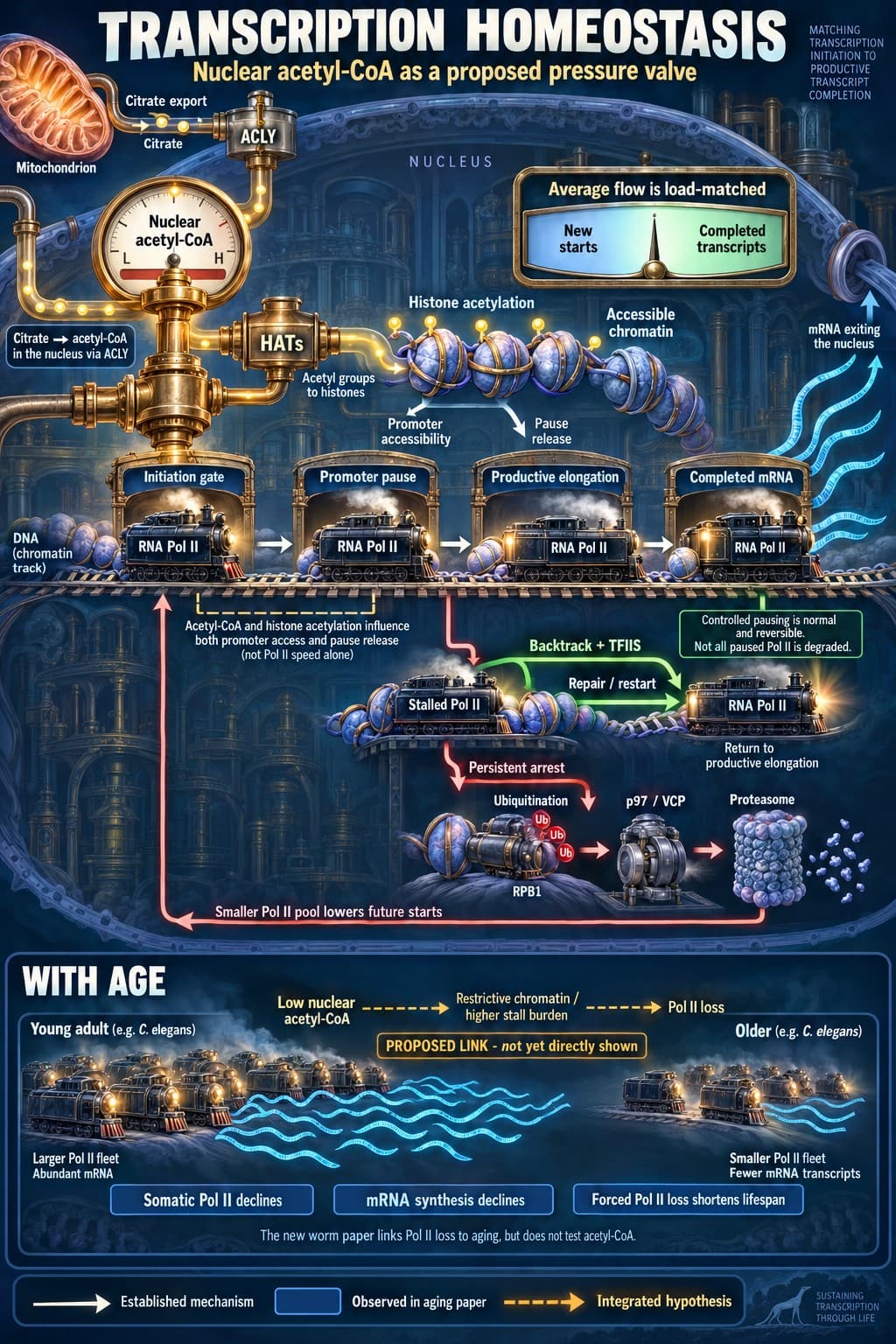
Relevance to the acetyl-CoA and chromatin hypothesis
The paper is compatible with a model in which metabolic or chromatin deterioration acts upstream of polymerase II loss, but it does not test that model.
It does not measure:
- Mitochondrial membrane potential
- Citrate export
- Nuclear acetyl-CoA
- ACLY or ACSS2 activity
- Histone acetylation
- Polymerase stalling
- Whether acetyl-CoA shortage promotes RPB-2 ubiquitination
Its most relevant contribution is to add polymerase II abundance as a possible intermediate step:
Metabolic or chromatin disruption → polymerase dysfunction or degradation → reduced transcriptional capacity → lower mRNA → functional decline
A decisive follow-up would manipulate nuclear acetyl-CoA while measuring RPB-2 abundance, turnover, ubiquitination, chromatin occupancy, and nascent transcription. Rescue of age-dependent RPB-2 loss by restoring nuclear acetyl-CoA would connect the two models much more directly.
Bottom line
The paper convincingly demonstrates that global mRNA abundance and somatic polymerase II decline with age in C. elegans, and that experimentally accelerating polymerase loss can accelerate multiple aging phenotypes.
Its strongest innovation is the proposal that young adults inherit a developmental surplus of transcriptional machinery that is progressively lost as the organism approaches a lower-capacity adult steady state.
What remains unproven is the central rate-setting claim. The study needs a selective preservation or restoration experiment showing that preventing natural RPB-2 loss delays normal aging. Until then, polymerase II decline should be regarded as a compelling candidate mechanism and amplifier of aging, rather than an established master clock.