What do people think of this substack article? I do know of divorces that have been caused by one spouse’s obsession with exercise (Triathalons) to the exclusion of family activities.
I was chatting with the health journalist Jen Murphy the other day. She spent two decades writing the Wall Street Journal’s What’s Your Workout? column, which covered the exercise habits of high-profile people. Think: presidents, CEOs, and founders of major companies.
Some of these busy people trained hours a day for triathlons and other sports. They skipped meals with friends because the menu didn’t fit their nutrition requirements. They avoided social gatherings that might go too late and impact their sleep.
Jen told me there was often a fascinating tension to those pieces. “I regularly had spouses—or ex spouses—email me to say they wished their partner put as much energy into their relationship and family as they did into their workouts,” she said.
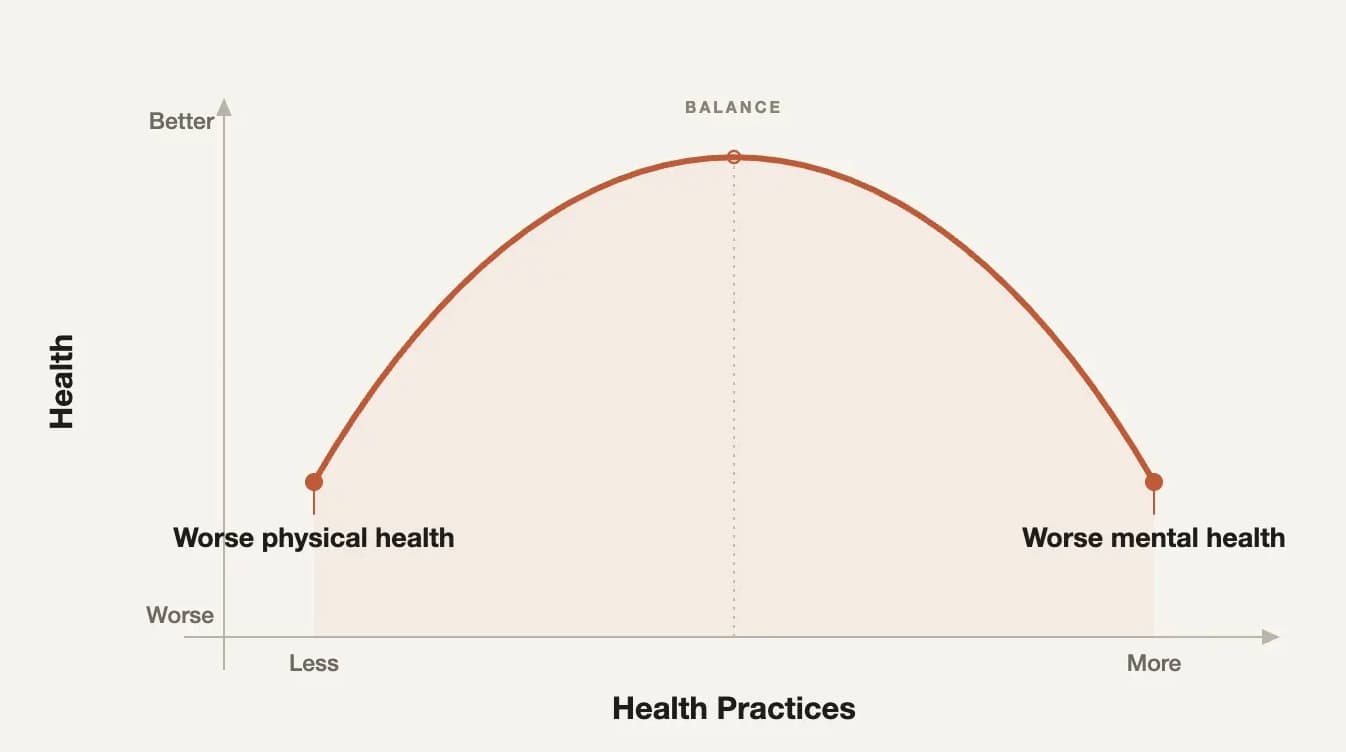
Health practices, pursued beyond a certain point, stop making your life better.
Your body fat percentage, VO2 max, and biomarkers may look perfect on paper. But the damage shows up between your ears. Anxiety rises, relationships suffer, life becomes robotic.
So, a question: How much is enough?
Health practices exist on an inverted U-shaped curve. Too few and physical health suffers. Too many, and life does.
Full article:
1 Like
Common sense? If you are putting in more time to optimize health than getting back time of better health it makes little sense. Of course depends on what you enjoy - life is for living, so QOL matters most. If you love, say, exercise so much you don’t care about less time gained back than put in, bully for you. Relationships are just part of the package - what are your priorities, and have you arranged them correctly?
One issue is choice of partner. It is usually helpful to be on the same page regarding your health priorities. If you do something extreme/unusual (say, CR), you better have your partner on board, or it’ll all go south. If you give up normal life to go live on a mountain and focus 100% on whatever - health, spirituality, meditation whatnot, it’ll have consequences. People have joined monasteries, retreats, special communities etc. since forever. Nothing new. Common sense.
2 Likes
There were several years in my life when I was obsessed with running and tennis, because they provided two things: “runner’s high” and “winner’s high.”
“Runner’s high,” a short-lasting, deeply euphoric state following intense exercise.”
“Winner’s high” refers to the intense rush of euphoria, confidence, and power that a person experiences immediately after achieving a significant victory or success."
“Despite its popularity in fitness circles, a true runner’s high is actually relatively rare. Surveys show that many casual and seasoned athletes never experience it. To even put your body in the position to trigger it, you typically need to sustain a moderate-to-high-intensity aerobic effort for at least 30 to 45 minutes.”
This is true, but some people like me are able to experience it with only about 20 minutes into a jogging run. I think this is true for many aerobic sports. This can easily become an addiction in some people
When we win something, i.e., a tennis match, we get a cocktail of endorphins, dopamine, and serotonin in our system. This can easily become an addiction in some people
My opinion is that people who do triathlons or run or bike excessively are people whose biology produces these effects to a greater extent than it does in most people.
When I was into jogging and tennis, I remember how pissed off I was when something interfered with my jogging or tennis schedules.
I understand these people: They just get more endorphins, etc., than the average Joe gets from these activities.
3 Likes
The article talks about anxiety. May-be also add in compulsiveness. Working out, especially swimming, are the only times that I am not asking myself “why am I doing this,?” “why am I spending my time on this?”. There is peace only in doing the thing you don’t want to be doing but know for sure that it is important to do. And this, more than the potential satisfaction – this whip, not the carrot – is what keeps me going.
1 Like