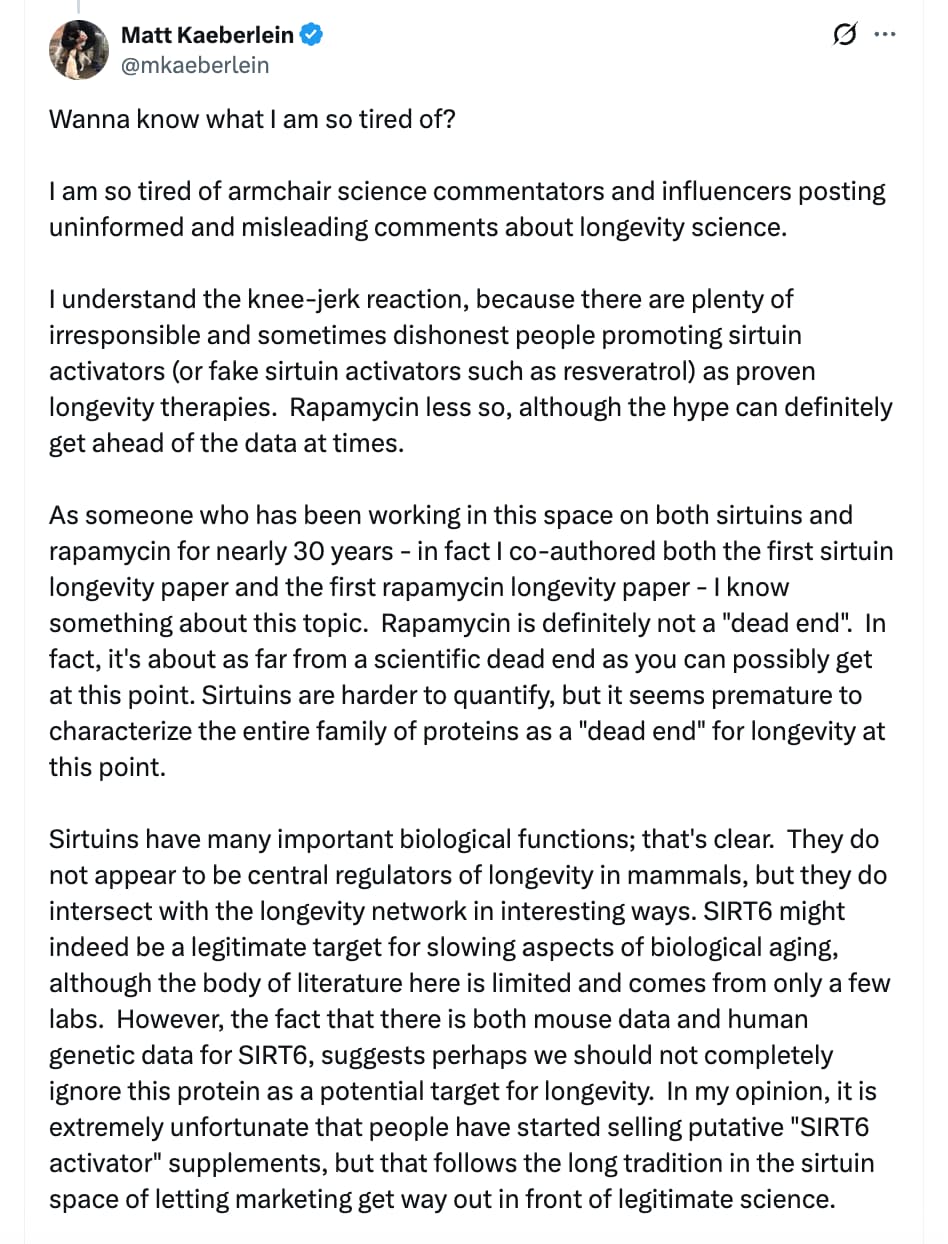
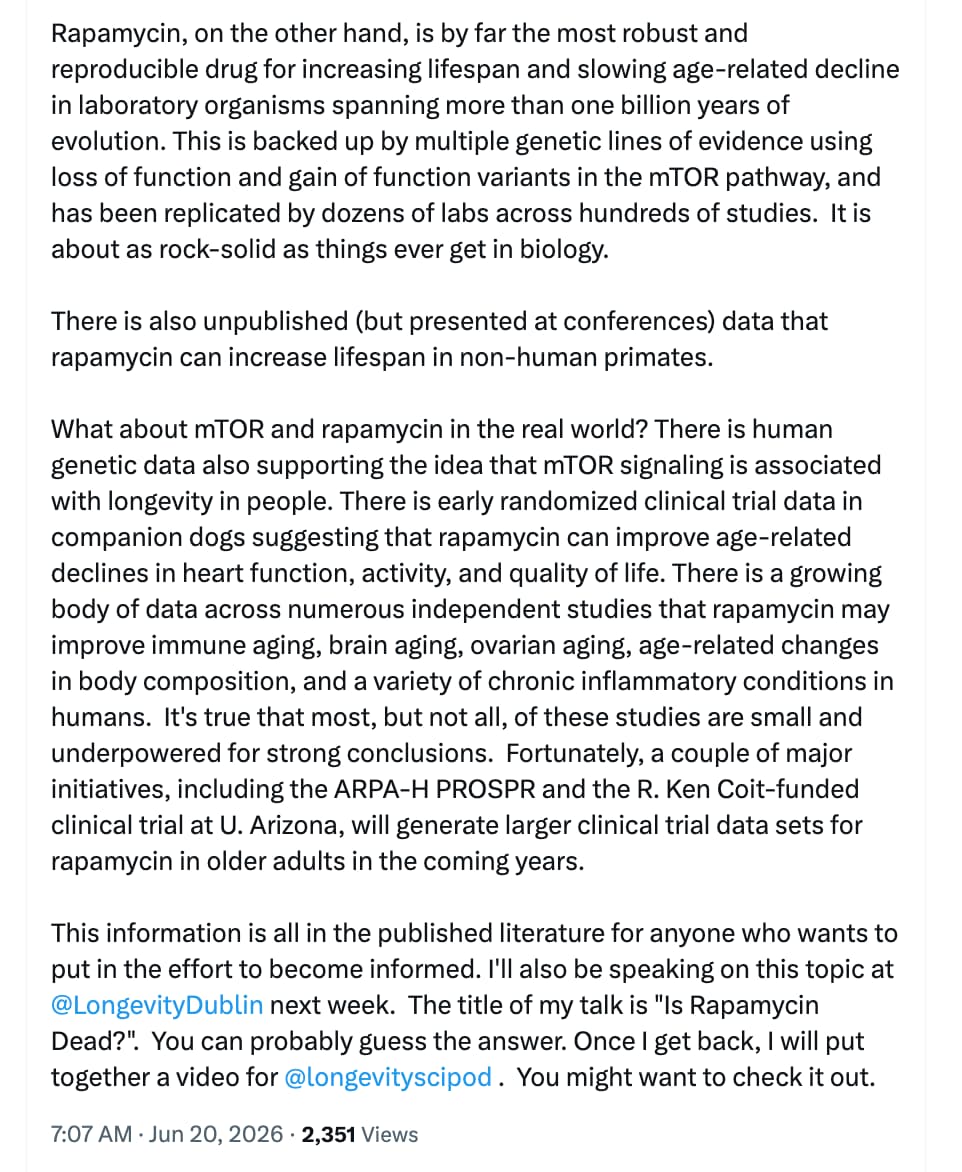
His approach is very basic - which is fine as a starter, but definitely not pushing the boundaries at al:
I. Executive Summary
The analyzed transcript presents a reductionist, aggressively pragmatic framework for human lifespan extension, dismissing esoteric longevity interventions in favor of optimizing canonical cardiometabolic risk factors. The core thesis posits that extreme longevity is primarily a function of minimizing cumulative vascular, metabolic, and toxicological insults over time. The speaker identifies the foundational pillars of healthspan as the strict maintenance of normotension, euglycemia, lean body mass, and the maximal suppression of circulating atherogenic lipoproteins. Rather than relying on unproven anti-aging therapeutics, the protocol emphasizes established standard-of-care interventions (such as statins and implied GLP-1 receptor agonists) to enforce optimal physiological baselines.
A significant portion of the discourse is dedicated to dismantling the historically accepted “J-curve” of alcohol consumption. The speaker accurately reflects a growing consensus in modern epidemiology and toxicology, categorizing ethanol as a systemic toxin devoid of any safe or cardioprotective physiological threshold. This perspective aligns with recent shifts in global public health advisories, including the World Health Organization’s explicit 2023 declaration that no level of alcohol consumption is safe for human health, and recent umbrella reviews debunking the “sick-quitter bias” inherent in older cohort studies.
Furthermore, the speaker’s emphasis on the parameters of “not too low, not too high” for glycemic and hemodynamic control acknowledges the complex biological reality of U-shaped mortality curves in specific physiological parameters (e.g., hypoglycemia-induced sympathetic activation or hypotensive organ hypoperfusion). Conversely, the directive to lower cholesterol “as low as you can get it” reflects the contemporary lipidology consensus that low-density lipoprotein (LDL) and Apolipoprotein B (ApoB) possess no lower physiological limit for toxicity, functioning purely as causal vectors for atherogenesis. The analytical conclusion drawn from this transcript is that actionable longevity is achieved through the rigorous, often pharmacologically assisted eradication of modern mortality drivers: atherosclerosis, metabolic syndrome, and substance-induced cellular toxicity.
II. Insight Bullets
Hemodynamics & Vascular Health
- Systemic hypertension remains the leading modifiable driver of global cardiovascular mortality.
- The transcript correctly identifies that both hypertensive and hypotensive extremes accelerate mortality, necessitating tightly regulated hemodynamic ranges.
- Pulse pressure widening (a marker of arterial stiffness) is a downstream consequence of failing to regulate blood pressure over decades.
- The 2025 AHA/ACC guidelines reflect the transcript’s aggressive stance, moving treatment targets toward <120/80 mmHg to optimize lifespan.
- Chronic elevated hydrostatic pressure directly induces endothelial sheer stress, accelerating atherogenesis.
- Target organ damage (renal failure, left ventricular hypertrophy) is the terminal outcome of unmitigated blood pressure dysregulation.
Metabolic & Glycemic Dynamics 7. Euglycemia is framed not merely as the absence of diabetes, but as the active maintenance of a narrow glucose homeostatic window. 8. Hypoglycemia carries acute mortality risk (arrhythmia, coma) and must be avoided, validating the speaker’s “not too low” caveat. 9. Hyperglycemia drives mortality via the formation of Advanced Glycation End-products (AGEs) and subsequent structural protein cross-linking. 10. Glycemic variability (frequent spikes and crashes) independently predicts microvascular complications even when HbA1c is seemingly controlled. 11. The transcript implies that maintaining extreme insulin sensitivity is a non-negotiable prerequisite for longevity. 12. Continuous Glucose Monitoring (CGM) data increasingly supports the necessity of flattening postprandial glycemic excursions to extend healthspan.
Lipidology & Atherosclerosis 13. The statement “low cholesterol, as low as you can get it” directly aligns with the Mendelian randomization data for LDL-C and ApoB. 14. Plaque buildup is a cumulative function of ApoB particle concentration multiplied by time (area under the curve). 15. Human physiology requires minimal circulating LDL-C; aggressive pharmacological lowering (via statins or PCSK9 inhibitors) does not disrupt cellular lipid requirements. 16. Atherosclerotic Cardiovascular Disease (ASCVD) is entirely preventable if atherogenic lipoproteins are suppressed to neonatal levels. 17. The transcript dispels the myth of “healthy” high cholesterol, treating it strictly as a pathogenic variable. 18. Statin therapy is explicitly endorsed, underscoring a preference for proven pharmacological tools over lifestyle-only dogma.
Adiposity & Body Composition 19. “Do not be fat” translates biologically to the prevention of visceral adipose tissue accumulation. 20. Adipocyte hypertrophy triggers hypoxia, initiating systemic meta-inflammation via macrophage infiltration. 21. Excess adiposity acts as an active endocrine organ, secreting pro-inflammatory cytokines (TNF-alpha, IL-6) that degrade multi-organ function. 22. Lean body mass preservation is implicit in the directive against obesity, as sarcopenic obesity is a primary driver of frailty. 23. The mitigation of adiposity is the most effective upstream intervention to simultaneously resolve blood pressure and glycemic abnormalities.
Toxicology & Lifestyle Factors 24. Alcohol is correctly identified as a Class 1 carcinogen and direct cellular poison (ethanol/acetaldehyde). 25. The historical “J-curve” for alcohol (showing moderate drinking as protective) is severely confounded by “sick-quitter” bias and socio-economic variables. 26. Recent massive cohort datasets confirm a linear dose-response relationship between alcohol consumption and all-cause mortality. 27. The transcript notes a 4% increase in annual mortality risk after a threshold of seven drinks per week. 28. Sleep optimization is cited as a core pillar, critical for glymphatic clearance and autonomic nervous system reset. 29. Smoking cessation is mentioned as an absolute baseline, due to its synergistic acceleration of both atherogenesis and oncogenesis. 30. The overall protocol emphasizes subtractive interventions (removing toxins, reducing lipids, lowering pressure) rather than additive “biohacks.”
III. Adversarial Claims & Evidence Table
| Claim from Video |
Speaker’s Evidence |
Scientific Reality (Current Data) |
Evidence Grade |
Verdict |
Verified Source |
| “Avoid high blood pressure… well regulated… not too low not too high” |
General assertion. |
2025 AHA/ACC Hypertension Guidelines emphasize aggressive risk-based management, confirming <130/80 mmHg as mandatory and <120/80 mmHg as optimal for lifespan extension. Hypotension (U-curve) is also acknowledged in frail populations. |
Level A |
Strong Support |
PMC12995957 |
| “Avoid high blood sugar… not too low not too high” |
General assertion. |
Glycemic variability and prolonged hyperglycemia drive micro/macrovascular damage. Meta-analyses confirm HbA1c and Glycated Albumin are powerful predictors of all-cause and CV mortality. Hypoglycemia increases acute fatal arrhythmia risk. |
Level A |
Strong Support |
MDPI: Paradigm Shifts in Diabetes |
| “Do not be fat… that is bad for you” |
General assertion. |
Global Burden of Disease meta-analyses consistently link elevated BMI and visceral obesity with exponential increases in T2DM, ASCVD, and all-cause mortality, reducing life expectancy by up to 15%. |
Level A |
Strong Support |
ResearchGate: Global Prevalence of T2DM |
| “Have low cholesterol as low as you can get it” |
General assertion. |
Mendelian randomization and massive RCTs (statins, PCSK9i) confirm a log-linear relationship between LDL-C/ApoB lowering and ASCVD risk reduction. There is no known physiological “floor” for LDL-C toxicity in adults. |
Level A |
Strong Support |
MDPI: Oral PCSK9 Inhibitor Meta-Analysis |
| “No evidence of a protective effect of alcohol… universally zero.” |
Cites recent cohort data and HHS/CDC suppression rumors. |
The WHO (2023) declared zero safe levels of alcohol. Recent high-quality reviews adjusting for abstainer bias (e.g., JAMA Netw Open 2023) negate the J-curve for all-cause mortality. Note: NASEM 2025 acknowledged moderate intake associates with lower CV mortality in flawed observational data, but genetic/Mendelian studies show linear risk.
|
Level A |
Strong Support |
JAMA Netw Open (Zhao et al., 2023) |
IV. Actionable Protocol (Prioritized)
High Confidence Tier (Level A/B Evidence)
-
Aggressive Lipid Lowering: Deploy statins, ezetimibe, or PCSK9 inhibitors to drive ApoB to neonatal levels (<40 mg/dL). Plaque regression requires sub-physiological lipid concentrations.
-
Normotension Enforcement: Maintain resting blood pressure strictly between 105/70 and 120/80 mmHg. Utilize continuous monitoring and deploy ARBs or Calcium Channel Blockers at the earliest sign of upward drift.
-
Visceral Adiposity Eradication: Maintain a body fat percentage indicative of low visceral adipose tissue (typically <15% for men, <23% for women). Utilize GLP-1/GIP agonists if lifestyle interventions fail to sustain optimal body composition.
-
Absolute Alcohol Abstinence: Treat ethanol as a neurotoxic, cardiotoxic, and carcinogenic agent. There is zero biological justification for alcohol intake in a longevity protocol.
Experimental Tier (Level C/D Evidence)
-
Flattening Glycemic Variability: Use Continuous Glucose Monitors (CGMs) not just to lower HbA1c, but to minimize standard deviation in daily glucose. Intervene with acarbose, metformin, or strict low-glycemic diets to blunt postprandial spikes.

CGM sensors track real-time glycemic variability. Source: Ирина Мещерякова / Getty Images
Red Flag Zone (Safety Warnings)
-
The Alcohol “J-Curve”: Any clinical advice suggesting 1-2 drinks per day for “cardioprotection” is outdated and relies on epidemiologically flawed data (sick-quitter bias).
Produced by Gemini 1.5 Pro.
 Verified