Could Equol Be an Underappreciated Skin-Longevity Compound?

For me, skin quality is probably the main reason for my interest in anti-aging/longevity. It is the biggest organ and also the most visible of all. Good skin = you look healthy, simple.

There are already plenty of things that seem useful: (iso)tretinoin, hyaluronic acid, azelaic acid, niacinamide, SPF, etc. But recently I came across some anecdotes from people claiming that dutasteride improved their skin in addition to helping with androgenetic alopecia (MPB).

This isn’t well studied, but I started wondering whether reducing DHT could have some effect on collagen/elastin production or preservation. We don’t really know, and obviously internet anecdotes are not exactly the pinnacle of science, but it got me interested and led me to look into it further. If lowering DHT really does improve skin, perhaps there are more interesting ways of doing this than simply taking dutasteride for a purpose it wasn’t designed for.

So that’s how I came across this patent: US8668914B2 - Use of equol for treating skin diseases

Equol is a metabolite of soy isoflavones and is usually described as a phytoestrogen. However, it isn’t simply “plant estrogen.” It has much weaker and more selective estrogen-receptor activity than estradiol, and there are two forms: S-equol and R-equol, which behave differently. Some people (especially Asians) naturally produce S-equol when they consume soy foods such as tofu, while many other people don’t. And R-equol isn’t naturally produced by humans from how I understand it.

This is especially interesting for men because equol can also bind DHT and potentially reduce its androgenic activity. So unlike dutasteride, which reduces DHT production, equol may essentially act as a little DHT sponge. And R-equol is particularly interesting because it has much weaker estrogen-receptor activity than S-equol while still retaining the DHT-binding properties. So potentially you could get some of the anti-DHT effect without simply taking an estrogenic drug, which would be nice because it could eliminate (or at least reduce) feminising effects in men, which you’d have to be mindful of with things link estriol creams.

Then I found this study:

Determination of S- and/or R-equol in plant-based food products and efficacy of topical or oral 4′,7-isoflavandiol (R/S equol) to improve skin health in adult men

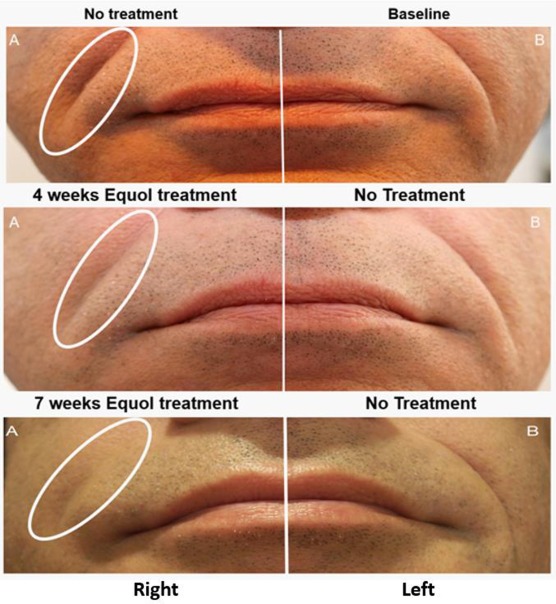
The researchers tested topical and oral R/S-equol in men and reported improvements in various skin parameters. Notice the following experiment where it was applied to the nasolabial fold area for 7 weeks:
1-s2.0-S1756464621002127-gr4
Nasolabial folds are kind of the final boss when combatting signs of aging in the face. People get threads or Sculptra in hopes of improving them. But here we see significant improvement in only 7 weeks of using some topical equol? I don’t know what to think of this tbh…

Consider also these results
1-s2.0-S1756464621002127-gr5
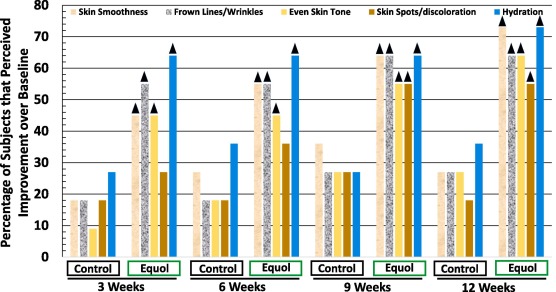
Ok, ‘improvement’ may not be exactly quantified here, it’s self reported. But regardless, consider that the▲-sign indicates significant improvement compared to the baseline and we see that after 12 weeks there is reported significant improvement in all of the reported categories: smoothness, fine lines/wrinkles, even tone, spots, and hydration.

And interestingly, this was an oral study in men. The dose was only 6 mg/day of R/S-equol for 12 weeks.

Another study I found was this one: Effects of 10 Mg S-Equol on Menopausal Symptoms and Skin Health in Perimenopausal Women: A Randomized, Double-Blind, Placebo-Controlled Trial. So they took 10mg/day of S-equol for 8 weeks (only women for this study). Some of the results below:
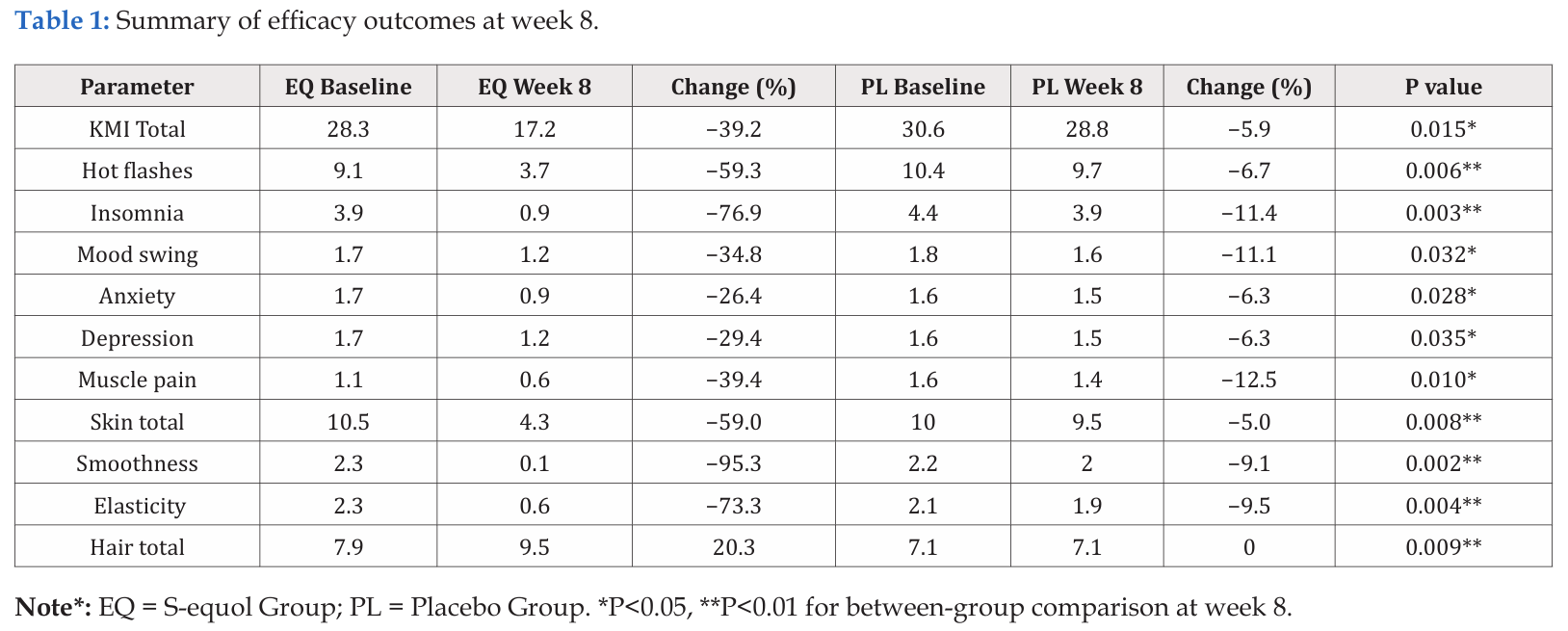

This measures the Kupperman Menopausal Index (KMI) for the first few items, and Skin Condition Rating Scale (SCRS) for the skin results. With these indices, lower values = better results. For the hair, it uses Hair Condition Rating Scale (HCRS) where higher values = better results! Besides significant improvements in skin quality, we also notice some bonus effects, like on anxiety and insomnia.

What is causing the skin effects?

It could potentially be several things happening at once:

DHT ↓ / DHT blocked → less androgen signaling

Some estrogen-receptor activity → potentially beneficial effects on skin

Direct effects on skin cells → potentially more collagen/elastin and better extracellular matrix

The patent specifically claims increased collagen and elastin production, and there are some experimental studies pointing in the same general direction. I think the elastin increase is especially interesting, because unlike collagen, this can be very difficult (near impossible) to reliable achieve from what I know about it.

Effects on Men vs Women

This is an important consideration I think. Equol is mostly sold as a supplement for menopausal women, so is it basically like taking estrogen? It seems that’s not really the case: S-equol has considerably more estrogen-receptor activity, especially at ERβ, while R-equol has much weaker estrogenic activity. That might make R-equol particularly interesting for men. Perhaps at higher doses there could still be issues with feminising effects, but the human skin study used only 6 mg/day, and most commercial products I’ve found contain S-equol rather than R-equol. From what I can tell a dose around 5-20mg/day should not cause big issues in men (but that’s just based on what I found). For women I don’t think they even have to worry about potential negative sides here.

Availability on the Market

Most commercial equol products seem to be S-equol products aimed at menopausal symptoms. If you think it might be worth giving it a try, here are some products I found:

  • Kobayashi Pharmaceutical Equol 30 Capsules
    This is a Japanese product which you can import, features only 2mg Equol (probably S-Equol) among some other components. Costs about 50c USD per pill. There are other Japanese brands selling similar products I have noticed (maybe more potent, too?).
  • Nutrined Equol
    120 capsules, 6mg (probably S-)Equol per capsule. Also costs about 50c USD per capsule, so this is more reasonable
  • Zentra S-Equol
    At least this one specifies it’s just S-Equol. Anyway, 10mg per capsule, which is nice, but it costs about 1.70USD per capsule, which is not necessarily cheap.
  • Equelle Menopause Symptom Relief
    This brand seems well-established. Features 5mg S-Equol per tablet. Container has 60 tabs. Costs about 70c USD per tablet.
  • Dr. Morgan S-Equol Plus
    Some Canadian brand I think. Contains 10mg S-Equol along with Genistein (some other component which might be interesting but I won’t get into that here). Bit expensive though, also ~1.70USD/capsule.
  • Garden of Life Herbals Menopause + Hair Growth
    Just another option, also contains 10mg S-equol, also ~1.70USD/capsule.

Research chems

There may be more options, and I would be especially interested in finding an affordable source for raw “research” chemicals. Particularly, I think it would be great if there were an affordable source for R-equol or racemic (R,S)-equol, since that seems more relevant to the DHT hypothesis. Maybe people more experienced in this can share their insights about such procurement? For dosing, I think taking something like 10-15mg per day would probably a good start to see if there are any benefits. Might be worthwhile to experiment with lower and higher doses as well.

I did find that the CAS code is probably 94105-90-5 (that’s for the (R,S)-equol variant). And on this site that I found it seems like you can order 100g for 342 EUR. So assuming 20mg/day, that’d last you 5000 days at 7c per day. But I have no experience ordering such things and I’m not even sure I’m interpreting this correctly as some other sites offer is for exponentially higher prices.


Anyway, what do you think? Would this be worth trying? I think it wouldn’t hurt to just get a 3mo supply of S-equol (because this can be found easily) and see if there are indeed any noticable improvements of the skin. So perhaps I’ll do that… If you are interested in this or already have experience with it, please share you thoughts. I did a search for equol on the forum, but surprisingly nothing came up yet, so I hope this post can prompt a discussion in R/S-Equol for those interested.

Maybe it would also be nice if someone could AI summarise relevant papers on the subject.

6 Likes

In my view, the key to taking R/S-equol is doing a soy challenge test to determine whether you’re an equol producer or a non-producer. If you’re a non-EP, the benefits of taking R/S-equol are minimal. I looked up the research on R/S-equol, and I think the results are pretty unimpressive.

Of course, that mainly applies to men. For some female equol producers, taking R/S-equol can still offer certain benefits.

AI:

When non-EPs directly ingest purified S-equol tablets (such as SE5-OH), it undergoes classic oral absorption of an exogenous small molecule, with plasma concentrations rapidly surging to micromolar-level peaks (e.g., 3.22 µmol/L) within 1–2 hours. Such an acute surge of free compounds triggers phase II metabolic detoxification enzymes (glucuronidation and sulfation) in the liver and intestinal wall, causing the vast majority to be rapidly excreted in urine as inactive conjugates; consequently, target organs cannot mount an effective physiological response within such a narrow therapeutic window.

Following soy intake in individuals with the EP phenotype, daidzein enters the colon and undergoes sustained, gradual biotransformation by the gut microbiota with progressive absorption, thereby maintaining a steady, biologically active plateau concentration around 24 hours.

Notably, when the reverse experiment was performed on this subject after a washout period of 9 weeks (i.e., treating only the left side of the face) the equol treatment was not successful in diminishing the nasolabial fold, indicating that if the skin crease/wrinkle is down the to the fascia, then the topical equol treatment cannot treat deep lines/wrinkle, but can ameliorate fine to medium lines/wrinkles (data not shown).

Hey, the point of taking it as a supplement is that that way anyone can benefit from it even if you don’t produce it naturally. If you have interesting research to share, feel free to do so. I didn’t find many studies but whatever interesting material I did come across I have linked in the first post, and to me it seemed all those studies did show promising results. Also your ai response doesn’t seem to be correct in various ways. The studies show that absorption is effective and that being a natural equol producer is not a prerequisite.

Anyway, I’m thinking of ordering it as a raw chemical, maybe just 10g to see if it has any effect. But if others already have irl experience, I would be interested in hearing about it too.

My mistake. After further checking, non-equol producers can get some cardiovascular benefits from taking S-equol, while equol producers cannot. As for skin anti-aging, there doesn’t seem to be much to analyze. Let’s see if anyone else has any good thoughts.

https://onlinelibrary.wiley.com/doi/epdf/10.1111/j.1365-2265.2012.04400.x
III. Subgroup Analysis Data (by Sex and Equol-Producing Status)

  1. Stratification by Sex (15 men, 34 women; 33 women for CAVI)
  • Women: LDL-C was significantly reduced (between-group comparison of delta, P < 0.01); CAVI was significantly reduced (between-group comparison of delta, P < 0.01); the difference in HbA1c changes between groups did not reach statistical significance.
  • Men: No statistically significant differences were observed between the two interventions for HbA1c, LDL-C, or CAVI.
  1. Stratification by Equol-Producing Status (33 equol non-producers [ENP], 32 for CAVI; 16 equol producers [EP])
  • Equol Non-Producers (ENP): HbA1c decreased by approximately 0.27% (vs. a 0.13% increase in the placebo group, P < 0.01); LDL-C decreased by approximately 0.3 mmol/l (vs. a 0.04 mmol/l increase in the placebo group, P < 0.01); CAVI decreased by approximately 0.34 (vs. a 0.22 increase in the placebo group, P < 0.01).
  • Equol Producers (EP): There were no statistically significant differences between the supplement and placebo interventions for any of the three parameters.
  1. Subgroup of Female Equol Non-Producers (Female ENP, Figure 4)
  • Significant reductions were observed in all three parameters: HbA1c (between-group comparison of delta, P < 0.05), LDL-C (between-group comparison of delta, P < 0.01), and CAVI (between-group comparison of delta, P < 0.01)

I’ve dropped oral use, but I’m now interested in topical use. Thanks for sharing this ingredient.

https://pubmed.ncbi.nlm.nih.gov/28574180/

Methods: Sixty-four participants were divided in four groups and three of them treated topically with the following: emulsion with Equol powder (Isoflavandiol-E-55-RS®); emulsion with microencapsulated Equol (Vesisorb® Isoflavandiol-E-55-RS®) and an emulsion with lecithin (Vesisorb® placebo). A control group of 6 volunteers did not receive any intervention. The active compound was a 0.5% equol-racemate. For 58 participants, all samples were collected. Structural analysis, molecular analysis and questionnaires were performed at the start of the study and after 8 weeks of intervention, twice a day. Structural skin parameters were analysed by Visioscan® VC 98 and Cutometer® dual MPA 580. Molecular analyses from epidermal cells collected by skin stripping of the forehead included telomere length and LINE-1 methylation, following DNA extraction, bisulfite conversion and qPCR as well as high-resolution melting curve analysis. Effects of nutrition and lifestyle habits were evaluated with a standardized food and lifestyle questionnaire.

Results and discussion: The surface analysis showed significant improvements in skin roughness, skin texture and skin smoothness after both interventions. Cutometer® dual MPA 580 measurement revealed improvement of skin firmness and elasticity parameters for both preparations. A decrease in mean LINE-1 methylation (n.s.) and telomere length (sign. P < 0.05) was observed in the sample group with age. In the treated groups, significantly longer telomeres were observed after intervention. Whether changes in telomere length reflect changes in the regulation of telomerase, epigenetic interactions or turnover of keratinocytes needs further research. Stability and availability of preparations in skin seems to be high as not many significant differences in the activity of pure or encapsulated substances were seen.

I wanted to get a summary of this paper, so here it is after I’ve run it through my paper analysis prompt:

Kimchi’s Hidden Molecule: Equol Turns Up in Plants, and Takes Aim at Men’s Wrinkles

This is two papers stapled together. The first is a chemistry survey reporting that equol, long assumed to be made only by gut bacteria acting on soy isoflavones, is present preformed in six of seven ordinary plant foods, and that some of it is R-equol, a form never before reported in food. The second is a pair of very small skin trials in men: an open split-face test of a 0.3% topical equol lotion in three or four subjects for seven weeks, and a 12-week placebo-controlled trial of 6 mg/day oral equol in 22 men. The oral group reported 34% to 48% improvement across five self-rated skin parameters versus 8% to 18% in the placebo group. Every clinical outcome in the paper is a man’s opinion of his own face. No instrument, no blinded grader, and no biopsy touched a single participant.

For twenty-five years equol has been described as something your gut bacteria make for you, or fail to make. It is what intestinal microbes produce from daidzein, one of the isoflavones in soy. Roughly half of people in Asian populations and a quarter elsewhere carry the machinery to make it. Everyone else eats soy and gets very little.

A single-author study from Brigham Young University now reports that equol is already sitting in ordinary plant foods before any gut bacteria touch it. Using chiral chromatography, which separates left-handed and right-handed versions of the same molecule, Edwin Lephart tested seven plant products bought from stores in Utah and California. Six contained equol. Fermented Chinese cabbage carried the most at 17.4 parts per million. Iceberg lettuce, kimchi, unfermented Chinese cabbage and white cabbage all registered. Green sweet peas had none.

The surprise is not simply the presence of equol but which kind. Human gut bacteria make only S-equol. The R form has never been reported in a food product. Lephart found R-equol in red Batavia lettuce, and both forms together in the Chinese cabbages and in kimchi. If that holds up, the equol producer versus non-producer division that shapes a great deal of soy research becomes leakier than assumed, because a non-producer eating cabbage would still be taking a dose.

The second half of the paper leaves food chemistry and enters cosmetics. Equol resembles estradiol closely enough to bind estrogen receptor beta, which is abundant in the outer layers of skin. It also grabs dihydrotestosterone and pulls it away from the androgen receptor. In cell work it raises collagen and elastin and suppresses the enzymes that break them down. Almost every clinical test of this has been run in women.

Lephart ran two small trials in men. In the first, three or four men (the paper says both) applied a 0.3% equol lotion to one side of the face for seven weeks. Photographs of one 50-year-old show his nasolabial fold fading on the treated side. In the second, 22 men took either 6 mg of equol daily or a placebo for twelve weeks and rated their own skin. The equol group reported improvements of 34% to 48% across smoothness, wrinkles, tone, spots and hydration. The placebo group reported 8% to 18%.

Those numbers deserve scrutiny rather than applause. There is no instrument reading, no blinded photograph grading, no measured hydration or elasticity, and no statement anywhere that the study was randomised or double-blind. Eleven men per group is small enough that one participant changing one answer flips the headline result, and that is not a figure of speech: the paper’s significance threshold sits exactly at five men out of eleven. Compare the two groups against each other rather than each against its own starting point and nothing reaches significance at all.

The food chemistry is the more durable contribution, and even that rests on retention times from a single column, with no mass spectrometry to confirm the peaks in the food samples. A claim that plants manufacture a bacterial metabolite needs a second laboratory, ideally one with no patent position, to repeat it.

Actionable Insights

Fermented cabbage is a plausible dietary source. At 17.4 mg/kg, about 350 g per day of fermented Chinese cabbage (suan cai) would match the 6 mg trial dose. Kimchi at 4.9 mg/kg would need over a kilogram per day, which is not realistic. Iceberg lettuce, oddly, tested at 9.6 mg/kg.

On the size of the reported benefit: effect size asks how far apart two groups are relative to how much people vary within each group. By convention 0.2 is small, 0.5 medium, 0.8 large. The oral equol effects came out between 2.1 and 2.8, which is enormous, and that is the problem. Effects that large in 22 men rating their own faces are far more likely to reflect expectation and small-sample noise than biology. Tretinoin, the best-validated topical wrinkle treatment, produces effects around 0.5 to 0.8 on instrument-graded endpoints.

In plain terms, the equol group moved their self-rating from about 4.5 to about 6.3 out of 10 over twelve weeks. The placebo group moved to about 5.0. Six men out of eleven noticed anything about their skin spots. Four of eleven placebo takers reported better hydration.

Context and Source

  • Full title: “Determination of S- and/or R-equol in plant-based food products and efficacy of topical or oral 4’,7-isoflavandiol (R/S equol) to improve skin health in adult men, a Placebo-controlled pilot study”
  • Author: Edwin D. Lephart (single author)
  • Institution: Department of Physiology, Developmental Biology and The Neuroscience Center, College of Life Sciences, Brigham Young University, Provo, Utah
  • Country: United States
  • Journal: Journal of Functional Foods, volume 83 (2021), article 104563, Elsevier
  • Declared conflict: the author is an inventor on equol patents in the United States and worldwide. Oral pilot data were presented at Dermatology Innovations Spring 2021, a commercial venue.
  • Impact evaluation: The impact score of this journal is 7.2 (CiteScore; the Journal Impact Factor has ranged from roughly 3.8 to 5.6 across recent JCR editions, Q2 in both Food Science and Technology and Nutrition and Dietetics), evaluated against a typical high-end range of 0 to 60+ for top general science, therefore this is a Medium impact journal.

Next, I used my in-depth prompt to analyze the claims made in the paper, and then had those claims analyzed by looking at the research in the area of that claim and seeing if the surrounding research confirmed or conflicted with the paper. Here are the results from that analysis:

Claims and External Verification

Source paper: Lephart ED (2021), Journal of Functional Foods 83:104563, DOI 10.1016/j.jff.2021.104563

Evidence hierarchy used: A = human meta-analysis or systematic review. B = human RCT. C = human observational or cohort. D = pre-clinical (animal, in vitro, ex vivo). E = expert opinion, narrative review, anecdote, or single uncontrolled case.

Link provenance note, stated because the protocol demands it: every link below was returned by a live search executed for this task. Records marked “abstract retrieved” were opened and their content read. Records marked “listing only” appeared in live search results with the URL and DOI visible, but the publisher blocked retrieval of the page body (403, 402, or a bot challenge). Nothing here is reconstructed from memory.


Section 1: Chemistry and Provenance Claims

  • Claim C1: Equol is a bacterial metabolite of daidzein, and human gut bacteria produce only S-equol.
  • Claim C2: Roughly 50% of Asians and 25% of non-Asians are equol producers.
  • Claim C3: “Equol producer” status means maintaining plasma equol around or above 10 to 20 ng/mL.
    • Evidence Level: C/E. This is a convention, not a measured biological threshold, and the paper presents it as such.
    • Primary source cited by the paper is Equol: history, chemistry, and formation (2010), listing only; the journal blocked full retrieval. The threshold is definitional and varies by assay and matrix (plasma versus urine). Treat any dichotomisation of producer status as arbitrary.
  • Claim C4: S-equol and/or R-equol are present preformed in plant-based foods including unfermented lettuce and cabbage.
    • Evidence Level: D, and contested. This is the paper’s central novel claim and it is an analytical chemistry claim, not a biological one.
    • Directly at odds with the current consensus framing. The 2024 Gut Pathogens review treats equol as exclusively microbial in origin in humans, with no plant biosynthetic route described. Equol: a metabolite of gut microbiota (2024).
    • The reference method for this question is LC-MS with carbon-13 labelled internal standards, used in Phytoestrogen content of fruits and vegetables commonly consumed in the UK based on LC-MS and 13C-labelled standards (2009), listing only (robots.txt blocked retrieval). Lephart’s paper used chiral HPLC with diode array detection at 280 nm and no mass confirmation of any food peak, which is a weaker method for the harder claim.
    • Verdict: not refuted, not corroborated. It requires independent replication with mass spectrometry before it can be assigned any level above D.
  • Claim C5: R-equol has never previously been reported in a food product and is reported here for the first time.
    • Evidence Level: D, single laboratory, single analyst, unreplicated.
    • I found no independent report of R-equol in a plant food in live search. The priority claim appears to stand, which is a statement about the literature and not about whether it is true.
    • The measured value that carries the claim (red Batavia lettuce, 2.13 ppm) sits just above the paper’s own 1 ppm detection limit, below any conventional limit of quantitation, and below the bottom of its own calibration curve (2.4 micrograms/ml).
  • Claim C6: S-equol occurs in fermented Asian foods.
    • Evidence Level: D. Prior reports exist (Abiru 2012 on stinky tofu, Jou 2013), cited by the paper. Both are analytical chemistry in soy-derived fermented products, where a daidzein substrate and a fermenting microbial population are both present, so the finding has a plausible route. This is the least surprising part of the food data and the part most likely to replicate. No independent confirmation retrieved in live search for the specific kimchi and suan cai values reported here. Source unverified in live search for the primary Abiru and Jou records.

Section 2: Receptor Pharmacology and Mechanism Claims

  • Claim M1: Equol binds human estrogen receptors, with S-equol having higher affinity for ER-beta than ER-alpha.
    • Evidence Level: D, strongly supported. This is solid receptor pharmacology.
    • S-equol, a potent ligand for estrogen receptor beta (2005) reports a Ki of 0.73 nmol/L for S-equol at ER-beta. Abstract retrieved.
    • Translational note: this is binding data, not a human outcome. The receptor affinity is real; what it does to a human face is a separate question with separate evidence.
  • Claim M2: R-equol or racemic R/S equol shows better efficacy than S-equol.
  • Claim M3: Equol binds 5-alpha-dihydrotestosterone directly and sequesters it from the androgen receptor.
    • Evidence Level: D. Translational Gap.
    • Equol is a novel anti-androgen that inhibits prostate growth and hormone feedback (2004). Abstract retrieved. Species: Sprague-Dawley rats, castrated and DHT-treated. Lephart is a co-author. The finding is real and interesting: equol binds DHT but not testosterone, and does not bind the androgen receptor itself.
    • Translational Gap flagged. This is castrated rat prostate data being used to explain self-reported facial skin changes in intact middle-aged men. No human study demonstrates DHT sequestration by oral equol at 6 mg/day, and no androgen measurement was made in this study. The dose gap is not addressed anywhere.
  • Claim M4: Equol stimulates collagen, elastin, TIMP-1 and growth factors while inhibiting MMPs and reactive oxygen species.
  • Claim M5: Equol is a potent antioxidant with anti-inflammatory and anti-photoaging properties.
    • Evidence Level: D/E. Supported in cell-free and cell culture systems, unsupported at achievable human systemic concentrations.
    • No human RCT of equol with an oxidative stress or inflammatory biomarker endpoint was retrieved in live search. Source unverified in live search for any Level A or B support.
    • The concentration objection raised in Part 2 stands: direct radical scavenging at roughly 270 nmol/L against millimolar endogenous glutathione is not a credible mechanism. Any real redox effect would have to be indirect and transcriptional, which nobody has demonstrated in humans for equol.
  • Claim M6: Equol’s efficacy is greater than astaxanthin for antioxidants, extracellular matrix integrity, growth factors and inflammatory biomarkers.
  • Claim M7: Equol binds ER-beta in epidermal keratinocytes, producing sustained release and enhanced dermal delivery, so microencapsulation adds nothing.
    • Evidence Level: D/E. Franz cell penetration data plus inference. No independent confirmation retrieved.
    • The observation it rests on (microencapsulated and plain topical equol performed similarly in Magnet 2017) has at least one simpler explanation: neither formulation did much, and the study lacked power to separate them. Source unverified in live search for the receptor-reservoir mechanism specifically.
  • Claim M8: Equol improves prostate health in benign prostatic hyperplasia.

Section 3: Clinical Efficacy Claims

  • Claim K1: Oral S-equol improves skin aging in postmenopausal women.
    • Evidence Level: B, single small pilot RCT, and undercut by a newer and better trial.
    • Oyama A, Ueno T, Uchiyama S, et al. The effects of natural S-equol supplementation on skin aging in postmenopausal women: a pilot randomized placebo-controlled trial. Menopause 2012;19(2):202-210. Publisher abstract page, listing only; the publisher returned a paywall error and the DOI could not be confirmed. DOI unverified in live search.
    • The important update: S-equol status modulates skin response to soy isoflavones in postmenopausal women: results from a randomized placebo-controlled pilot trial (2025). Abstract and results retrieved. Randomised, triple-blind, 66 women, 80 mg soy isoflavones for 84 days, instrumented endpoints. Crow’s feet roughness improved 5.6% with treatment versus a 1.6% worsening on placebo, and the difference was not statistically significant. Only associations with measured S-equol level reached significance, at a single timepoint.
    • Read that against Lephart’s self-reported 48% wrinkle improvement with d = 2.08. A larger, triple-blinded, instrument-measured trial in the more responsive population (oestrogen-deficient women) could not clear significance on the analogous endpoint.
  • Claim K2: Topical R/S equol improves roughness, texture, smoothness, firmness, elasticity and skin cell telomere length in women.
    • Evidence Level: B, single trial, industry-adjacent, not independently replicated.
    • Magnet U, et al. Topical equol preparation improves structural and molecular skin parameters. International Journal of Cosmetic Science 2017. DOI 10.1111/ics.12408, listing only; Wiley returned 403 and the abstract body could not be read.
    • The telomere length claim in particular is a large biological assertion from a topical cosmetic study over 8 weeks and I found no independent replication in live search. Treat it as unverified.
  • Claim K3: Oral R/S equol at 6 mg/day improves five self-rated skin parameters in men over 12 weeks.
    • Evidence Level: B by design label, E by information content.
    • The design is nominally a placebo-controlled parallel trial, which is Level B. But every endpoint is self-report, randomisation and blinding are never stated, n is 11 per group, and the between-group comparisons do not reach significance when actually performed. On evidence content this is closer to a structured anecdote than a trial result.
    • The external context that matters most: Clinical implications of skincare: lessons from placebo-controlled dermatology trials (2026). Retrieved. Vehicle and placebo arms in dermatology routinely deliver 24% to 66% improvement depending on condition, and “vehicle arms often achieve a substantial proportion of the efficacy seen in active treatments, frequently exceeding half of the efficacy.” The review also warns that reliance on subjective grading leaves results “susceptible to expectancy effects and investigator bias.” That is clinician grading. Participant self-grading is the weaker case still.
    • No trial registration for this study was found on ClinicalTrials.gov in live search.
    • Broader context: Effectiveness of dietary supplements for skin photoaging in healthy adults: a systematic review and meta-analysis of randomized controlled trials (2025). Retrieved. 40 RCTs, 2,119 adults, 22 in the pooled analyses. Isoflavones and equol do not appear among the assessed supplement classes at all, meaning the oral equol skin literature is too thin to have entered a Level A synthesis.
  • Claim K4: Topical 0.3% R/S equol reduced a nasolabial fold to near-undetectable in 7 weeks.
  • Claim K5: Isoflavones are safe in men and do not feminize.
  • Claim K6: Estrogen signalling improves skin collagen, elasticity and thickness (the background premise for the whole ER-beta rationale).
    • Evidence Level: A. Supported.
    • Skin Rejuvenation in Women using Menopausal Hormone Therapy: A Systematic Review and Meta-Analysis (2023). Retrieved via the PubMed record. 15 studies, 1,589 patients. Significant increases in skin thickness (p less than 0.00001) and collagen content (p less than 0.00001), modest elasticity gain (p = 0.03), no significant effect on dryness (p = 0.14).
    • Important qualifier: this is systemic estradiol in oestrogen-deficient women, not a weak ER-beta-preferring phytoestrogen at 270 nmol/L in men with intact gonadal steroid production. The premise is sound; the extrapolation to this intervention and this population is not established.
    • Related: the broader phytoestrogen literature does not inherit the hormone therapy result. Phytoestrogens for menopausal vasomotor symptoms, Cochrane Review (2013). Retrieved. 43 RCTs, 4,084 participants, “no conclusive evidence” of benefit, most trials small, short and at high risk of bias.
  • Claim K7: Men have higher sebum content, thicker and more pigmented skin, deeper wrinkles, larger pores and more facial sagging than women.
    • Evidence Level: C. Human observational, broadly accepted descriptive dermatology. Not contentious and not load-bearing for any efficacy claim. The paper cites Rahrovan et al. 2018; source unverified in live search.
  • Claim K8: Oral R/S equol at 6 mg/day produces plasma levels of 60 to 70 ng/mL at peak, and pharmacokinetics are linear.
  • Claim K9: Topical equol cannot treat wrinkles that extend to the fascia, but can ameliorate fine to medium lines.
    • Evidence Level: E. This is a post hoc explanation for a failed reverse-crossover in one subject. It is unfalsifiable as stated, because wrinkle depth was never measured. No external support retrieved.
  • Claim K10: This is an advantage over most cosmeceuticals, which can only treat fine lines.

Section 4: Verification of My Own Part 2 Assertions

Holding my own analysis to the same standard.

  • My comparator claim: “tretinoin produces effects around 0.5 to 0.8 on instrument-graded endpoints.”
    • Correction. The current Level A synthesis reports mean differences on ordinal wrinkle grading scales (0.412 fine, 0.245 coarse), not standardized effect sizes, so a direct Cohen’s d comparison is not available from it. My 0.5 to 0.8 figure was a reasonable order-of-magnitude recollection but it was not sourced, and I should not have stated it as a specific number. The substantive point survives intact and arguably strengthens: the best-validated topical agent in dermatology produces modest graded improvements over 16 weeks to 2 years, which makes a self-reported d of 2.1 to 2.8 over 12 weeks less credible, not more. Tretinoin for Photodamaged Facial Skin (2025).
  • My mechanistic speculation: cGAS-STING and dermal fibroblast senescence.
    • Evidence Level: D for the pathway, non-existent for the equol link. The pathway itself is well described: oxidised mitochondrial DNA and retrotransposon cDNA in the cytoplasm activate cGAS-STING and drive SASP through a ROS-cGAS-STING-ROS feedback loop. Dermal Fibroblast Senescence: The Central Hub of Skin Aging (2026). Retrieved. That review makes no mention of isoflavones or equol. My Low confidence tag was correct and I am leaving it Low.
  • My claim that placebo response would plausibly account for the observed effect.

Summary of Verification Outcomes

Claim Level Verdict
C1 Equol is a bacterial metabolite, S-form only in humans A/D Supported
C2 Producer prevalence 50% Asian / 25% non-Asian C Supported, wide variance
C3 Producer threshold 10 to 20 ng/mL C/E Convention, not a biological threshold
C4 Equol preformed in plant foods D Contested, needs MS confirmation and replication
C5 R-equol in food, first report D Priority plausible, value below limit of quantitation
C6 S-equol in fermented Asian foods D Prior support exists, most likely to replicate
M1 S-equol is a potent ER-beta ligand D Strongly supported
M2 R or R/S equol outperforms S-equol D Contradicted by the author’s own 2005 co-authored paper
M3 Equol sequesters DHT D Translational Gap: castrated rats to human faces
M4 Collagen up, MMP down D Translational Gap: micromolar in vitro to nanomolar in vivo
M5 Potent antioxidant in vivo D/E Implausible at achieved concentration
M6 Superior to astaxanthin D Translational Gap: gene array to clinical superiority
M7 Keratinocyte ER-beta reservoir effect D/E Unverified
M8 Equol for BPH D/E Author’s own uncontrolled pilot, low-tier venue
K1 Oral S-equol improves skin in women B Undercut by a 2025 triple-blind trial that missed significance
K2 Topical equol improves skin and telomeres in women B Single trial, no independent replication
K3 Oral equol improves men’s skin B label, E content Not established
K4 Topical equol erased a nasolabial fold E Case report, not evidence
K5 Isoflavones are safe in men A Fully supported
K6 Estrogen improves skin collagen A Supported, but extrapolation to this dose is not
K7 Male versus female skin differences C Supported, not load-bearing
K8 Plasma equol 60 to 70 ng/mL E Not measured; samples existed and were not reported
K9 Fascia-depth wrinkles untreatable E Unfalsifiable post hoc explanation
K10 Superior to cosmeceuticals on medium wrinkles E Contradicted by the tretinoin meta-analysis

Bottom Line on Verification

Two claims in this paper reach Level A and both are borrowed background rather than findings: isoflavones are safe in men, and estrogen signalling improves skin collagen. Neither is evidence that equol does anything.

Every claim the paper is actually making rests on Level D or E evidence, and in most cases on Level D or E evidence generated by the same author. Three specific translational gaps are being crossed without acknowledgement: castrated rat prostate to human facial skin, micromolar cell culture to nanomolar plasma, and gene expression arrays to clinical superiority claims.

The most damaging finding from external verification is not a limitation the paper failed to disclose. It is that the paper’s stereochemistry argument, that R-equol and racemic equol outperform S-equol, runs against the receptor pharmacology in a 2005 American Journal of Clinical Nutrition paper on which Lephart is a listed co-author, and which reports R-equol as relatively inactive. The intervention tested was 50% that enantiomer. Either the 2005 receptor data or the 2021 mechanistic framing has to give, and the paper does not address the conflict.

It looks to be a pretty safe molecule, even at much higher dosing - so pretty low risk to try. There is also research on Equol as a cognitive enhancer.

Here is the Human Translational and Safety data:

The Translational Protocol

Human Equivalent Dose (HED)

A forward animal-to-human HED for the paper itself is not applicable: Lephart 2021 is a human study and dosed humans directly at 6 mg/day oral. Declaring that and stopping would be lazy, because the mechanism the paper leans on is entirely rodent. The useful calculation runs in reverse: what oral human dose would be required to reproduce the exposure that produced the anti-androgen effect the paper cites as its mechanism.

Source of the animal dose: Equol is a novel anti-androgen that inhibits prostate growth and hormone feedback (2004), Sprague-Dawley rats, equol 0.25 mg/kg/day subcutaneous, 4 days. Abstract retrieved.

FDA body surface area normalization (Estimating the Maximum Safe Starting Dose in Initial Clinical Trials for Therapeutics in Adult Healthy Volunteers, 2005). Km values: mouse 3, rat 6, adult human 37.

Step 1, BSA normalization:

HED (mg/kg) = Animal dose (mg/kg) x (Animal Km / Human Km)

HED = 0.25 x (6 / 37) = 0.25 x 0.1622 = 0.0405 mg/kg/day

For a 70 kg adult male: 0.0405 x 70 = 2.84 mg/day

At face value the paper’s 6 mg/day looks like roughly 2x the rat-equivalent dose. That reading is wrong, because the rat dose was subcutaneous and the human dose was oral.

Step 2, route correction for oral bioavailability.

Absolute oral bioavailability of S-equol, measured against IV in the only such study retrieved: Bioavailability study of enantiopure (S)-Equol in CD(SD)IGS rats (2025). Retrieved. Male rats: 1.59% at 20 mg/kg, 5.03% at 60 mg/kg, 8.14% at 160 mg/kg. Female rats: 22.9% to 66.0%. The sex difference is roughly an order of magnitude and it runs against males.

Oral HED = 2.84 / F

Assumed F Required oral dose Study dose 6 mg/day is
8.14% (male rat, best case) 34.9 mg/day 5.8-fold short
5.03% (male rat, mid) 56.4 mg/day 9.4-fold short
1.59% (male rat, low-dose regime) 178.5 mg/day 29.7-fold short
30% (female rat, not applicable to men) 9.5 mg/day 1.6-fold short

Read this plainly. If the rat anti-androgen mechanism is the explanation for the clinical result, the 6 mg/day oral dose in men is somewhere between 6-fold and 30-fold below the exposure that produced it. The mechanism and the dose do not fit together. Either the effect is not androgen-mediated, or the effect is not real, or human oral bioavailability of equol is far better than male rat bioavailability. Nobody has measured the third possibility. [Confidence: Medium, limited by cross-species bioavailability extrapolation]

Pharmacokinetics and Pharmacodynamics

All human PK below is for enantiopure S-equol. No human PK for racemic R/S equol was retrieved in live search.

Parameter Value Source
Tmax 1.5 to 3 hours Cognitive Vitality Report, S-equol (2021), retrieved
Plasma elimination half-life 8 hours same
Cmax linear with dose across Phase I range same
Food effect food lowers Cmax but not AUC same
Absolute oral bioavailability, human Source unverified in live search no human IV comparison found
Absolute oral bioavailability, male rat 1.59 to 8.14% Sci Rep 2025
Circulating form predominantly glucuronide and sulfate conjugates, as with other isoflavones; free fraction is a small share of total inferred from isoflavone class behaviour, not directly measured for equol in live search

An 8 hour half-life makes the paper’s twice-daily 3 mg schedule pharmacologically sensible. It also means the paper’s quoted 60 to 70 ng/mL is a peak, not a steady-state trough, and the trough will be substantially lower. The paper reports no AUC and no trough.

Molar conversion, which matters for every mechanism claim: 60 to 70 ng/mL equals 248 to 289 nmol/L, or roughly 0.25 to 0.29 micromol/L. The “equol producer” convention of 10 to 20 ng/mL equals 41 to 83 nmol/L.

Safety and Toxicity

This is the one domain where the evidence is genuinely reassuring, and it is worth separating cleanly from the efficacy question.

NOAEL stands for No-Observed-Adverse-Effect Level

Endpoint Value Species / setting
NOAEL, 91-day repeat dose 2,000 mg/kg/day (highest dose tested, so a limit-dose NOAEL) Rat
Acute oral LD50 (SE5-OH) greater than 4,000 mg/kg Rat
Genotoxicity negative in the SE5-OH battery in vitro and in vivo
Developmental and reproductive toxicity assessed for SE5-OH J Toxicol 2009, listing only
Sex and thyroid hormones S-equol does not alter serum sex or thyroid hormone levels human and animal safety studies
Phase I dose range explored 10 to 320 mg single dose; 10 to 160 mg twice daily human
Liver signal none reported; weak CYP induction in vivo, no hepatotoxicity signal retrieved human and animal
Kidney signal Safety Data Absent for equol-specific renal endpoints beyond routine toxicology panels
Racemic R/S equol toxicology Safety Data Absent. The entire toxicology package is S-equol or SE5-OH.

Source for NOAEL, LD50, Phase I range and hormone neutrality: Cognitive Vitality Report, S-equol (2021), retrieved. Primary subchronic study: Safety assessment of (S)-Equol: Subchronic toxicity study in Sprague Dawley Rats (2024), listing only; ScienceDirect blocked retrieval.

Safety margin math, same FDA method:

NOAEL HED = 2,000 x (6 / 37) = 324.3 mg/kg/day, which is 22,700 mg/day for a 70 kg adult, or 22.7 g/day.

Applying the standard 10x safety factor gives a maximum recommended starting dose analogue of 2,270 mg/day.

  • Margin over the paper’s 6 mg/day: 378-fold after the safety factor, 3,784-fold raw.
  • Margin over commercial 10 mg/day: 227-fold after the safety factor.
  • Margin over the 40 mg/day high end of menopause trials: 57-fold after the safety factor.

Acute LD50 HED: 4,000 x (6/37) x 70 = 45.4 g as a single dose. Not reachable by any plausible ingestion.

Adverse events actually observed in humans. One 102-subject study reported 47% with at least one treatment-emergent adverse event: abdominal distention 13 to 15%, and endometrial hypertrophy 13%. The endometrial finding is in women and is the only signal in the file that deserves real attention. It is not applicable to men, but it is a reminder that a compound with nanomolar ER-beta affinity is not inert tissue-wide.

S-equol.pdf (449.3 KB)

Yo @vampire I’m engaged in mortal combat with the final boss so you have my attention. I don’t understand the rationale for the failed crossover intervention though. Why would ONE side of the nasolabial fold extend down to the fascia while the other one doesn’t? They seem roughly symmetrical to me. So it’s very fishy that one side responded so amazingly while the other, diddly squat.

Thanks for the ai summary @RapAdmin . Maybe you can also do the other study I linked in the OP? Effects of 10 Mg S-Equol on Menopausal Symptoms and Skin Health in Perimenopausal Women: A Randomized, Double-Blind, Placebo-Controlled Trial. I think that one’s interesting as well, and perhaps of higher quality?

I also read your pdf from the Alzheimers org. It focuses on many health benefits, but not skin. But I understand other people might be more interested in those things actually.

@medaura Maybe you can replicate the study, why not? I have to say I am skeptical, I mean, such drastic changes in a few weeks? Especially on the nasolabial folds which are so difficult to address… But as for your not understanding the reasoning regarding the fascia in the study, I agree, I found it confusing myself. And basically they just say, “well, it’s because of this.” But actually, did they provide any test results confirming that? No. So, did they even perform such tests in the first place? Good chance they didn’t. It’s just some speculation I think, and that doesn’t help to make me feel more confident about these results. But yeah, it would still be interesting to see if people can achieve any results themselves copying their method, right?

Besides that, if you are serious about your boss fight, be careful with cosmetic interventions. Many practitioners don’t know how to address this problem well. They might just put some filler directly into the fold, which changes the shape of the face and makes it look very unnatural very quickly. The reason the folds are there is because of sagging fat from the cheeks, NOT because of fat loss in the fold themselves. So just filling them is not the solution here. Also, you don’t want to dissolve the nasolabial folds (eg aqualyx), loss of volume will make you look older and it will make the skin sag more. The best option to me seems Scupltra for the cheekbone area. It will create more volume over time and this will lift the sagging, reducing the fold. Good chance it will look natural, and Sculptra is also longer lasting than normal filler. Another option could be something like pcl threads with a screw pattern, or at least with hooks. But people tend to be disappointed with threads generally speaking. Maybe they expect too much. I think over time it can be helpful. Not sure exactly what info you were looking for but perhaps it may be helpful–this is just what I know about it. :slight_smile:

1 Like

Yeah I don’t use fillers at all anyway. Got this conceit that it has to be my own tissue or nothing, so only like biostimulators or threads. And yes the boss is tricky like you say. I think mine are interesting in that I don’t have much volume loss and have had them since my mid 20s, though of course lighter than today. One is deeper than the other and when I smile, the deeper one has a dimple. So I actually do suspect it’s got to do with some fascial tethering. And that my problem is from an overactive muscle in that area, not loss of volume. So maybe Botox can help, but haven’t tried it. They’re not deep, they’re shallow folds but kind of sharp, at least on that one side. I can try it and report back but am highly skeptical. Still, they did do something to the dude in the pic which had amazing results on one side. I can find the S type for very cheap on Alibaba but not the R type.

Too Good to Be True: A Soy Metabolite Trial Where the Placebo Group Forgot to Respond

A Chinese supplement manufacturer has published an eight-week randomized trial reporting that 10 mg per day of its branded S-equol product improved essentially every perimenopausal symptom it measured, with hot flashes down 59%, insomnia down 77%, and skin smoothness improved by 95%. The underlying biology is legitimate: S-equol is a genuine selective ER-beta agonist with a plausible mechanism and a modest but real evidence base from larger, independent trials. This particular study, however, is not the evidence that supports it. The reported effect sizes run four to five times larger than the best prior trial of the same compound at the same dose. The placebo arm improved by only 6.7%, in a symptom domain where placebo responses of 30% or more are the norm. The reported p-values are mathematically inconsistent with the reported means and standard deviations by several orders of magnitude, three percentage calculations in the treatment column do not reconcile with their own source numbers, both authors are employed by the companies that manufacture and test the product while declaring no conflict of interest, and the paper was published seven days after submission in a journal that carries no Clarivate impact factor and is not indexed in MEDLINE, Scopus, or Web of Science.

A Chinese ingredient supplier has published a small trial claiming that a soy-derived compound clears up almost everything women complain about during perimenopause. Over eight weeks, 30 women took either 10 mg of the company’s branded S-equol or a matching dummy capsule. The treated group reported 59% fewer hot flashes, 77% less insomnia, better mood, less joint pain, thicker hair, and a 95% improvement in skin smoothness. Every comparison came out in the product’s favour.

The idea behind S-equol is real and worth understanding. Soy contains a compound called daidzein. In the gut, certain bacteria convert daidzein into equol, and equol binds to one of the body’s two estrogen receptors, ER-beta, far more tightly than it binds to the other one, ER-alpha. That distinction matters. ER-alpha is the receptor implicated in the growth of breast and uterine tissue, and it is a large part of why hormone replacement therapy carries the risks it does. A compound that speaks to ER-beta while largely ignoring ER-alpha offers, in theory, some of estrogen’s benefits without the same risk profile. Only about a third to a half of adults carry the gut bacteria needed to make equol from soy, which is why taking equol directly, rather than eating more tofu, has a genuine rationale.

That much is established. What this particular paper adds is where the trouble starts.

The problem is the placebo group. Hot flashes are among the most placebo-responsive symptoms in medicine. Pooled analyses find that dummy pills reduce hot flash frequency by roughly a third, and in trials of paroxetine, an approved treatment, close to 80% of the total benefit patients experienced was attributable to placebo. In this new trial, the placebo group improved by 6.7%. Women who enrolled in a menopause study, took capsules daily for two months, and attended three clinic visits reported almost no change at all. That is not how menopause trials behave.

The rest of the numbers have the same quality. The reported effects are four to five times larger than those from the best previous trial of the same compound at the same dose, which enrolled 160 women rather than 30 and ran for 12 weeks rather than eight. Skin smoothness scores fell from 2.3 to 0.1 on a four-point scale, meaning nearly every woman in the treated group was rated as having essentially flawless skin after eight weeks. When the reported averages and standard deviations are used to recalculate the statistics, they imply p-values near one in a million, not the p-values of 0.006 and 0.015 the paper prints. Three of the percentage improvements in the treated column do not match the numbers they are calculated from. None of the placebo column percentages are wrong.

Both authors work for the two companies that make and test the product. The paper declares no conflict of interest. It was received on 27 August 2026 and published on 3 September, seven days later, in a journal that charges roughly 2,579 US dollars per article and is not indexed in MEDLINE, Scopus, or Web of Science. The compound may well work. This paper is not how you would find out.

Actionable Insights

Set expectations from the larger independent trial, not this one. Aso and colleagues (2012, 160 women, 12 weeks, same 10 mg dose) found S-equol cut hot flashes by about 1.9 per day while placebo cut them by about 1.0. The real benefit is therefore roughly one fewer hot flash per day. As an effect size that is a Cohen’s d near 0.47. In plain terms: pick one woman on S-equol and one on placebo at random, and the S-equol woman is doing better about 63 times out of 100. A coin flip is 50. Real, moderate, not a transformation. The new paper implies a d of 2.2, or 94 times out of 100. Treat that as an artifact.

Three practical points. Equol producer status matters more than dose: only 30 to 50% of adults carry the gut bacteria that make equol from soy, so direct supplementation is mainly rational for non-producers, and testing exists. If you try it, judge vasomotor and sleep effects at 8 to 12 weeks, and discount the skin and hair claims, which rest on subjective 0 to 3 ratings by an unspecified assessor. Finally, nothing here is a longevity outcome: no bone density, lipids, glucose, blood pressure, inflammatory markers, or body composition were measured. [Confidence: High]

Context and Source

Field Detail
Full title Effects of 10 Mg S-Equol on Menopausal Symptoms and Skin Health in Perimenopausal Women: A Randomized, Double-Blind, Placebo-Controlled Trial
Authors Wei Zhang, Yan Li
Institutions Shanghai EGT Synbio Group Co., Ltd. (Shanghai) and Shandong UGEL Bio-tech Co., Ltd. (Shandong). Both are commercial entities, not academic or hospital institutions.
Country China
Journal American Journal of Biomedical Science and Research (publisher: BiomedGrid LLC, Rancho Cucamonga, California)
Volume / ID 2026, 32(1), AJBSR.MS.ID.004130
DOI 10.34297/AJBSR.2026.32.004130
Access Open access, CC BY 4.0. Article processing charge listed by the publisher at 2,579 USD for a research article.
Received / Published 27 August 2026 / 3 September 2026 (7 days)
Trial registration None stated. No ChiCTR, NCT, or other registry identifier appears anywhere in the paper.
Ethics approval Referenced generically as “the institutional ethics committee”. No committee named, no approval number given.

Journal impact evaluation

There is no Clarivate Journal Impact Factor and no Scopus CiteScore for this title. The publisher self-advertises “Impact Factor: 2.716” on its author guidelines page, a figure not issued by Clarivate or Elsevier and not traceable to any recognised metrics body.

Applying the standardized formulation: The impact score of this journal is 0 (no verifiable JIF or CiteScore exists; the self-declared 2.716 is not issued by any recognised metrics authority), evaluated against a typical high-end range of 0 to 60+ for top general science, therefore this is a Low impact journal.

Personally, I would not be willing to bombard my system with something that is anti-androgenic and pro-estrogenic at the same time. Seems like heading for trouble - e.g., neurocognitvie changes, libido, gynecomastia. Not worth it for a better skin IMO

However, I wrote an article specifically on this topic and how reducing DHT makes males age better -including the skin.

Article: Why I Take Finasteride Despite Not Losing My Hair

2 Likes

Thank, interesting blog post, I read the whole thing. :slight_smile: I doubt equol will cause significant side effects such as lower libido, especially with the doses used in the studies I wouldn’t describe it as bombarding the system. But it isn’t very well studied so if you want to be risk averse equol probably isn’t going to be very interesting. If I manage to order it I will keep people updated here but I’ll probably only do so next year.

The study posted above. reposted below:

https://www.sciencedirect.com/science/article/pii/S1756464621002127

says:

2.4. Topical equol Split-Face protocol and test product application

In the topical study four subjects were tested in the split-face equol treatment protocol that were selected based upon age (40 to 59 years old), and in good health without use of topical or oral skin products (see criteria above). Truncated facial photographs were taken at baseline, 4 weeks and finally at 7 weeks of the topical study with standardized positioning/distance and lighting. The topical lotion contained water, a glycol base formula with R/S equol at 0.3% with phenoxyethanol as the preservative in a small pump bottle that delivered 0.5 ml per pump. This was applied once per day (usually in the morning after face washing) to the right portion of the face at the midline from the bottom of the eye orbit to the jawbone (mandible) and laterally to the ear using upward strokes with the fingers. The left side of the subject’s faces did not receive any topical treatment.

Finally, in preliminary topical studies the lotion without the R/S equol ingredient did not improve skin health parameters (e.g., hydration, fine or medium lines/wrinkles, etc.) after 6 weeks of application.

2 Likes