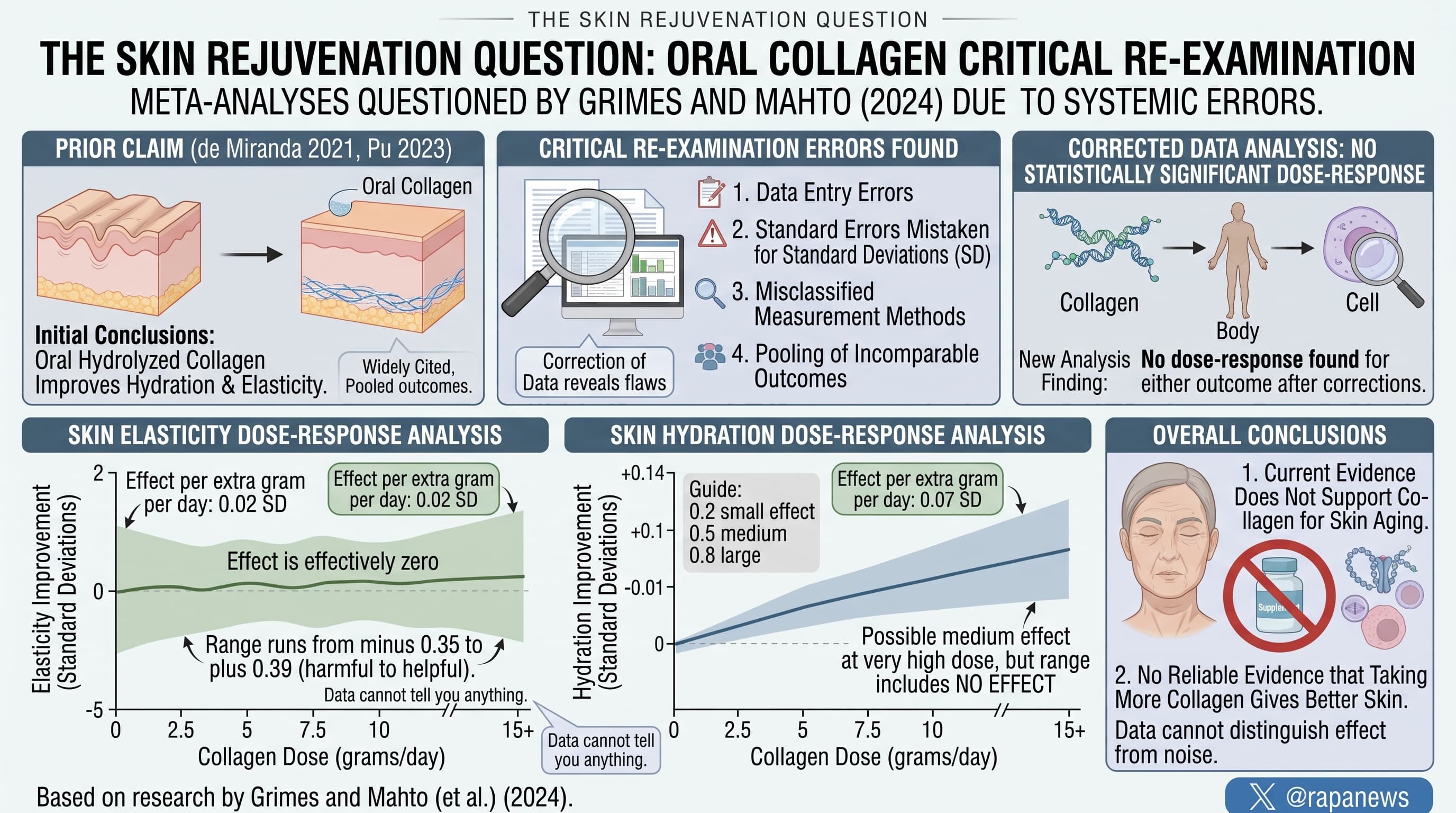
Two widely cited meta-analyses (de Miranda 2021 and Pu 2023) concluded that oral hydrolyzed collagen improves skin hydration and elasticity. Grimes and Mahto re-examined both and report data entry errors, standard errors mistaken for standard deviations, misclassified measurement methods, and pooling of outcomes that cannot be compared. After correcting the data and testing whether higher collagen doses produce bigger effects, they found no statistically significant dose-response for either outcome. They conclude that current evidence does not support recommending collagen for skin aging. That conclusion is stronger than their own analysis strictly supports, particularly for hydration.
Collagen powders are among the best-selling “beauty from within” products, and their marketing leans on two meta-analyses. A 2021 analysis of 19 trials and a 2023 analysis of 26 trials both reported that swallowing hydrolyzed collagen for about 90 days improved skin hydration and elasticity. A biostatistician at Trinity College Dublin and a London dermatologist have now gone back through the underlying numbers, and the result is uncomfortable for the supplement industry.
The first problem is basic bookkeeping. The 2021 analysis said five hydration studies reported results in micrometers. None did. Eight of the nine used capacitance devices that report arbitrary units. Several trials had their standard errors entered as standard deviations, a mistake that makes a study look far more precise than it is and inflates its apparent effect. One trial with no placebo group was included. In the 2023 analysis, one study was counted despite being explicitly excluded in the text, another contributed “hydration” data from a survey question, and a result the original authors called non-significant was entered as highly significant.
The second problem is conceptual. Both meta-analyses pooled results using standardized mean differences, which assumes that different instruments are measuring the same thing on different scales. A percentage change, a suction-based elasticity ratio and a pressure reading in megapascals are not the same construct. The resulting inconsistency between studies was extreme, with heterogeneity scores above 90 percent, a level at which a single pooled number means very little.
The third problem is dose. Trials used anywhere from about 0.25 to 10 grams a day, a 40-fold range, yet both meta-analyses treated collagen as a yes-or-no exposure. The new paper corrected the data and ran a meta-regression, asking whether more collagen gave more benefit. Across 16 hydration and 18 elasticity studies, it did not, at least not to a statistically significant degree. For a real pharmacological effect, the authors argue, some gradient should be visible.
Then there is funding. In the 2021 dataset, seven of nine hydration trials were industry sponsored. Four of those seven reported a benefit. Neither of the two independent trials did. The elasticity trials showed the same pattern.
The authors go further than calling for better trials. They say collagen should not be promoted or recommended in dermatology practice, and suggest professional bodies advise against endorsing it.
Some caution is needed in the other direction. The paper tests whether benefit rises with dose. It does not report a corrected overall estimate of collagen versus placebo. In the hydration plot, most trials still sit above zero, and the dose trend narrowly missed significance. A benefit that plateaus at a low dose would be invisible to this method. The fair reading is that the positive case for collagen was built on flawed analyses and is now unproven, not that collagen has been shown to do nothing.
Actionable Insights
There is no reliable evidence that taking more collagen gives better skin. For elasticity, each extra gram per day changed the result by 0.02 standard deviations, which is effectively zero, and the plausible range ran from clearly harmful to clearly helpful (minus 0.35 to plus 0.39). In plain terms, the data cannot tell you anything. [Confidence: High]
Hydration is less clear cut. Each extra gram per day was linked to a 0.07 standard deviation improvement, with a plausible range of minus 0.01 to plus 0.14. As a rough guide, 0.2 is a small effect, 0.5 medium and 0.8 large. Going from 2.5 to 10 grams daily would predict about half a standard deviation, a medium effect, but the range includes no effect at all. [Confidence: Medium]
Practical points:
- If you take collagen for skin, treat it as an unproven bet, not an evidence-based intervention.
- High doses are not justified by the data.
- Even the positive trials measured instrument readings. A 5 percent change on a hydration meter may not be visible in a mirror.
- Trust in collagen trials should be discounted for sponsorship: 4 of 7 industry hydration trials were positive against 0 of 2 independent ones.
- Sunscreen and topical retinoids have far stronger evidence for skin aging.
Context/Source
- Open Access Paper: “Hydrolyzed Collagen for Skin Aging Meta-Analyses Are Unreliable”
- Institutions: TCD Biostatistics Unit, School of Medicine, Trinity College Dublin, and Self London (a private clinic)
- Countries: Ireland and United Kingdom
- Journal: Journal of Cosmetic Dermatology (Wiley), 2026; 25:e71208
- Impact evaluation: The impact score of this journal is 2.5, evaluated against a typical high-end range of 0–60+ for top general science, therefore this is a Low impact journal. Within dermatology specifically it is a mid-tier (Q2) specialty title.