what else do you take as part of your ATap boosting combination?
I haven’t done this for a while, but I did take Methylene Blue and Creatine.
1 Like
You’ve successfully convinced me to stop taking patented CoQ10. Since it’s already hard to nail down the right dosage for standard CoQ10, it’s even trickier for those special formulas claiming high bioavailability. I only took it because of the hype, but looking back at the scientific research, I’ve realized this ingredient is actually quite underwhelming.
1 Like
CoQ had a very strong result and all cause mortality reduction here. 32% relative risk reduction
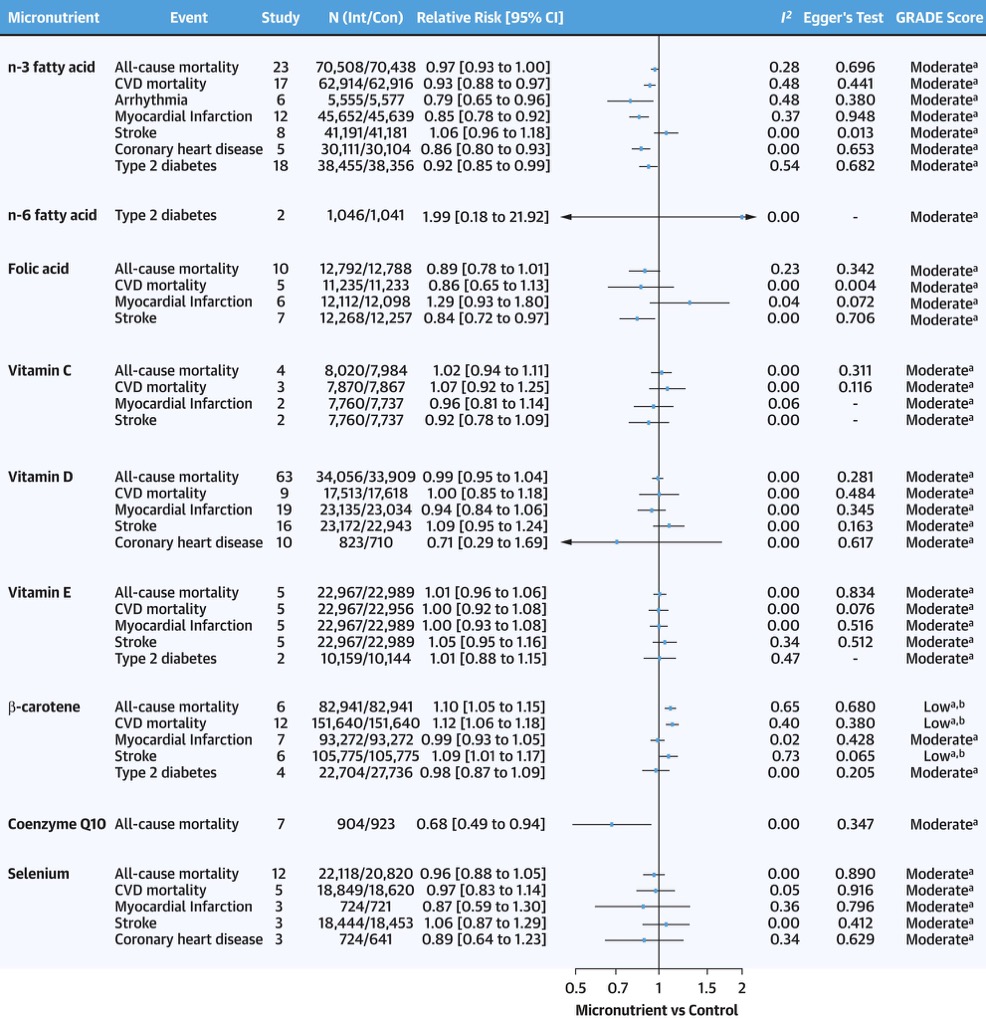
In the interest of fairness, here are the limitations (from Grok)
- Small sample size: Only ~1,827 people across 7 trials. Compare that to n-3 (140k+ people) or Vitamin D (67k+). Small studies can overestimate benefits, and results can shift with new larger trials.
- Population matters: CoQ10 benefits in these trials often come from people with existing heart failure or cardiovascular disease (where CoQ10 levels are commonly low). It may not translate the same way to healthy people for general “longevity.”
- Evidence limitations: GRADE is only “Moderate” (common issues in supplement trials: blinding, compliance, etc.). Later studies (post-2022) on general populations sometimes show neutral results or even potential harm in subgroups like obese individuals.
- Context from broader research: This chart comes from a 2022 umbrella review (JACC). Many CoQ10 studies focus on heart failure patients, where benefits on mortality, hospitalizations, and symptoms are more consistently reported (often RR around 0.6–0.7). In healthy or general populations, the all-cause mortality benefit is less certain.
3 Likes
What’s the source?
But what’s the underlying paper?
I tried finding it from the comments but … nothing helpful there.
Given its recency, likely this study:
Although that article refers to a Nature article from 2025: AAV gene therapy for autosomal recessive deafness 9: a single-arm trial | Nature Medicine
Lilly bought a company for related approach: Lilly Strengthens Hearing Therapeutics Strategy in $1.12B+ Gene-Editing Deal With Seamless | Hearing Health & Technology Matters
1 Like
I couldn’t find it from the comments either. I am guessing it was a chart made of all the studies in a compilation by someone. Probably he made it himself
OK, so I guess it’s BS.
Here. He did link it in the comments. It’s part of the antioxidant study
1 Like
Seems like a wonderful guy.
Jordan Lasker (also known on social media as Crémieux Recueil) is an American internet personality and independent researcher who argues for a genetic relationship between race and intelligence. He has promoted natalism and allegedly supports eugenics.[1][2] On X and Substack, Lasker is known for compiling charts on what he calls the “Black-White IQ gap”.[3] His research on race and intelligence has been criticized by academics as an example of pseudoscience entering mainstream academia.[4][5][6]
Background
Lasker was a PhD student at Texas Tech University.[4] He resides in Macon, Georgia.[7]
In 2025, an investigation by the magazine Mother Jones found that between 2014 and 2016 Lasker had made many anti-Semitic and racist posts on Reddit under the pseudonym Faliceer.[7] In 2016, the account Faliceer self-identified as a “Jewish White Supremacist Nazi”. He also wished Adolf Hitler a happy birthday, promoted eugenics and attacked interracial relationships.[7]
I don’t care what any of that says about him. We are talking about CoQ10.
1 Like
Yes, don’t shoot the messenger. Anyway it’s a 2022 looking at heart failure. From what I remember more recent studies that looked at Q10 in heart failure didn’t find that? But we should look at the trials included in that 2022 paper. I’ll do that later…
1 Like
Recent Chinese study
Results :Our MR analysis revealed that genetically predicted plasma CoQ10 levels was inversely associated with of any stroke (AS, OR = 0.803, 95% CI: 0.659–0.978, p=0.029), any ischemic stroke (AIS, OR = 0.792, 95% CI 0.651–0.964, p = 0.020) and small vessel stroke (SVS, OR = 0.512, 95% CI 0.294-0.892, p = 0.018). However, no associations were observed between genetically predicted plasma CoQ10 and large artery stroke (LAS), cardioembolic stroke (CES), intracranial hemorrhage (ICH), atrial fibrillation (AF), myocardial infarction (MI) or heart failure (HF).
Conclusions :Our MR analysis implies a protective effect between higher plasma CoQ10 levels and AS, AIS or SVS. The results and the underlying pathways or mechanisms between plasma CoQ10 levels and stroke needs further investigation.
So MR finds no effects on heart failure even though the trials that found ACM benefits were in heart failure? Not great? (although prevision <> cure)
I started 200mg NOW ubiquinol three weeks ago. After about a week, virtually all the shoulder and neck pain I got from the strain of backpack straps while ‘rucking’ disappeared. And my timed performance for the full walk improved about 2-3%. It’s a walk I’ve been doing for 21 years, so have a good sense of when something shifts the effort required. I take 5mg rosuvastatin. But even prior to starting that, I had pain. So I would say its an improvement that’s not just offsetting statin degradation. If it’s my imagination, I hope my imagination can keep it up!
1 Like
Supplementation of coenzyme Q10 (median dose 50 mg/d; range 33.3-100 mg/d) reduced all-cause mortality (RR: 0.68; 95% CI: 0.49-0.94) in 7 trials performed in heart failure patients.
But I can’t find the list of the 7 trials included.
Also, last year the Heart Failure Association (HFA) of the European Society of Cardiology (ESC) published a scientific statement in the European Journal of Heart Failure: The crosstalk between immune activation and metabolism in heart failure. A scientific statement of the Heart Failure Association of the ESC 2025
Cardiac metabolism in HF can also be beneficially targeted by specific drugs, by improving mitochondrial membrane stability, mainly dependent on cardiolipin and coenzyme Q10.202, 203 Coenzyme Q10 is an obligatory component of the respiratory chain in mitochondria and plays an essential role in ATP formation in most tissues, including the heart. In addition, Q10 has antioxidant properties and protects circulating low-density lipoprotein particles from oxidation. Its inhibition of the mitochondrial permeability transition pore prevents the activation of apoptotic cascades and the oxidative inactivation of key proteins involved in ATP production204 (Table 1). Lower levels of coenzyme Q10 are associated with worse HF symptoms, lower ejection fraction and higher NT-proBNP.205, 206 However, association between its values and mortality remains controversial.207 Coenzyme Q10 supplementation improved HF symptoms and reduced major cardiovascular outcomes in patients with HF in a randomized controlled trial.208 However, a more recent meta-analysis, due to the low quality of available data, concluded for no convincing evidence supporting the use of coenzyme 10 in patients with HF.209
Ref 209 = the 2021 Cochrane review
In terms of Mendelian randomization, I quickly checked and found positive effects for stroke but not more.
So Q10 still looks as disappointing. Although anecdotal evidence of benefits such as the one of @none above is interesting!
1 Like
I still lean on it being a slight positive. Nothing amazing but probably better than most other supplements. No downside of taking it other than spending money. It does seem to have quite a lot of positive anecdotes for whatever that’s worth. I have been using it for so long that I would have to come off to know if I can notice any subjective benefit of it.
I recently switched from 2.5 Rosuvastatin to 2mg Pitavastatin, which depletes CoQ10 far less so I have have less of a need for it now anyway. I still would rather use it just in case.
Side note, it would be nice to have this and the other recent CoQ10 thread merge together.