You will see the effect of an admittedly high dose on the feedback systems for glucose. Because I have long periods between rapamycin I think I see my glucose feedback system stabilising before rapamycin knocks it off balance again. I don’t think it is an immediate thing, but happens after a couple of days and because initially of hepatic insulin resistance and then the other systems over compensate and it ends up with a period of really high insulin responses without the insulin resistance.
I will do another CGM session before I use rapamycin again.
I’ve been doing the same combo of rapa and rosuvastatin and it also raises my A1C. I’m taking a hiatus from Rapamycin for the time being to see if it improves the A1C.
How is it all supposed to happen then? Mechanistically? I’d think that if glucose is getting dumped out in urine it shouldn’t be available to wreak havoc on internal systems through dysregulation of its oxidization? Or is this a question for ChatGPT deep research mode? Just trying to think of a plausible mechanism.
I noticed you’re using Libre. Have you validated the Libre readings with a glucose meter? I found that Libre was consistently off by about 1 mmol/L, so I wouldn’t fully trust the absolute numbers — though the spikes are probably accurate. I’ve since switched to Dexcom, which I find far more accurate, especially since it can be calibrated against a glucose meter.
On a somewhat related note, I started an SGLT2 inhibitor and noticed my A1C rose by 0.4% — despite better glucose control as shown by Dexcom (tight curves, low variability, and 100% time in range). The likely reason? SGLT2s stimulate erythropoietin (EPO), which increases red blood cell lifespan. Since A1C reflects cumulative glucose exposure over the life of a red blood cell, older cells can show more glycation — artificially inflating the A1C, even when actual glucose levels are lower.
Thanks @CronosTempi , I have edited my post to clarify my points. Basically, i noticed that if I take rosuvastatin 5mg daily, along with sirolimus 5mg weekly, I seem to experience glucose dysregulation. So, as an experiment, I’m trying rosuvastatin 5mg only once a week, to see if it makes any difference to glucose, while also seeing if I still get any significant lipid loweing effect (in addition to Ezetimibe + Bempedoic acid, which I continue to take on a daily basis).
Got it, thank you! Out of curiosity, is there a particular reason you settled on rosuvastatin rather than any other statin? I ask because I myself am prediabetic and trying to lower both ApoB and A1c. And to that end, I switched from 10mg/day atorvastatin to 4mg/day pitavastatin. The idea being that atorvastatin - like rosuvastatin - is linked to glucose disregulation and new onset diabetes, meanwhile pitavastatin is not (also there are many other things to like about pitavastatin).
Thanks @LukeMV, for sharing your similar experience. You did mention in the past that rosuvastatin alone is not causing glucose dysregulation in your case, so it is more likely rapa doing it (or perhaps in combination)
I will run another experiment taking a 3-month break from sirolimus, will also consider taking a break from rosuvastatin, or perhaps take it less frequently… I’m trying not to change too many variables in my experiment… In my case, I’m not dependent on statins as such, since I believe my risk profile is quite low (CAC score zero, very low Triglycerides 45 mg/dL, very low HomaIR 0.44, hsCRP < 0.4), I’m basically taking low-dose lipid lowering meds to keep my lifetime LDL exposure low.
Noted @CronosTempi. I didn’t have a hard-science reason for picking rosuvastatin as such. Basically, 1) I followed Dr Brad Stanfield’s research videos, 2) took a note that it is water soluble (which I now know may not necessarily be the case, as it could potentially cross the blood brain barrier in some people), and 3) thought that I can get away with a baby dose of 5mg, 4) More potent than other statins, at low dose.
Sure, at some stage, I’ll experiment with other forms of statins (Pravastatin / Pitavastatin) that have some meta-analysis suggesting lowest risk for new onset diabetes.
Thanks @JeffW , excellent analysis. Yeah, I did think about this one, I understand that HbA1c is not a perfect marker by any means. My Homa-IR is very low at 0.44 when last tested (likely suggesting that my glucose regulation is generally quite good). However, with a combo of weekly rapa + daily rosuva (consistently taken for 4 weeks), I noticed my HbA1c significantly went up (with all other variables largely remaining the same), which prompted me to slap on my CGM (yes, it is Abbott Freestyle Libre 2) to observe the patterns. Sure, will consider using Dexcom at some stage.
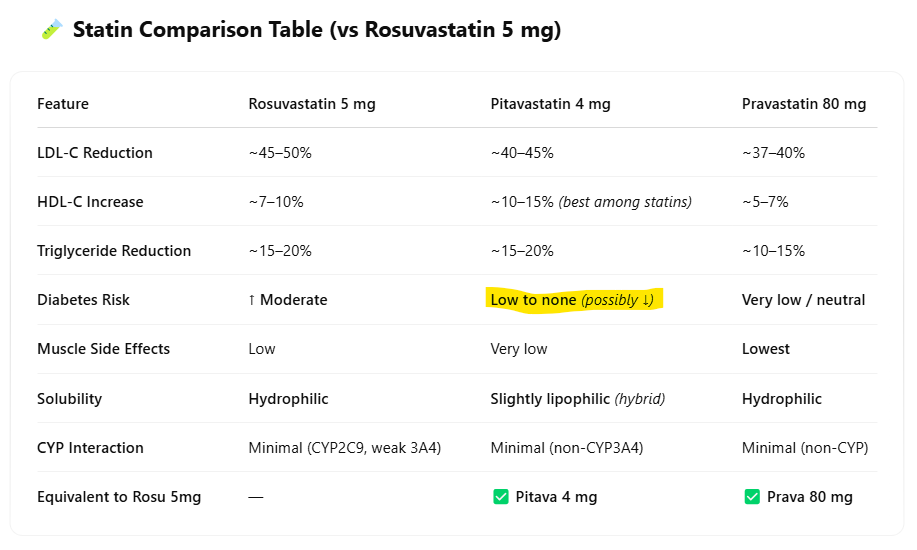
@CronosTempi , here is ChatGPT comparison for equilavent of rosuva 5mg (just for general reference, to be viewed with caution)… At low dose 4mg, Pitava seems to make a good case for me to try
I don’t really see the issue here, to be honest? Your glucose went up after eating a burrito, which isn’t a surprise. And it never went hyperglycaemic. The movement up and down is quite normal because digesting the food over several hours and it’s being constantly absorbed, and you are also clearing it from the blood. If you add activity like walking, that’s going to accelerate the clearance. That is balanced with increasing and decreasing your hepatic glucose output, all aimed at keeping your blood glucose relatively stable. To me, that “up and down” looks like homeostasis working perfectly.
Pretty ambitious, depending on your genetics. Based on the goals, why not add some fasting, taking the Rapamycin at the start of the fast? I think that would give you better mTORC1 activity reduction, and it’s also a way of lowering glucose area under the curve.
Another good video with Kaeberlein on Siim Land’s podcast. I like these collaborations.
I. Executive Summary
In this interview, biogerontologist Dr. Matt Kaeberlein evaluates current geroscience therapeutics, off-label longevity protocols, and consumer biomarker metrics. He addresses high-profile public departures from geroprotective regimens—specifically Bryan Johnson’s cessation of rapamycin—labeling the decision-making framework unscientific. Johnson’s reliance on commercial epigenetic clocks to judge rapamycin’s efficacy is fundamentally flawed because those same clocks fail to register positive biological signals from proven healthspan interventions like physical exercise and dietary optimization. Furthermore, attributing transient blood lipid or glycemic perturbations solely to rapamycin in an individual concurrently executing over 100 uncontrolled interventions lacks scientific rigor.
Kaeberlein emphasizes that while no randomized controlled trials (RCTs) have proven that rapamycin extends human lifespan, robust rodent data confirm multi-species lifespan extension (Harrison et al., 2009). Human observational data and clinical trials evaluating mTOR inhibition—such as low-dose everolimus trials—demonstrate improved antiviral immune responses and enhanced vaccine titers in elderly cohorts rather than systemic immunosuppression (Mannick et al., 2014). Off-label intermittent rapamycin regimens show minimal adverse events beyond aphthous stomatitis (canker sores) in approximately 15% of users.
Kaeberlein establishes a stark hierarchy between lifestyle practices and supplementation, assigning a 90–95% weight to lifestyle (resistance training, cardiovascular conditioning, sleep, and whole-food nutrition) and less than 10% to geroprotective supplements. He debunks popular longevity compounds, noting that meta-analyses across dozens of animal studies prove resveratrol has a net zero effect on lifespan [Source unverified in live search]. Among small molecules, Kaeberlein ranks SGLT2 inhibitors (canagliflozin) and acarbose higher than metformin, noting that metformin fails to extend lifespan in non-diabetic rodent models within the National Institute on Aging Interventions Testing Program (NIA ITP) and actively blunts exercise-induced mitochondrial adaptations (Konopka et al., 2019).
Regarding diagnostic metrics, Kaeberlein criticizes commercial direct-to-consumer epigenetic clocks, citing trial data where duplicate blood samples evaluated across four commercial vendors yielded biological age disparities exceeding 20 years. He concludes that current commercial clocks lack the precision required to guide clinical interventions. Finally, Kaeberlein discusses middle-to-late life rapamycin initiation, showing that starting mTOR inhibition later in life retains the majority of geroprotective benefits while minimizing lifetime exposure risks.
II. Insight Bullets
Flawed Rationale for Rapamycin Cessation: High-profile public claims that rapamycin is ineffective based on consumer epigenetic clocks are invalid, as these clocks fail to capture verified geroprotective effects from exercise and nutrition.
Confounding in Uncontrolled Protocols: Attributing glycemic or lipid dysregulation to rapamycin while simultaneously taking dozens of unvalidated compounds violates scientific methodology.
Absence of Human Lifespan RCTs: No completed Phase 3 clinical trials exist proving rapamycin extends human lifespan; evidence remains restricted to preclinical animal models and human surrogate biomarkers.
Preclinical Robustness of mTOR Inhibition: Rapamycin consistently extends median and maximum lifespan across multiple model organisms, including yeast, worms, flies, and mice (Harrison et al., 2009).
Reversal of Immunosenescence: Low-dose or intermittent mTOR inhibition enhances immune function and vaccine response in older adults rather than causing clinical immunosuppression (Mannick et al., 2014).
COVID-19 Off-Label Survey Findings: An observational survey of 333 off-label rapamycin users revealed a lower incidence of moderate-to-severe COVID-19 outcomes and reduced long-COVID symptoms compared to non-users [Source unverified in live search].
Prevalence of Aphthous Stomatitis: The primary statistically significant side effect of off-label intermittent rapamycin use is oral canker sores, occurring in roughly 15% of users.
Preservation of Muscle Mass: Contrary to fears of muscle wasting, low-dose mTOR inhibition preserves lean mass and mitigates age-related sarcopenia in preclinical models.
Failure of High-Dose Exogenous Antioxidants: Mega-dosing general antioxidants fails to extend lifespan and disrupts essential reactive oxygen species (ROS) cellular signaling required for physiological adaptation.
Targeted Antioxidant Therapies: Future antioxidant interventions must target specific intracellular compartments (e.g., mitochondria-targeted peptides like SS-31) rather than flooding systemic circulation.
Dominance of Lifestyle Over Supplementation: Lifestyle interventions account for 90–95% of achievable healthspan extension, whereas geroprotective supplementation contributes less than 10%.
Utility of Deficiency Correction: Standard supplements (Vitamin D, Omega-3 fatty acids) provide significant mortality reduction only when correcting clinically documented baseline deficiencies.
High Confidence in SGLT2 Inhibitors: SGLT2 inhibitors (canagliflozin, empagliflozin) represent the most promising post-rapamycin longevity class, extending male mouse lifespan in NIA ITP trials (Miller et al., 2020).
Correlative Human SGLT2 Inhibitor Data: UK Biobank observational analyses demonstrate reduced all-cause mortality in individuals taking SGLT2 inhibitors compared to propensity-matched controls [Source unverified in live search].
Geroprotective Potential of 17-Alpha Estradiol: Non-feminizing estrogens (17-alpha estradiol) robustly extend male lifespan in NIA ITP rodent studies (Strong et al., 2016).
Acarbose Lifespan Effects and Intolerance: Acarbose extends male rodent lifespan by blunting postprandial glucose spikes (Harrison et al., 2014), but exhibits poor human compliance due to gastrointestinal distress on Western diets.
Metformin Inefficacy in Healthy Non-Diabetics: Metformin failed to extend lifespan in NIA ITP mouse trials and blunts hypertrophic and mitochondrial exercise adaptations in healthy adults (Konopka et al., 2019).
Definitive Refutation of Resveratrol: Meta-analyses of over 50 animal studies confirm that resveratrol produces an average lifespan extension of zero, debunking its status as a geroprotector [Source unverified in live search].
Risks of Unmonitored Polypharmacy: Stacking 10–30 unvalidated supplements creates unpredictable biological interactions (“pulling wires at random”), increasing toxicity risks without compounding benefits.
Extreme Inconsistency in Commercial Epigenetic Clocks: Same-day duplicate testing across four commercial consumer biological age vendors produced results spanning a 20-year age variance, demonstrating high analytical noise.
Mathematical Nature of Epigenetic Clocks: Epigenetic clocks calculate a statistical correlation to population mortality risk rather than measuring a direct, isolated unit of biological age.
Heterogeneity of Peptide Therapeutics: Peptides cannot be evaluated as a single class; naturally occurring repair peptides (BPC-157) differ fundamentally from synthetic endocrine secretagogues.
Sarcopenia Risks of GLP-1 Receptor Agonists: GLP-1 agonists (semaglutide, tirzepatide) induce substantial lean muscle mass loss alongside fat loss, exacerbating sarcopenic obesity if unmitigated by resistance training and high protein intake.
Thymic Regeneration via the TRIIM Protocol: The TRIIM protocol (recombinant human growth hormone, DHEA, and metformin) reverses age-related thymic fat infiltration and restores immune cell output (Fahy et al., 2019).
Mechanistic Support for Therapeutic Plasma Exchange (TPE): TPE dilutes circulating pro-inflammatory factors, senescent cell secretomes, and environmental toxins, backed by heterochronic parabiosis research.
Equivalence of Oral NAD Precursors vs. IV Drips: Intravenous NAD+ infusions show no verified therapeutic superiority over low-cost oral precursors (Niacin, Nicotinamide, NR, NMN) in establishing systemic NAD homeostasis.
Developmental vs. Adult IGF-1 Paradox: Low IGF-1 during development extends lifespan and reduces disease incidence in animals, but severe protein restriction to lower IGF-1 in adults past age 55 increases frailty and mortality.
High Protein Requirements for Older Adults: Consuming 1.2–2.2 g/kg (0.6–1.0 g/lb) of daily protein paired with progressive resistance training is essential past age 55 to prevent sarcopenia and osteoporotic fractures.
CNS Autonomy in Cognitive Decline: Dog Aging Project data indicates that small dogs (low systemic IGF-1) experience canine cognitive dysfunction at rates identical to large dogs, demonstrating that systemic IGF-1 levels do not dictate brain aging trajectory.
Late-Life Rapamycin Initiation Efficiency: Initiating rapamycin in middle-to-late adulthood captures nearly identical lifespan extension benefits as early-life initiation while significantly limiting long-term side-effect exposure.
IV. Actionable Protocol (Prioritized)
High Confidence Tier (Level A/B Evidence)
Foundation Lifestyle Architecture: Maintain a progressive exercise protocol combining Zone 2 cardiovascular training, high-intensity interval training (HIIT), and progressive resistance training 3–5 times per week (PMID: 32051287).
Targeted Daily Protein Dosing for Sarcopenia Prevention: Consume 1.2 to 2.2 g/kg (0.6–1.0 g/lb) of total body weight in high-quality whole-food protein daily past age 55 to maintain lean skeletal muscle mass and bone mineral density.
Correction of Verified Micronutrient Deficiencies: Supplement exclusively to resolve documented serum deficiencies (e.g., Vitamin D3 for 25(OH)D<30 ng/mL; Omega-3 fatty acids for Omega-3 Index <8%).
GLP-1 Co-Therapy Mandatory Resistance Training: If prescribed GLP-1 receptor agonists (semaglutide/tirzepatide) for metabolic disease, mandate high daily protein intake (1.6–2.2 g/kg) and progressive resistance training to prevent severe sarcopenia and osteoporotic lean mass loss.
Experimental Tier (Level C/D Evidence with High Safety Margins)
Off-Label Intermittent Rapamycin Regimen: Low-dose intermittent rapamycin (e.g., 3–6 mg administered once weekly) under direct medical supervision, utilizing baseline and continuous monitoring of fasting lipids, HbA1c, and complete blood counts.
SGLT2 Inhibitor Utilization for Metabolic Longevity: Prescription SGLT2 inhibitors (canagliflozin 100–300 mg daily or empagliflozin 10–25 mg daily) under physician oversight for glycemic control and cardiovascular risk reduction (Miller et al., 2020).
Thymic Rejuvenation Protocol (TRIIM Framework): Implementation of rhGH combined with DHEA and an insulin-sensitizing agent (SGLT2 inhibitor or metformin) under volumetric MRI monitoring of the anterior mediastinum and serial T-cell subset tracking (Fahy et al., 2019).
Therapeutic Plasma Exchange (TPE): Periodic TPE in clinical settings to clear circulating senescent cell secretomes, pro-inflammatory cytokines, and heavy metals in aged or high-inflammatory cohorts.
Red Flag Zone (Claims Debunked or Safety Data Absent)
Resveratrol Supplementation: Purchasing or taking resveratrol for longevity purposes (Debunked; Zero Net Lifespan Effect across meta-analyses).
Metformin Monotherapy in Healthy Exercising Individuals: Using metformin as a primary longevity agent in non-diabetic individuals who exercise (Blunts Exercise Adaptations; Konopka et al., 2019).
Unmonitored Polypharmacy Stacking: Consuming stacks of 10–30+ unvalidated longevity supplements without biomarker tracking (High Toxicity Risk; Safety Data Absent).
High-Dose General Exogenous Antioxidants: Mega-dosing Vitamin C, Vitamin E, or N-acetylcysteine (NAC) prior to exercise (Blunts Hormetic Adaptation and ROS Signaling).
Clinical Decision-Making via Consumer Epigenetic Clocks: Altering medical protocols or drug dosages based on direct-to-consumer DNA methylation tests (High Noise / Poor Precision; Safety Data Absent).
Just to be clear, at this point there have been human trials, probably easy to find; one had only 5 humans but they saw RESTORATION OF HIPPOCAMPAL VOLUME… unheard of before. Other study had I think at least 50 ppl and they all reported they felt much better and had fewer aches and pains and a few had some canker sores and they were slow to report it because they were afraid they would be taken off the rapamycin and they felt so much better overall that the mouth sores were worth it. AZ state university started a larger study this year as well-- all humans.