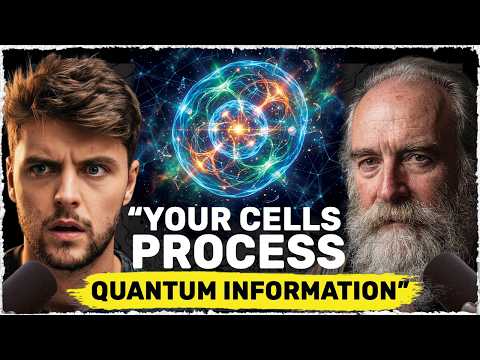
chatGPT:
Tidy transcript (cleaned, with structure)
0:00–1:46 — Quantum isn’t “just the tiny realm”
- Host opens by challenging the common “quantum = atoms and below, classical = everything else” split.
- Mentions long-distance entanglement demonstrated across thousands of kilometers via satellites; notes quantum communication relies on entangled states and this conflicted with Einstein’s intuitions.
- Introduces Dr. Chris Fields: independent researcher; career spanning nuclear physics → early genomics → quantum information theory; now collaborating with Michael Levin and Karl Friston.
- Framing claim: we draw boundaries to define objects, but that boundary-drawing may be the biggest unexamined assumption in science.
1:47–3:51 — Michael Levin and “agentive” biology
- Fields describes Levin’s influence: shifting biology from purely mechanistic descriptions to agentive / informational descriptions.
- Example puzzle: morphogenesis—how do cells know when to stop? (e.g., limb bud stops growing fingers at the right size).
3:52–7:12 — Fields’ “random walk” career + why boundaries matter
- Fields: career evolved as a “random walk” driven by interesting opportunities.
- Boundary interest originated in nuclear structure physics: multiple incompatible descriptions (rotational, vibrational, particle excitations, etc.) can map onto the same measured energy.
- Generalization: we mix observables to define “objects.”
- Humans learn objecthood as infants via sensory-motor experience: deciding “this is an object” is drawing a boundary.
7:12–8:48 — Sponsor segment (Consensus.ai)
- Promotional interlude about using Consensus.ai for paper search/summaries.
8:48–12:10 — Objecthood as state-space decomposition + “system identification”
- Fields: calling something an object = selecting a subset of state space as “states of this thing” vs “not this thing.”
- Example: the atoms of his body dispersed 100 miles apart wouldn’t be called an “object.”
- Science assumes the world is full of “things” without asking what measurements let observers identify systems.
- “System identification” is an old cybernetics concern; became influential in psychology/robotics.
12:10–15:21 — Philosophy of language + black-box limits
- Fields discloses: PhD in philosophy.
- Discusses Quine (ambiguity of reference): no amount of dialogue guarantees two speakers refer to exactly the same thing.
- Links to E.F. Moore (cybernetics): for a black box, no finite set of observations uniquely determines the internal mechanism.
- Connects to quantum info / security: what can be determined by finite experiments matters for cryptography, channel tamper detection, etc.
- Broader question: can we ever know that “what I see now” is the same system as “what I saw earlier”?
18:24–28:14 — What quantum information theory is (Fields’ version)
-
Quantum theory developed for atomic spectra; single-particle interference shows wave-like behavior.
-
Assumption of “quantum below, classical above” challenged by:
- black hole physics (Hawking radiation framing),
- quantum computation (Feynman and successors),
- entanglement experiments.
-
Explains entanglement: a Bell-state pair cannot be factored into independent states.
-
Einstein–Podolsky–Rosen argued theory incomplete; Aspect’s experiments (1980s) strongly supported entanglement correlations.
-
Emphasizes: entanglement now observed over very large distances (including satellite-mediated).
-
Quantum comms: if an intruder interacts, correlations degrade; you detect by comparing over a classical channel (noting that classical-channel security is a practical loophole).
-
“Translation”: physics as information exchange; any interaction can be represented as communication.
28:21–36:04 — Neurons as communication systems + what “quantum adds”
-
Host asks for grounding example: neuron A ↔ neuron B across synapse.
-
Fields gives classical account: neurotransmitter packets → diffusion → receptors → ion channels.
-
Analogy: like speech → microphone → internet bits → speaker → listener response.
-
“Quantum adds”:
- possibility of manipulating a shared quantum resource (entanglement),
- recognition that communication decomposes into discrete units; bits cost energy (Boltzmann/Shannon/physics-of-information),
- deeper point: as an acting system, you can’t measure your full impact on the world; you can’t guarantee you acted only on “one object.”
36:04–42:24 — Interfaces, Markov blankets, and limits of replication
-
Fields: the “you can’t fully infer the world behind the interface” theme appears in:
- cybernetics (black-box theorems),
- holography (info encoded on boundaries),
- Markov blankets (statistical physics),
- Hoffman’s interface theory of perception,
- user-interface design (“hide implementation details”).
-
Example: using Microsoft Word doesn’t let you deduce the underlying machine architecture.
-
Consequence: exact replication of experiments is impossible (Heraclitus “same river”): finite observers can only approximate context; total control would require infinite energy.
42:24–44:26 — Sponsor segment (BetterHelp)
- Promotional interlude about online therapy.
44:26–52:29 — Where this connects to Michael Levin + “biology as cognition”
- Host asks how boundaries/Markov blankets/QIT fit Levin collaboration.
- Fields: method shift—thinking of molecules/cells/tissues as information processors changes what experiments you imagine.
- Agentive framing helps re-ask hard questions (like “how do they know when to stop?”).
- Another implication: model organisms in terms of what they can detect and how they model their environment.
- Invokes Nagel (“what is it like to be a bat?”) as analogous to the challenge of imagining bacteria/immune cells/cancer cells’ “world models.”
52:29–1:05:15 — Do cells represent 3D space?
- Fields’ favorite concrete research question: do individual cells (or simple organisms) have any experience/representation of 3D space?
- He scales the question across organisms: mammals/birds/fish seem clearly spatial; trees/sponges/paramecia unclear.
- Example: Lacrymaria hunting with a long “neck”—does it represent targets in 3D, or is control purely local (Rodney Brooks’ distributed robotics analogy)?
- Claims QIT gives guidance: to build a reference frame for 3D space you need distinguishable objects (distinguish by non-spatial properties, e.g., clocks with different frequencies) to define directions/locations.
1:05:15–1:16:09 — Conscious Agent Theory (Hoffman) and Fields’ stance
-
Fields has co-authored papers with Hoffman/Prentner; says he’s not fully up to date on their latest assumptions.
-
Defines “agent” (in that formalism): essentially a loop of Markovian kernels—perception → decision → action.
-
Contrasts two approaches:
- bottom-up: build simple agents and network them;
- top-down (Fields’ preference): start with a universe where information is conserved (unitarity), then cut it with a boundary and analyze information flow.
-
Notes memory/time require sufficient internal degrees of freedom; “one-bit agents” can’t have memory, clocks, metabolism, etc.
1:16:09–1:21:46 — Boundaries as what systems can know about each other
-
Host: central claim seems to be understanding systems via information exchange encoded on boundaries.
-
Fields: distinguishes:
- theorist’s stipulative global description,
- subsystem A’s viewpoint,
- “not-A” viewpoint.
-
For subsystem A, what it can learn about not-A is whatever is accessible at the boundary/interface.
-
Wrap-up: Fields excited by the shift toward thinking of biological systems as communicating agents.
Summary (what the episode argues)
- Objects and systems aren’t “given”; they’re constructed. Fields argues that calling something an object is an act of boundary drawing—a practical, learned decomposition of the world into “systems” we can track and measure.
- Finite observers face black-box limits. From cybernetics and philosophy of language (Quine, black-box theorems), he emphasizes that no finite evidence uniquely pins down what’s “inside” or guarantees that two observers mean the exact same referent—or even that “the same system” persists across time in the way we assume.
- Quantum information reframes physics as communication. He presents QIT as a shift from “small weird stuff” to a general language where interactions = information exchange, with entanglement as an extra resource and with energetic/operational limits made explicit.
- Biology benefits from agentive/informational framing. In line with Michael Levin’s work, Fields argues that treating cells/tissues as information-processing agents reshapes experimental questions—especially about control, stopping rules, and how organisms model their worlds.
- Concrete research target: spatial representation in simple systems. He proposes probing whether cells/single-celled organisms construct anything analogous to 3D spatial reference frames, and suggests QIT offers constraints on what’s required to build such frames.
Critique (strengths, weaknesses, and what to watch for)
What’s strong
- Unifies several traditions cleanly. The episode successfully connects cybernetics (system ID), philosophy of reference, UI/interface metaphors, and quantum information into a single “boundary/observer” narrative. That synthesis is genuinely useful as a conceptual hygiene tool: it forces you to ask “what operationally defines the system?”
- Good move toward actionable biology questions. The “how do they know when to stop?” morphogenesis framing and the “do they represent 3D space?” proposal are concrete enough to be testable, which helps prevent pure metaphysics.
- Emphasizes observer limitations without slipping into nihilism. The point isn’t “science is impossible,” but “science is operational and approximate”—replication is constrained by finite control, and objecthood is a modeling choice.
Where it overreaches or blurs categories
- Entanglement description risks misleading metaphysics. Phrasing like “it’s just one object extended across two locations” can be read as a literal ontology claim. In standard physics discourse, entanglement is about the non-factorizability of the joint state and constraints on measurement statistics, not necessarily that there is “one spatial object” in the everyday sense. The episode leans into the “object” metaphor while simultaneously arguing that “objects are constructed,” which can confuse listeners: are we redefining objecthood, or asserting a new one?
- “Quantum means discrete” is too coarse. He says “quantum just means discrete or finite.” That’s partially pedagogical (quantization), but quantum theory’s distinctive content isn’t merely discreteness—superposition, non-commutativity, contextuality, and the structure of measurement matter. As presented, the listener might come away thinking Shannon-style discreteness = quantum, which isn’t right.
- Markov blankets / interfaces become a universal solvent. The narrative sometimes treats “boundary” as explaining almost everything (from perception to holography to UI design). That’s inspiring, but it can become too permissive: if every interaction is “information at a boundary,” you still need model-specific claims about what information is present, how it’s encoded, and what the agent can compute from it.
The key empirical gap
-
Agentive language needs operational handles. Saying “cells model their world” or “cells have a representation of 3D space” is provocative—but the episode doesn’t yet specify measurement criteria:
- What behavioral signatures distinguish a true internal reference frame from clever local feedback?
- What interventions would force a failure mode that can’t be explained by purely reactive chemotaxis?
- What data would count as evidence of memory, coordinate transforms, object permanence, etc., at the cellular scale?
Without those operational definitions, the program risks sounding like “cognition talk” rather than a research program.
A cleaner way to state the core thesis (to reduce confusion)
-
Instead of “nothing you’ve ever looked at is a real object,” a more precise version consistent with Fields’ argument would be:
- “Object boundaries are observer-dependent coarse-grainings chosen for control and prediction; physics constrains what can be inferred across an interaction interface.”
That keeps the insight (boundaries are constructed and inference-limited) without implying that there are no stable regularities or that objects are “illusory” in a simplistic sense.
If you want, I can also extract (a) the episode’s main claims as a numbered list, (b) which claims are empirical vs philosophical, and (c) a short set of “killer experiments” that would actually test the 3D-space-in-cells idea.