China surpasses US in research spending – the consequences extend far beyond scientific ranking and clout

China’s rapid rise in science has hit a milestone. The country’s investment in research and development has reached parity with – and by purchasing power measures has surpassed – that of the United States, according to a March 2026 report from the Organisation for Economic Co-operation and Development. Both nations have crossed the US$1 trillion threshold on research spending.

For 80 years, the U.S. operated the most productive scientific and technological enterprise in human history. Breakthroughs and advances that came from American labs included the internet; the mRNA vaccine; the transistor and its children, semiconductors and microprocessors; the Global Positioning System; and many more.

U.S. scientific and technological leadership was nurtured by sustained public investment in research universities and federal laboratories, as well as a culture of open inquiry. These investments turned scientific discovery into economic strength – accounting for more than 20% of all U.S. productivity growth since World War II.

In contrast, China had previously spent little to nothing on research and development. Some estimates show that China was among the lowest research spenders worldwide in 1980.

As a policy analyst and public affairs researcher, I study international collaboration in science and technology and its implications for public and foreign policy. I have tracked China’s rise across every major database for more than a decade.

The most recent reports showing that China is now outspending the U.S. on scientific and technological research is a turning point worth understanding clearly because, historically, global leadership in one sector – including technology and warfare – feeds into others. U.S. dominance is in question.

Rest of the article;
image

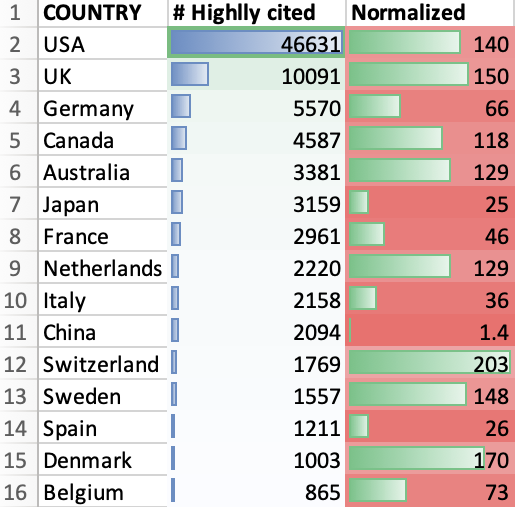
Number of highly cited scientists/engineers by country among top 100K most cited in the world and those numbers normalized by size of country.

Given that 75% of retracted papers involving fraudulent peer review are authored by Chinese scholars, it is necessary to approach submissions from China with a degree of caution; fraudulent research can have profound and long-lasting consequences.

Consider the 1998 paper published in The Lancet, which claimed a link between autism and vaccines. At the time, it ignited widespread public distrust and fueled a massive anti-vaccination movement. Despite its impact, the problematic study wasn’t officially retracted until 2010.

Similarly, a 2006 study published in Nature—cited over 2,300 times—was later proven to be fraudulent. The Aβ56 protein proposed in this paper was a foundational discovery for the “amyloid beta hypothesis,” the prevailing theory in Alzheimer’s research. This severe case of misconduct effectively set back Alzheimer’s progress by 16 years.

I strongly recommend that everyone install the PubPeer extension to identify problematic papers the moment you come across them.

1 Like

Got it!!

Thanks!

https://www.nature.com/articles/s41586-024-08248-5

Taking this paper as an example, the PubPeer browser extension highlights criticisms from other scholars. However, there are numerous other papers from China published in top-tier journals (such as Nature, Science, and Cell) that carry no such warnings, despite being confirmed as fraudulent. Furthermore, these journals sometimes refuse to retract the papers. Therefore, a more advanced approach is to maintain a high degree of skepticism toward Chinese research and verify whether the results have been successfully replicated by laboratories in other countries.