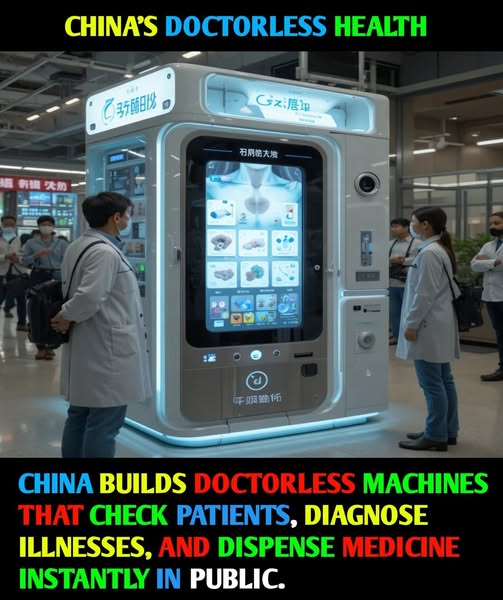
“China has introduced AI-powered health kiosks that operate entirely without human doctors. These advanced booths scan vital signs, conduct basic tests, and use AI to diagnose common illnesses within minutes. Each unit includes sensors, cameras, and automated dispensers for over-the-counter medicines. Patients step inside, input symptoms, and receive instant prescriptions or referrals to hospitals if needed. Deployed in metro stations, shopping centers, and rural areas, these kiosks offer 24/7 access to healthcare, bridging the medical gap in underserved regions. Experts believe they represent a major leap in automated public health technology.”
Fact-Check Verdict: Mostly True with One Critical Error
The text accurately outlines a real technological infrastructure deployed across China—specifically the “One-Minute Clinics” developed by healthcare platform giants such as Ping An Good Doctor and Alibaba Health. However, the assertion that these kiosks operate “entirely without human doctors” is false. It misrepresents the mandated medical, legal, and operational frameworks governing digital health technologies.
A Ping An Good Doctor ‘One-Minute Clinic’ operational booth… Source: FutureIOT
Claim vs. Fact Analysis
Text Claim
Verification Status
Real-World Fact & Evidence
“…operate entirely without human doctors.”
FALSE
The framework uses a strict “Human-in-the-Loop” model. AI conducts the preliminary triage, but Chinese medical regulations dictate that all final diagnoses and prescriptions must be reviewed, calibrated, and authenticated in real time by a licensed, remote human physician via telemedicine.
“Scan vital signs, conduct basic tests, and use AI to diagnose…”
TRUE
Kiosks feature integrated medical sensors and cameras to measure body temperature, blood pressure, heart rate, and blood oxygen levels. Large language models (LLMs) parse user input against hundreds of millions of historical medical consultation records to calculate diagnostic probabilities for common illnesses.
“Each unit includes… automated dispensers for over-the-counter medicines.”
TRUE
The physical structures are paired with automated, temperature-controlled smart medicine cabinets. They house between 38 and 100 varieties of common over-the-counter (OTC) medications and basic prescription items available for immediate purchase via QR code mobile payments.
“Receive instant prescriptions or referrals to hospitals if needed.”
PARTIALLY TRUE
Prescriptions are issued within minutes, but they are not generated autonomously by AI; they require the digital signature of an attending remote doctor. The automated referral protocol is true: if the algorithm flags high-risk symptoms or complex anomalies, it automatically routes the patient to a live specialist or a brick-and-mortar hospital.
“Deployed in metro stations, shopping centers, and rural areas…”
TRUE
Deployments are widespread across thousands of locations. For instance, the Shanghai Metro network alone contains over 250 kiosks. The initiative is a documented strategic push to lower wait times in congested urban tertiary centers and establish a baseline diagnostic tier in rural medical deserts.
Clinical Framework & Technical Constraints
The Diagnostic Masking Risk: While operators report diagnostic accuracy between 94% and 95% for routine primary care, medical literature highlights the risk of algorithmic masking. Atypical presentations of critical emergencies—such as a myocardial infarction presenting as basic gastric distress—pose a challenge to automated intake structures if physical palpation or electrocardiograms are omitted.
Regulatory Oversight: To enforce public safety, municipal health bureaus require kiosk operators to maintain separate medical device, teleconsultation, and pharmaceutical retail licenses. Algorithms are subjected to periodic national standardized certification testing, and physical units undergo hardware calibration audits every three months.
Musumeci Online
Data Fragmentation Gaps: A primary obstacle in automated public health logistics remains the integration of siloed commercial kiosk data into centralized regional Electronic Medical Record (EMR) databases. Without seamless interoperability, long-term continuity of care and chronic disease tracking remain compromised.
Cool, but this will now face the challenge of people figuring out how to game the system to get prescribed drugs with recreational value. I wonder how this will be combatted?