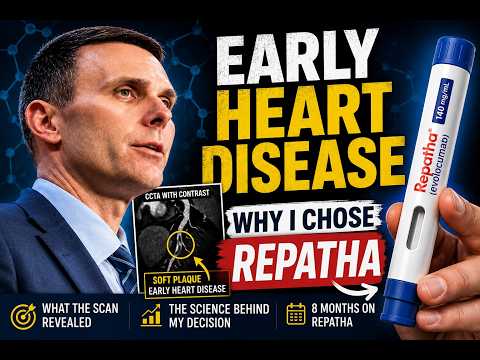
Matt Kaeberlein springs for Repatha.
Why I Started Repatha (And Why I Almost Didn’t) (via Matt Kaeberlein)
I. Executive Summary
In this clinical case review, biogerontologist Dr. Matt Kaeberlein and his personal physician, Dr. Kevin White, evaluate advanced cardiovascular diagnostics and lipid-lowering pharmacology for the early interception of atherosclerotic cardiovascular disease (ASCVD). Standard Coronary Artery Calcium (CAC) non-contrast CT scans quantify calcified, hard plaque but fail to visualize non-calcified, soft plaque—the active, vulnerable atheromatous burden responsible for acute plaque rupture and myocardial infarction. To overcome this diagnostic limitation, Kaeberlein underwent Coronary Computed Tomography Angiography (CCTA) with contrast, coupled with Cleerly AI automated volumetric plaque analysis. Despite maintaining rigorous lifestyle habits (resistance training, cardiovascular exercise, high-quality diet, sleep hygiene), Kaeberlein presented with persistent atherogenic dyslipidemia (ApoB 111 mg/dL, LDL-C 159 mg/dL, Total Cholesterol 209 mg/dL) driven by genetic risk factors and prior early-life lifestyle suboptimalities.
CCTA automated image analysis revealed a low total plaque volume of 16.1 mm³ (Percent Atheroma Volume = 0.5%), classifying him as Stage 1 early ASCVD. However, 14.0 mm³ (87%) of this total plaque volume comprised soft, non-calcified plaque, with only 2.1 mm³ calcified. While conventional primary care often dismisses low-volume soft plaque in mid-50s adults as age-appropriate, proactive healthspan medicine identifies soft plaque as active, progressive vascular pathology requiring aggressive early intervention.
To halt plaque progression and induce atheroma regression, Kaeberlein initiated Repatha (evolocumab), a monoclonal antibody that inhibits proprotein convertase subtilisin/kexin type 9 (PCSK9). By blocking PCSK9-mediated lysosomal degradation of hepatic low-density lipoprotein receptors (LDLRs), evolocumab increases LDLR cell-surface density, accelerating plasma clearance of ApoB-containing lipoproteins. After 6 to 8 months of monotherapy, Kaeberlein achieved a 64% reduction in LDL-C (down to 57 mg/dL), a 49% reduction in ApoB (down to 57 mg/dL), and a 48% reduction in Total Cholesterol (down to 109 mg/dL). Double-blind randomized controlled trials, including GLAGOV and FOURIER, confirm that reducing LDL-C below 50 mg/dL via PCSK9 inhibition halts atheroma progression, induces total atheroma volume regression, and thickens protective fibrous caps. This case highlights that lifestyle optimization is frequently insufficient to overcome genetic dyslipidemia, requiring direct anatomical imaging via CCTA and targeted lipid-lowering pharmacology to prevent clinical ASCVD events.
II. Insight Bullets
-
Limitations of Coronary Artery Calcium (CAC) Scoring: Standard non-contrast CAC scans detect only calcified (hard) plaque, completely missing non-calcified (soft) plaque and early-stage vulnerable atheroma.
-
Diagnostic Precision of CCTA with Contrast: Coronary Computed Tomography Angiography (CCTA) with contrast visualizes the arterial lumen and vessel wall, enabling non-invasive identification of soft plaque and non-obstructive coronary artery disease.
-
Automated Volumetric Plaque Analysis (Cleerly AI): AI-driven image analysis platforms sitting atop CCTA scans quantify plaque morphology, differentiating low-density soft plaque, fibrous plaque, and calcified plaque volume in cubic millimeters (mm³).
-
Predictive Superiority of Non-Calcified Plaque for Acute Coronary Events: Soft, non-calcified atheromatous plaque represents active arterial disease with high vulnerability to rupture, presenting a significantly higher risk for acute myocardial infarction than stable calcified plaque.
-
Discordance Between Biomarkers and Anatomical Plaque Burden: Blood lipid panels (ApoB, LDL-C) reflect circulating atherogenic particle concentration but cannot confirm the presence, stage, or volume of actual arterial plaque.
-
Insufficiency of Zero Calcium Scores in High-Risk Patients: Individuals with a CAC score of zero can still harbor substantial non-calcified soft plaque burden, demonstrating that a zero calcium score does not rule out active early-stage ASCVD.
-
Genetic Boundaries of Lifestyle Optimization: Rigorous adherence to lifestyle pillars (exercise, whole-food nutrition, sleep, stress management) cannot fully offset polygenic or monogenic drivers of elevated ApoB and LDL-C.
-
Clinical Profile of Early-Stage Atherosclerosis: Kaeberlein’s CCTA scan revealed a low total plaque volume of 16.1 mm³ (Percent Atheroma Volume = 0.5%), but 87% of the atheroma (14.0 mm³) consisted of non-calcified soft plaque.
-
Staging Criteria for Coronary Plaque Burden: Cleerly AI categorizes coronary plaque burden into quantitative stages: Stage 0 (0 mm³), Stage 1 (0–250 mm³), Stage 2 (250–750 mm³ with multi-vessel disease), and Stage 3 (>750 mm³).
-
Reversibility and Modifiability of Soft Plaque: Soft non-calcified atheroma is uniquely responsive to aggressive lipid-lowering interventions, exhibiting capacity for volume regression or dense calcification (stabilization) under intensive treatment.
-
Percent Atheroma Volume (PAV) Luminal Occupancy: PAV quantifies the percentage of the coronary arterial lumen space occupied by atherosclerotic plaque, providing an anatomical measurement of disease severity independent of vessel size variations.
-
Mechanism of Action of PCSK9 Inhibitors: Evolocumab (Repatha) is a monoclonal antibody that binds and inactivates circulating PCSK9, preventing PCSK9-mediated lysosomal degradation of hepatic low-density lipoprotein receptors (LDLRs).
-
Upregulation of Hepatic LDLR Density: By inhibiting PCSK9, evolocumab increases LDLR recycling back to the hepatocyte cell membrane, dramatically accelerating plasma clearance of circulating LDL and ApoB particles.
-
Efficacy Magnitude of Evolocumab Monotherapy: Clinical administration of evolocumab consistently reduces circulating LDL-C and ApoB levels by 55% to 60% relative to baseline.
-
Observed Biomarker Response in Clinical Case: Following 6–8 months of Repatha monotherapy, Kaeberlein’s LDL-C dropped from 159 mg/dL to 57 mg/dL (64% reduction), ApoB dropped from 111 mg/dL to 57 mg/dL (49% reduction), and Total Cholesterol dropped from 209 mg/dL to 109 mg/dL.
-
Atheroma Regression Evidence from the GLAGOV Trial: The double-blind RCT GLAGOV trial demonstrated that adding evolocumab to statin therapy reduced mean LDL-C to 36.6 mg/dL and induced total atheroma volume regression in 64% of patients (Nicholls et al., 2016).
-
Cardiovascular Event Reduction in the FOURIER Trial: The FOURIER trial established that evolocumab-induced LDL-C lowering to ultra-low levels significantly reduced major adverse cardiovascular events (MACE), including myocardial infarction and stroke, with an excellent safety profile (Sabatine et al., 2017).
-
Plaque Fibrous Cap Thickening (HUYGENS Trial): Intravascular optical coherence tomography (OCT) in the HUYGENS trial proved that evolocumab rapidly increases fibrous cap thickness and decreases lipid core arc in vulnerable soft plaques (Nicholls et al., 2022).
-
Long-Term Cardiovascular Risk Reduction via SCOT-HEART: The SCOT-HEART trial demonstrated that incorporating CCTA into standard care guided targeted preventive therapy, resulting in a 41% reduction in 5-year fatal or nonfatal myocardial infarction (Newby et al., 2018).
-
Rejection of Dogmatic “Lifestyle-Only” Anti-Pharmacology Bias: Healthspan medicine requires a pragmatic integration of lifestyle protocols with targeted, evidence-based pharmaceuticals when genetic risks prevent optimal biomarker achievement.
-
Misleading Nature of “Ideal” Social Media Health Figures: Public health figures presenting pristine physical appearances or low biomarkers often conceal pharmacological use or favorable genetics, creating unrealistic expectations for lifestyle-only approaches.
-
Future Emergence of Oral PCSK9 Inhibitor Therapeutics: Advances in lipid-lowering pharmacology are yielding small-molecule oral PCSK9 inhibitors and RNA-targeting agents (e.g., inclisiran), providing needle-free alternatives for patients uncomfortable with monoclonal antibody injections.
IV. Actionable Protocol (Prioritized)
High Confidence Tier (Level A/B Evidence)
-
Anatomical ASCVD Screening via CCTA with Contrast: Utilize Coronary Computed Tomography Angiography (CCTA) with contrast in middle-aged adults with elevated ApoB, family history of ASCVD, or discordant calcium scores to identify non-calcified soft plaque and quantify total atheroma burden (Newby et al., 2018).
-
Target-Driven ApoB / LDL-C Lowering Pharmacology: Implement evidence-based lipid-lowering therapy—such as PCSK9 inhibitors (evolocumab 140 mg SC biweekly or alirocumab), high-intensity statins, or ezetimibe—to achieve target ApoB levels (<60 mg/dL or <50 mg/dL in established plaque cases) and induce atheroma regression (Nicholls et al., 2016; Sabatine et al., 2017).
-
Comprehensive Lifestyle Foundation: Maintain a baseline non-pharmacological regimen consisting of progressive resistance exercise, Zone 2 cardiovascular training, low-saturated-fat whole-food nutrition, optimized sleep hygiene, and blood pressure control (<120/80 mmHg).
Experimental Tier (Level C/D Evidence with High Safety Margins)
-
Serial AI-Assisted Volumetric Plaque Tracking: Perform repeat CCTA scans with automated volumetric analysis (e.g., Cleerly AI) at 2-to-3-year intervals following initiation of intensive lipid-lowering therapy to evaluate soft plaque regression, atheroma calcification (densification), and Percent Atheroma Volume (PAV) changes.
-
Early Sub-Clinical ASCVD Interception: Initiate targeted lipid-lowering intervention upon identification of low-burden soft plaque (Stage 1 ASCVD, 0–250 mm³) in asymptomatic individuals rather than delaying treatment until high-grade luminal stenosis or clinical events occur.
Red Flag Zone (Claims Debunked or Safety Data Absent)
-
Relying Exclusively on Non-Contrast CAC Scans to Rule Out ASCVD: Assuming a Coronary Artery Calcium (CAC) score of zero guarantees absence of cardiovascular disease (Debunked; High Risk of Missed Soft Plaque).
-
Relying Solely on Lifestyle Interventions for Genetically Driven Dyslipidemia: Refusing lipid-lowering pharmacology when ApoB remains elevated (>100 mg/dL) despite rigorous diet and exercise (High Safety Risk; Accelerates Plaque Progression).
-
Ignoring Non-Calcified Soft Plaque in Mid-50s Adults: Dismissing low-volume soft plaque as “normal aging” without taking proactive therapeutic steps to stabilize or regress the active atheroma (High Safety Risk).