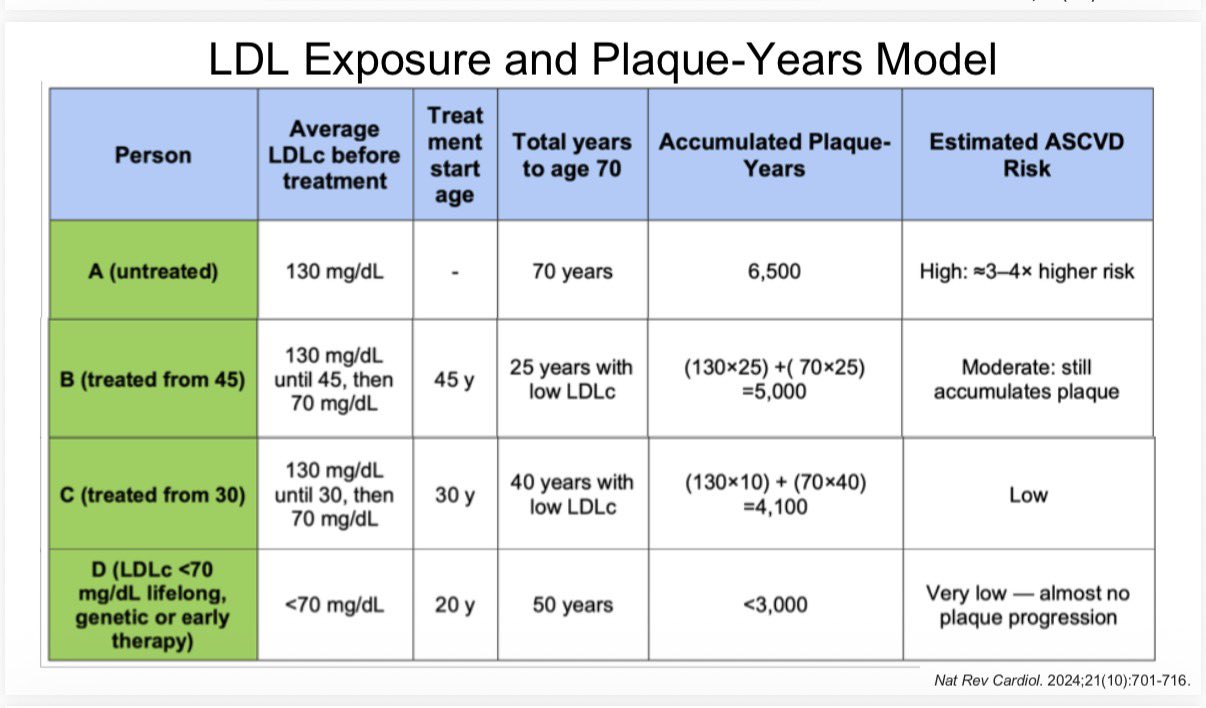
Over 30 years, this ARR is likely to more than triple. This ARR is only for the most complex procedures, and we know that with age the likelihood of needing more complex procedures climbs. Having that reduced is great.
This study only looked at preventing the most complex surgeries. Over 30 years, early vs. delayed treatment also drastically impacts MACE.
This stuff is very much like compound interest. 1% of interest over 30 years on your principal starts looking pretty impressive.
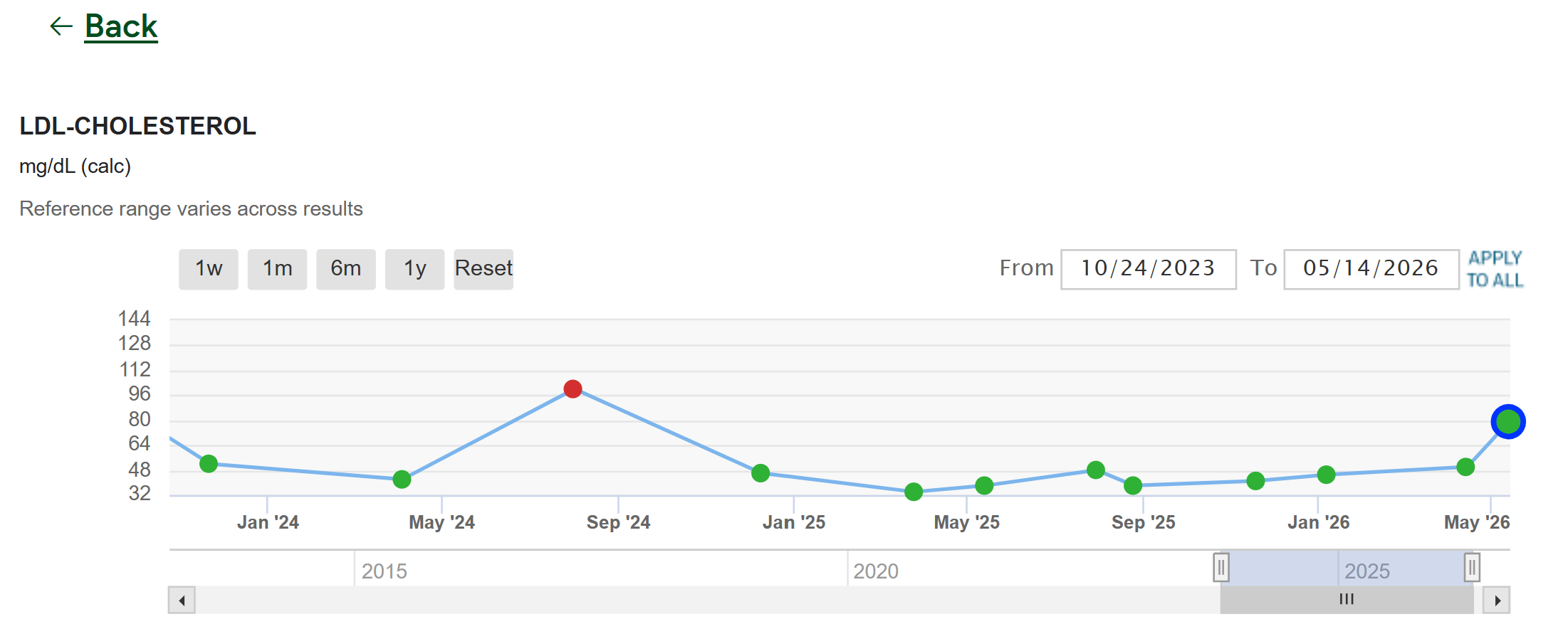
I find that I can put my cholesterol numbers anywhere that I want to. Unfortunately, I can’t do the same with my fasting cholesterol.
Right now I use pitavastatin, bempedoic acid, and ezetimibe. Using one, two, or all three a
I can adjust it to any level I want to. I am generally in the lower the better camp, but lately I’ve been reading some articles suggesting that for someone my age, lower the better might not be the best. So, the debate continues, and I am still researching the best level for someone my age. For most people, I think that the standard statins plus bempedoic acid, and ezetimibe will set LDL levels quite low.
“Yes, I did.” I got my weight down which of course brought my BMI down to 22. So I thought I would see how my cholesterol levels would be without all the cholesterol meds.
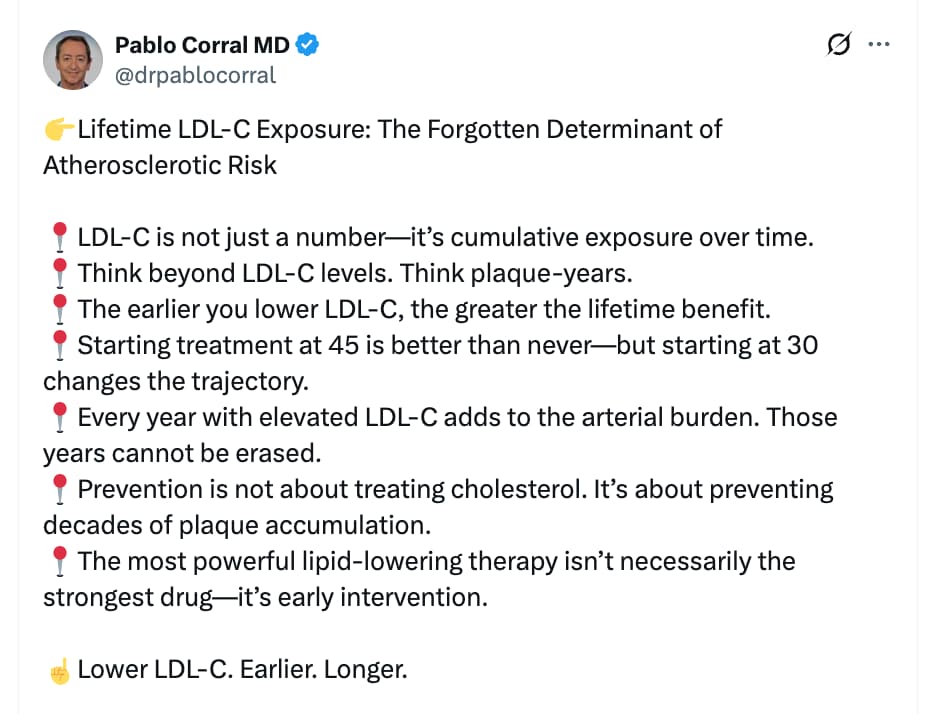
I have thought about this quite a lot. I wish I had known this before age 47 when I actively started lowering lipids. I hope that my children can start in their early 30s. I do think 20s may be a bit too much.
https://medicalxpress.com/news/2026-07-uncover-muscle-pain-widely-cholesterol.html
Just clarifies statin muscle pain is immune driven. -and that blocking the muscle pain effects does not affect the statin benefits as they are completely seperate pathways.
I am currently having great success with 3mg Naltrexone daily and 1mg Rapamycin weekly and can now tolerate lipid lowering medication with no muscle pain. I wish I had found this out 10yrs ago. I am retesting all the LLM against this protocol, and will let you know.
That may be true for some of the effects of statins, but I was on Rapamycin and statins and the muscle effects persisted. Switching to Pitavastatin was the only statine that did not cause these muscle issues.
It’s possible that weekly rapa isn’t enough to inhibit the NLRP3 inflammasome and that the low dose naltrexone is doing the heavy lifting. This is pretty exciting if it turns out to be a viable option for those of us who can’t even tolerate pitavastatin.
I researched this issue (whether naltrexone and rapamycin suppress the NLRP3 inflammation) and this is what Claude Fable 5 says:
Does Naltrexone Impact NLRP3?
Indirectly plausible, NOT directly demonstrated for LDN in humans. Evidence Level D, with an important negative finding. The logic is: TLR4 provides “signal 1” (priming) for NLRP3 inflammasome assembly, so a TLR4 antagonist should reduce NLRP3 priming and downstream IL-1β/IL-18. This is inference, not measurement. Critically, the human immune-cell study found that while naltrexone suppressed TNF-α and IL-6, it did NOT directly inhibit LPS-induced IL-1β — the canonical NLRP3 output. Naltrexone inhibits IL-6 and TNFα (but not IL-1β), Front Immunol (2017); (+)-naltrexone/(+)-naloxone equipotent TLR4 inhibitors, did not inhibit IL-1β, Br J Pharmacol (2016). Live searches returned no dedicated study showing LDN reduces NLRP3/caspase-1 expression in an animal model, and none in humans. Verdict: “naltrexone lowers NLRP3” is an extrapolation from TLR4 biology, and the one relevant human dataset argues against a direct effect on the NLRP3 endpoint (IL-1β). Tell it like it is: unproven, and partially contradicted.
Are you sure It’s Fable 5? It still has restriction on biology questions and switches automatically to Opus 4.8.
Switched to Opus 4.8
Fable’s safeguards flagged this message. The safeguards are intentionally broad right now and may flag safe and routine coding, cybersecurity, or biology work.
I have panclass myalgia from all LLT-especially statins (including pitavastatin) and Repatha BA. I uploaded my genome reports into Opus 4.8, and Claude suggested LDN for my mLoy affected macrophages and Rapa for the cytokine release. I can only report that I can tolerate Repatha now and based on my LDL numbers next month I will decide wether to layer in BA. I am not brave enough to throw statins at this thereapy yet.
With an Amgen card and insurance, it’s 50 for 3 months now. I’m told that most insurance plans these days don’t require prior authorization to get it now. You can go here to find out coveragfe information: Coverage Information | Repatha® (evolocumab) HCP
I’ve always had the impression that PCSk9i were the future LDL-c lowering medication (set to replace statins), but when I looked at data comparing them to statins for ACM and MACE, I was surprised to find that based on the available data, statins beat them.
Here are 2 studies comparing them:
Niu, Q. (2025). Which is the optimal choice in lipid-lowering therapy for reducing major cardiovascular events? A network meta-analysis. Frontiers in Pharmacology. Read the study on PubMed Central
Riesen, W. F. (2025). Lipid-lowering Medications - Statins Versus PCSK9 Inhibitors. Journal of Clinical Cardiology and Cardiovascular Interventions. Read the publication on ResearchGate
Results for MACE
Statin Monotherapy: Highly effective. Statins possess pleiotropic effects such as reducing vascular inflammation and stabilizing arterial plaques to prevent them from rupturing.
PCSK9 Inhibitor Monotherapy: While effective, some large-scale network meta-analyses suggest that PCSK9 inhibitor monotherapy does not consistently outperform statins alone. A comprehensive NMA published in Frontiers in Pharmacology reviewed 29 randomized trials totaling over 68,000 patients and found that the clinical benefits of statin monotherapy were not inferior to PCSK9 inhibitor monotherapy .
Results for ACM
Statins: Have a multi-decade, robust track record of significantly reducing both cardiovascular mortality and all-cause mortality (with a relative risk reduction of roughly 9% to 10% compared to placebo).
PCSK9 Inhibitors: Despite dramatically lowering LDL-C and reducing non-fatal heart attacks and strokes, major dedicated cardiovascular outcome trials (like FOURIER for evolocumab and ODYSSEY OUTCOMES for alirocumab) failed to show a statistically significant reduction in all-cause mortality. Meta-analyses confirm that adding a PCSK9 inhibitor to background statins yields no additional ACM benefit over statins alone.