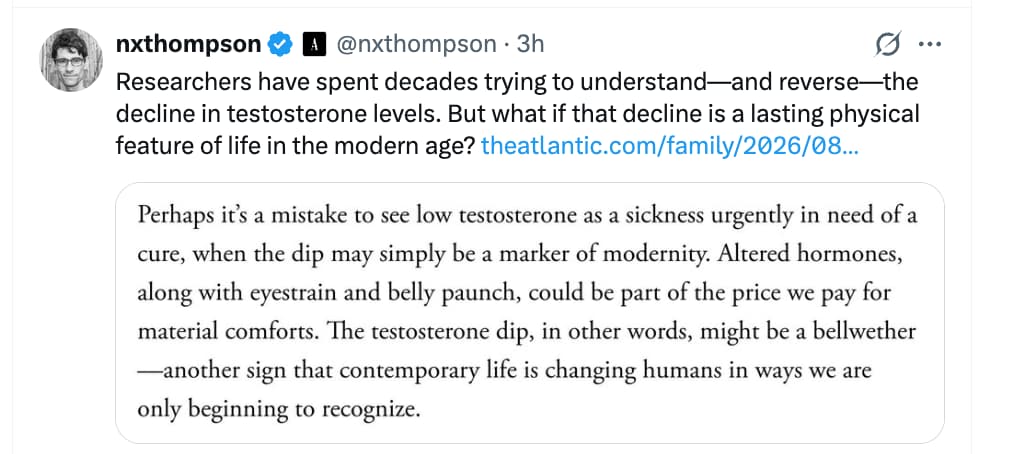
Male aging is traditionally viewed through the lens of gradual androgen decline, but treating hormone loss in isolation misses the broader physiological network. A comprehensive review published in the Journal of Endocrinological Investigation demonstrates that age-related testosterone decline, sleep disruption, and metabolic dysfunction form a mutually reinforcing, multi-system feedback loop. Rather than defaulting immediately to lifelong hormone replacement, the authors highlight functional hypogonadism as a distinct, non-structural state that can be reversed through weight loss, metabolic optimization, and sleep interventions.
The conventional view of male aging treats falling testosterone as an inevitable clock ticking down in the testes. However, emerging research reveals that male endocrine decay operates within a broader network of interconnected systems. As men age past their mid-30s, circulating testosterone levels decline, contributing to loss of lean muscle, accumulation of visceral fat, reduced bone density, and sleep fragmentation. Crucially, this relationship is bidirectional. Sleep disorders, particularly obstructive sleep apnea and loss of deep slow-wave sleep, impair nighttime testosterone production. Simultaneously, visceral adiposity generates systemic inflammatory signals that directly shut down testicular hormone synthesis.
The central insight of this integrative model is the clinical distinction between organic late-onset hypogonadism and functional hypogonadism. Organic hypogonadism stems from structural failure of the testicles, pituitary gland, or hypothalamus. In contrast, functional hypogonadism represents a non-structural, stress-induced suppression of the hypothalamic-pituitary-gonadal axis. It is driven primarily by abdominal obesity, insulin resistance, chronic low-grade inflammation, and sleep fragmentation.
Because functional hypogonadism is an adaptive suppression rather than permanent tissue destruction, it is inherently reversible. When men improve their sleep quality, lower body fat, and reverse metabolic dysfunction, endogenous testosterone production can recover without exogenous pharmacological replacement. Exogenous testosterone replacement therapy provides symptomatic relief in confirmed organic deficiency, but it disrupts native circadian hormonal rhythms, suppresses natural sperm production, and requires ongoing clinical monitoring. By treating sleep disruption and metabolic dysfunction as primary drivers, clinicians and individuals can intervene early to halt the multisystem deterioration characteristic of male physiological aging.
Actionable Insights
-
Protect deep sleep architecture: Restricting sleep for just one week reduces daytime testosterone levels by 10% to 15% in healthy young men. Prioritizing 7 to 8 hours of continuous sleep supports peak morning androgen production, which occurs primarily during deep slow-wave sleep.
-
Target visceral adiposity reduction: Up to 73% of men with age-related testosterone deficiency are overweight or obese. Reducing abdominal fat eliminates pro-inflammatory cytokines such as interleukin-6 and tumor necrosis factor-alpha, which directly inhibit testicular hormone production.
-
Monitor natural decline rates: Total testosterone declines by approximately 0.4% per year, while free (unbound) testosterone drops by 1.3% per year due to age-related increases in sex hormone-binding globulin. Regular exercise and glycemic control slow this trajectory by preserving insulin sensitivity and muscle mass.
-
Screen sleep apnea before hormone therapy: Men presenting with fatigue, low libido, and erectile complaints should undergo screening for obstructive sleep apnea. Resolving upper airway collapse protects endothelial function and prevents metabolic amplification of androgen suppression.
Context/Source
- Open Access Paper: Late-onset and functional hypogonadism in aging men: an integrated perspective on hormonal, sleep, and metabolic dimensions
- Institutions: Universidade Federal de São Paulo (UNIFESP), Instituto do Sono, and Universidade Federal do ABC (UFABC)
- Country: Brazil
- Journal Name: Journal of Endocrinological Investigation
- Impact Evaluation: The impact score of this journal is 3.2, evaluated against a typical high-end range of 0–60+ for top general science, therefore this is a Medium impact journal.