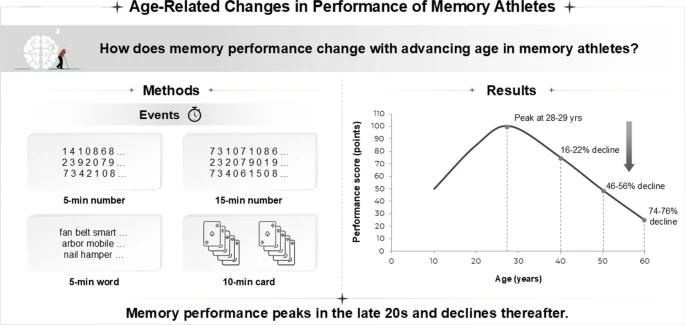
A new study published in GeroScience reveals a sobering reality for those attempting to “biohack” their way to permanent cognitive superiority: even the world’s most elite memory athletes are subject to the same relentless biological clock as the rest of us. Researchers from the University of Texas at Austin in the USA conducted a comprehensive analysis of competitive memory performance across the human lifespan, finding that mental peak occurs much earlier than many might hope—specifically between the ages of 28 and 29.
The study evaluated the top 30 performers across four distinct age categories—junior, young, middle-age, and senior—competing in standardized events such as memorizing thousands of random digits, words, or shuffled decks of cards. Using advanced polynomial and non-parametric regressions, the researchers identified a clear “inverted U-shaped” trajectory. While performance climbs steadily through the teenage years and early twenties, it hits a definitive ceiling in the late twenties before beginning a steady, and eventually steep, descent.
The magnitude of this decline is significant. By age 40, even these highly trained athletes show a 16-22% reduction from their peak scores. This drop-off accelerates dramatically in later decades; by age 50, performance falls by 46-56%, and by age 60, it plummets by 74-76%. The researchers noted that tasks with longer durations and higher cognitive loads—such as the 15-minute number memorization—showed the sharpest declines, suggesting that sustained executive control is particularly vulnerable to the aging process.
While these athletes still perform at levels far exceeding the general population at any given age, their rate of decline mirrors the physiological “loss of power” seen in elite physical athletes, such as Olympic swimmers or track stars. This suggests that while intensive mnemonic training can build a massive “cognitive reserve,” it cannot fundamentally alter the underlying biological slope of brain aging.
Actionable Insights
Establish a High Baseline Early: Cognitive training should be viewed similarly to building peak bone mass or muscle in youth. Because the rate of decline is relatively consistent, starting from an exceptionally high baseline (the “law of initial baseline”) ensures that even after a 50% decline, you remain significantly more functional than the untrained average.
Prioritize Cognitive Reserve: The resilience of older memory athletes suggests that “domain-specific expertise” acts as a buffer. Engaging in intensive, strategy-based mental tasks may not stop the biological clock, but it provides a superior “functional floor” for late-life independence.
Acknowledge Task Complexity: The study found that longer, more complex tasks (e.g., 15-minute vs. 5-minute drills) amplify age-related deficits. Biohackers should focus on strategies that optimize “processing speed” and “executive control” as these are the first systems to flag.
The Late-20s Window: For those pursuing maximum cognitive output, the ages of 25–30 represent the biological “Goldilocks zone” where neural efficiency and experience intersect.
Impact Evaluation: The impact score (JIF) of this journal is 5.3, evaluated against a typical high-end range of 0–60+ for top general science, therefore this is a High impact journal in the specialized field of geroscience and aging biology.
I see more than a little self-deception among some in their 50’s, 60’s and even 70’s who claim they have not experienced any cognitive decline. They have and a myriad of tests would establish that.
This said, I have two problems with the study (more than that but two big ones).
This is more a tournament-by-bracket comparison than a sample of memory athletes across the lifespan. The pool sizes from which those top 30s are drawn probably differ by orders of magnitude across age groups because memory sport demographics skew heavily young. Taking the top 30 of (perhaps) several thousand young adults versus the top 30 of (perhaps) several dozen seniors means the “young” group represents the extreme right tail of a large distribution while the “senior” group represents most of a small distribution. The resulting age-performance comparison conflates true performance differences with differential percentile representation. This single design choice can generate an inverted-U shape even if the underlying age effect on performance is far more modest, and the authors do not address it.
While, to be fair, the goal here was to test only a narrowly defined notion of memory, any implication that this finding generalizes to cognitive skills is unsound. It is true that working memory capacity declines with age and is an important function in some forms of cognition. However, it is possible to compensate for declining working memory size by moving the variables from the mind to visual space.
Well, yes, my memory is definitely not as good as it used to be. However, my reasoning ability and ability to understand complex problems seems to be intact. Well, that is for a short while until I forget about whatever problem I was researching! LOL!
So, should the topic be changed to " MEMORY Power Peaks Early: Elite Memory Training Cannot Outpace Biological Decline? "
Personally, N=1, some skills seem to be lost faster than others. I definitely feel a loss of brain function in certain areas. For instance, the older I get, the less able I am to do math in my head than I used to, and I’m more likely to have to use a calculator. Some functions, such as reasoning, seem pretty much intact, though they may take a little longer. I have noticed no major decline in my ability to do crosswords, maybe a little slower, but not much.
Loss of working and short-term memory is quite noticeable. “Why did I come into this room?” and “Where did I put that tool?” when working on projects. Oddly, my memory for remembering bank account, social security numbers, etc., seems mostly intact. Spelling has deteriorated somewhat to the point that I constantly have spell check enabled on all of my devices.
Ha! I can recall the, “What am I doing in this room” phenomenon in my 20’s. It is generally not thought associated with brain aging but I think our decline in working memory (like CPU scratchpad buffers) – mine for certain – might accelerate it. I will begin worrying about it in earnest when I get to the room and ask, “What am I doing in this room . . . and whose room is this?”
I used to have a cognitively demanding job and I very clearly remember the day back in my mid 40’s (first aging cliff?) when i sat back in my chair and said to my colleague, “my brain feels completely full up. I think I need to start forgetting old superfluous information to take more in”.
And I think that is exactly what has happened. For example, forgetting the names of famous people from when i was growing up; totally superfluous until my kids ask me about who were the top footballers or actors etc from back then. I can remember faces but then have to google to re-establish that neural connection in the brain.
There are other things that I don’t remember maybe more recent but when it’s pointed out to me it always feels like the sort of thing that i have no interest in trying to remember hence it doesn’t remain in the memory (because of that conscious decision i made not to remember some things?)
As for everything else, i can still “do” everything, just noticeably that much more slowly, though again as i point out to my kids, I think part of it is deliberately slowing down so as not to make any mistakes which i see my kids make when the are rushing through things.
When i put my mind to it i can still do things like form filling pretty quickly, just as fast as the kids, but deliberately slowing down to not make mistakes I believe is “wisdom” coming through and not necessarily cognitive decline.
(I believe my mental maths is still better than most brought up in the “reach for the calculator” or “spreadsheet” generation. I continue to do my budgeting with pen, paper and mental arithmetic (am only 57yo)).
Would be interested to here what other people think of my experience. Am I trying to pretend cognitive decline isn’t really hitting me hard?
I think that there is something to be said for that. The brain, like any other computer, has a limited memory capacity. At some point the memory has to be full up. The brain unfortunately decreases in capacity in old age. I don’t know exactly how the brain compensates for this.