https://www.nature.com/articles/s41591-026-04448-w
This is what I wrote about in my 2025 BSRA poster. Basically some human eggs are being fertilised at an older state hence although ageing probably occurs at the same rate age related disease occur at an earlier stage for some people. It is partially stochastic, however.
chatGPT(5.5paid)
Summary
The paper argues that accelerated biological aging may be one integrative explanation for rising early-onset solid cancers in recent birth cohorts. It uses “age gap” measures: how biologically old someone appears relative to chronological age.
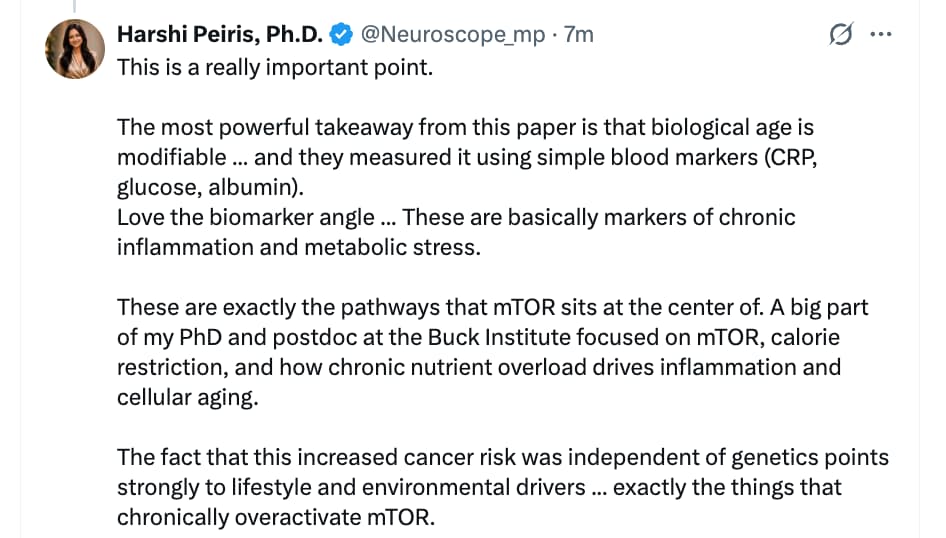
The main discovery cohort is UK Biobank, with 154,169 adults under 55. The authors find that PhenoAge-defined biological age gap increased across birth cohorts, with people born in 1965–1974 showing a 23% higher standardized age gap than those born in 1950–1954. Higher PhenoAge age gap was prospectively associated with early-onset solid cancer risk: HR 1.08 per standard deviation, with stronger signals for lung cancer, gastrointestinal cancers, colorectal cancer, other GI cancers, and uterine cancer.
They test whether this is just an artefact of one aging clock by using alternative measures. KDM age gap showed weaker overall association but stronger signals for lung and GI cancers. Metabolomic age gap showed modest overall association, with clearer signals for lung and uterine cancer. The associations were reportedly robust to adjustment for lifestyle factors, telomere length, and polygenic risk for aging and selected cancers.
They then add organ-specific proteomic aging in a smaller UK Biobank subset. Two notable associations emerged: immune-system aging with early-onset lung cancer and adipose-tissue aging with early-onset colorectal cancer. These associations persisted after adjustment for systemic aging, suggesting that organ- or tissue-specific aging may add information beyond whole-body biological age.
A partial validation was done in the US All of Us Research Program, with 10,262 participants. PhenoAge age gap again increased across birth cohorts, and higher PhenoAge age gap was associated with early-onset solid cancer risk: HR 1.22 per standard deviation, though this validation had only 104 cancer cases, limiting site-specific analysis.
Novelty
The novelty is not simply “aging is linked to cancer”; that is well established. The distinctive contribution is that the authors connect birth-cohort shifts, biological aging clocks, and early-onset cancer risk in a prospective epidemiological framework.
The paper is novel in four main ways:
-
It treats biological aging as a possible integrative marker of generational exposure burden, rather than looking for one exposure at a time.
-
It focuses on early-onset cancer, where conventional age-related cancer explanations are less straightforward.
-
It compares multiple systemic aging clocks: PhenoAge, KDM, and metabolomic age gap.
-
It adds organ-specific proteomic aging, linking immune aging to lung cancer and adipose aging to colorectal cancer, which gives the epidemiology a more biologically plausible tissue-specific structure.
Critique
The core finding is interesting, but it should be read as association, not proof of causality. The authors themselves acknowledge residual confounding as a limitation. Biological aging clocks partly encode inflammation, metabolic dysfunction, renal function, smoking-related physiology, adiposity, and other cancer risk correlates. Even extensive adjustment may not fully separate “accelerated aging as a causal driver” from “accelerated aging as a composite risk marker.”
A second issue is reverse causation or preclinical disease effects. The authors exclude cancers near baseline and run sensitivity analyses, but occult cancer or precancerous inflammatory/metabolic changes could still influence blood biomarkers before diagnosis, especially for lung and GI cancers.
Third, the effect size for overall early-onset solid cancer is modest: HR 1.08 per s.d. for PhenoAge in UK Biobank. That is epidemiologically meaningful at population scale, but not yet a strong individual prediction tool. Site-specific effects are larger, especially lung cancer, but case numbers are much smaller.
Fourth, UK Biobank is not population-representative: it is healthier, less deprived, and predominantly White. The All of Us replication is more diverse but much smaller, with short follow-up and only 104 early-onset solid cancers. This makes the validation useful but incomplete.
Fifth, the organ-specific proteomic aging analysis is exploratory. It used a smaller sample and many organ-cancer comparisons. The authors note a potential circularity concern because the proteomic organ-aging models were originally developed partly using UK Biobank data; applying published coefficients reduces but does not eliminate the problem.
Finally, “birth cohort” is doing a lot of work here. Later cohorts have higher age gaps, but the paper does not identify which exposures caused that shift. Obesity, metabolic syndrome, diet, inactivity, air pollution, sleep/circadian disruption, endocrine disruptors, infections, medication patterns, diagnostic changes, and healthcare access could all contribute. The study is better at showing that something about recent generations is captured by aging biomarkers than at explaining what that something is.
Overall assessment
This is a strong, well-designed observational paper that supports the idea that accelerated biological aging is a useful integrative marker for early-onset cancer risk, especially for lung, GI/colorectal, and uterine cancers. Its most valuable contribution is framing early-onset cancer as a problem of life-course physiological dysregulation, not just isolated carcinogenic exposures.
The paper does not prove that accelerated aging causes early-onset cancer, nor does it yet provide a prevention strategy. The next step would be longitudinal studies with repeated aging-clock measurements, better early-life exposure data, and mechanistic work linking specific biological aging pathways to tissue-specific tumor initiation.
I also wrote about this on my blog last September: