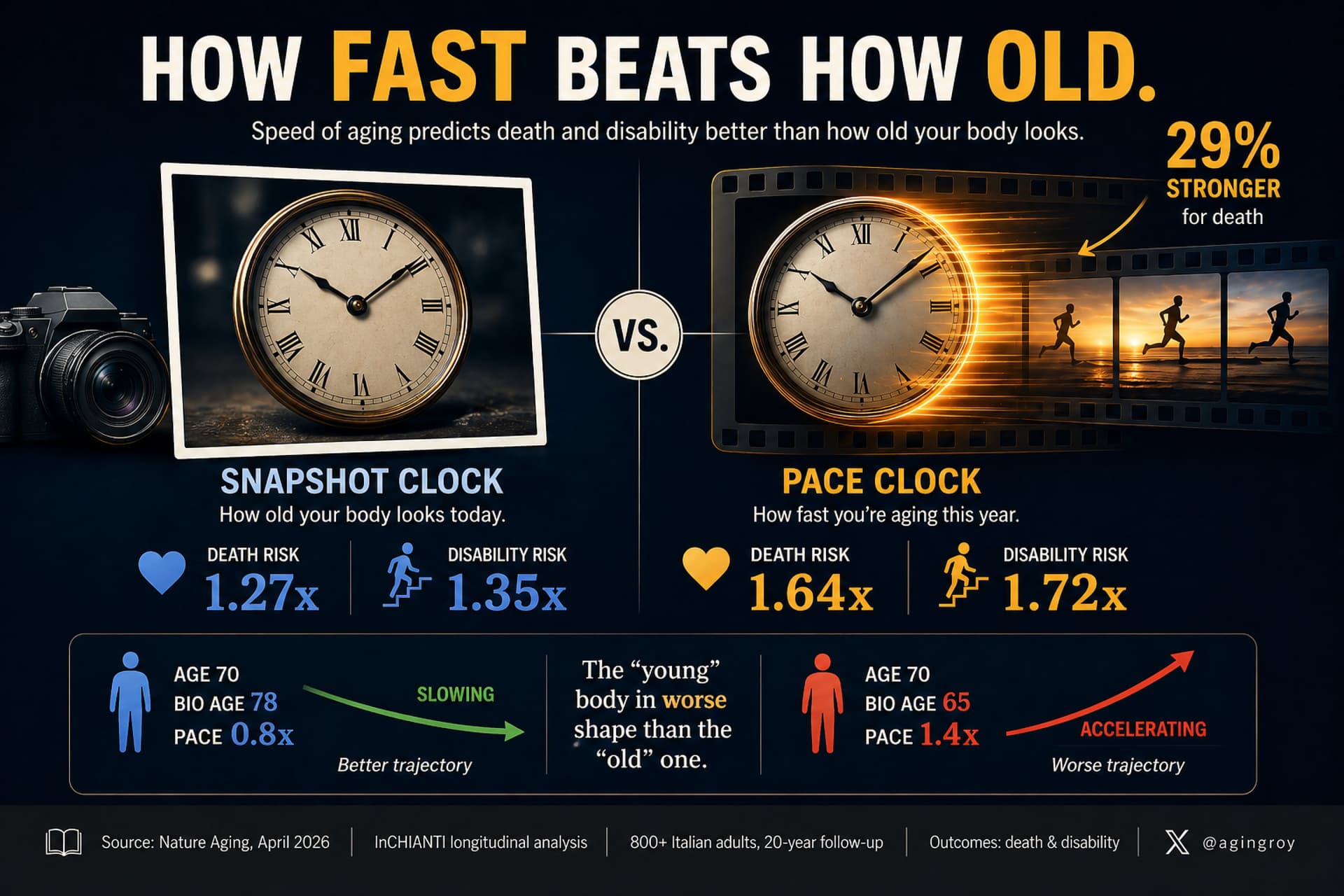
For years, the “epigenetic clock” has been the gold standard for biohackers and longevity enthusiasts looking to quantify their biological age. By measuring DNA methylation patterns, these tools offer a “snapshot” of how much wear and tear your body has endured compared to your chronological years. However, a significant question has remained: Does a single high reading doom you to an early grave, or is it the speed at which that clock is ticking that truly determines your fate?.
New research published in Nature Aging by scientists at the National Institute on Aging (NIA) suggests that the rate of change is a critical, independent predictor of survival. Analyzing data from the InCHIANTI study —a 24-year longitudinal cohort of 1,453 adults in Italy—researchers tracked how epigenetic ages shifted over decades. They utilized a battery of tests, including first-generation clocks (Hannum, Horvath), second-generation clocks (PhenoAge, GrimAge), and the latest third-generation “pace of aging” markers (DunedinPACE).
The findings fundamentally reframe how we should view biological aging markers. While having a high baseline biological age is a known risk factor, the study discovered that longitudinal changes in these clocks predict mortality independently of where you start. This means that even if an individual has a high biological age today, slowing the subsequent rate of change significantly improves their long-term survival prospects.
Interestingly, the study noted a “moderate inverse association” between baseline age and subsequent change—essentially, those who started “older” sometimes saw slower subsequent acceleration. While this may partially be “regression to the mean,” it also hints at biological self-regulatory mechanisms. Most importantly, the study validates several epigenetic clocks as potential “surrogate endpoints” for clinical trials. If an intervention—be it a drug, diet, or lifestyle change—can demonstrably slow the progression of these clocks, it is likely to translate into a genuine reduction in mortality risk rather than a mere statistical fluke.
Actionable Insights
-
Prioritize Velocity Over Position: A single epigenetic test provides a baseline, but the “pace of aging” (calculated through longitudinal testing) is the more actionable metric for evaluating interventions. Users should prioritize tools like DunedinPACE or DNAmGrimAge for tracking changes over time.
-
Long-Term Monitoring is Essential: Because longitudinal changes carry independent information, biohackers should aim for consistent, repeated measurements (e.g., annually or bi-annually) rather than one-off snapshots to truly assess if their longevity stack is working.
-
Contextualize “High” Readings: If a baseline test shows an accelerated biological age, do not assume it is a fixed trajectory. The ability to slow the rate of future aging remains a powerful lever for reducing downstream mortality risk.
-
Focus on Second and Third-Generation Clocks: The study found that associations with mortality were strongest for clocks like GrimAge2 and DunedinPACE , which were specifically designed to capture physiological decline and mortality risk rather than just chronological age.
Context & Impact
- Paywalled Paper: Longitudinal changes in epigenetic clocks predict long-term mortality
- Institution: National Institute on Aging (NIA), National Institutes of Health (NIH).
- Country: USA (Analysis) / Italy (InCHIANTI Cohort).
- Journal: Nature Aging.
- Impact Evaluation: The impact score (JIF) of this journal is approximately 16.6, evaluated against a typical high-end range of 0–60+ for top general science; therefore, this is a High impact journal.