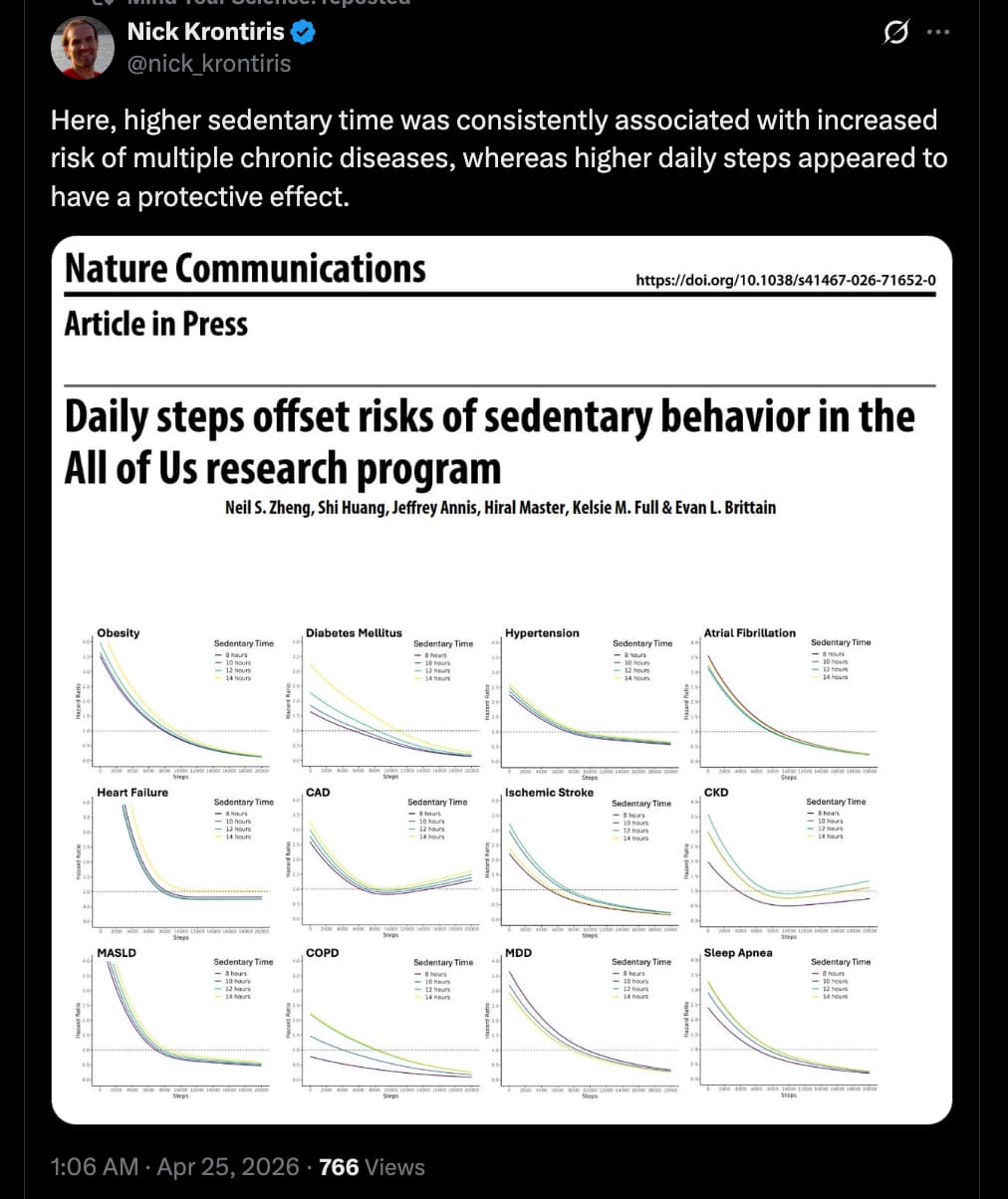
A massive meta-analysis of 226,889 individuals has redefined the relationship between daily walking and human mortality, suggesting that the “10,000 steps” target is a conservative baseline rather than a ceiling for health. The study reveals that the risk of dying from any cause begins to drop significantly at just 3,867 steps per day, while the threshold for reducing cardiovascular death is even lower, at 2,337 steps. This data challenges the long-standing definition of a sedentary lifestyle as anything under 5,000 steps.
The research establishes a clear, dose-response relationship: for every additional 1,000 steps taken daily, the risk of all-cause mortality decreases by 15%. Similarly, an increment of just 500 steps is associated with a 7% reduction in cardiovascular-specific mortality. Crucially, the researchers investigated activity levels up to 20,000 steps per day—far beyond previous analyses—and found no evidence of a “plateau” where benefits diminish. The “more is better” rule appears to hold true across sexes and geographical regions, regardless of local climate.
Age plays a significant role in how the body translates movement into survival. While older adults (over 60) see the most pronounced mortality reduction between 6,000 and 10,000 steps, younger populations require a higher volume of activity—roughly 7,000 to 13,000 steps—to reach the sharpest phase of the risk-reduction curve. Despite the widespread use of step counters, global activity levels remain dangerously low, with 27.5% of the population failing to meet basic physical activity targets. This study provides a modular roadmap for longevity: even minimal transitions from sedentary behavior to low-level activity produce clinically significant survival advantages.
Actionable Insights
-
Recalibrate the Baseline: Abandon the binary “sedentary vs. active” mindset. Survival benefits for cardiovascular health begin at approximately 2,337 daily steps, providing a low-entry target for those with mobility limitations.
-
Targeted Dose-Response: Aim for a 1,000-step daily increase to achieve a 15% reduction in all-cause mortality risk. For cardiovascular health, even a 500-step increase yields a 7% risk reduction.
-
Age-Specific Optimization: If you are under 60, target 7,000 to 13,000 steps per day for the highest ROI in risk reduction. If you are over 60, the optimal range for the sharpest risk reduction is 6,000 to 10,000 steps.
-
Ignore the Ceiling: There is currently no evidence of a “limit” to benefits up to 20,000 steps. Continue increasing volume as long as recovery allows.
-
Volume Over Intensity: The total step count is the primary driver of mortality reduction; intensity is secondary when total volume is equal.
Context
- Open Access Paper: The association between daily step count and all-cause and cardiovascular mortality: a meta-analysis
- Institution: Medical University of Lodz.
- Country: Poland.
-
Journal Name: European Journal of Preventive Cardiology, Published: 09 August 2023
Impact: The impact score of this journal is 8.3, evaluated against a typical high-end range of 0–60+ for top general science, therefore this is a High impact journal.