5 Likes
Thanks. Amazing price. I really like what Cuban has done with his pharmacy. Now let’s see a GLP.
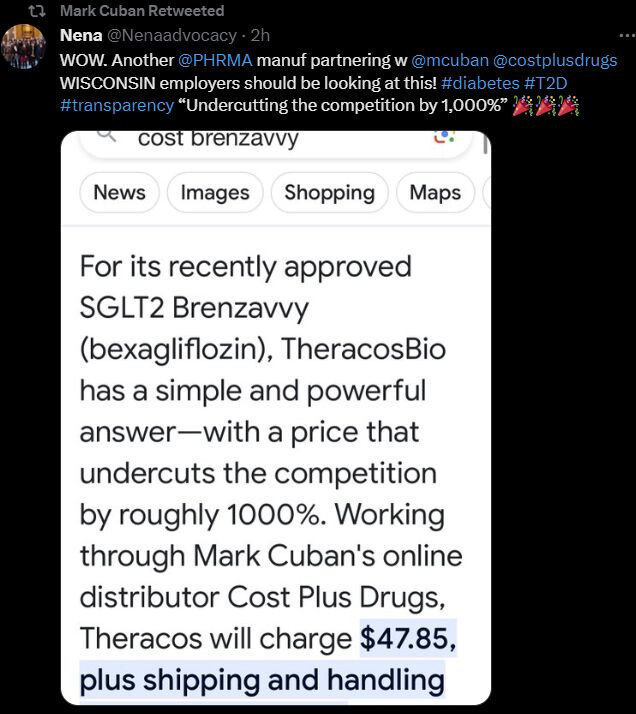
I checked and Bexagliflozin is already available at cost plus drugs.com. And Acarbose is dirt cheap there.
1 Like
How does it compare with dapagliflozin and empagliflozin then?
What about SGLT1 if I want to not regret eating strawberries?
For HbA1c reduction in people with type 2 diabetes and preserved kidney function, they are all fairly close, but canagliflozin 300 mg tends to be the strongest:
Drug and usual maximum glucose-lowering dose Typical placebo-adjusted HbA1c reduction Canagliflozin 300 mg about 0.8–1.2 percentage points Canagliflozin 100 mg about 0.6–0.9 points Empagliflozin 25 mg about 0.6–0.8 points Empagliflozin 10 mg about 0.5–0.7 points Dapagliflozin 10 mg about 0.5–0.7 points Bexagliflozin 20 mg about 0.4–0.6 points In one canagliflozin monotherapy trial with baseline HbA1c around 8.0%, the placebo-adjusted reductions were 0.91 points with 100 mg and 1.16 points with 300 mg. That study also found unusually large reductions in two-hour postprandial glucose, consistent with canagliflozin’s partial intestinal SGLT1 effect.
For empagliflozin added to metformin, both 10 and 25 mg produced about a 0.6-point placebo-adjusted reduction, despite the 25 mg dose being nominally larger. The incremental benefit from 10 to 25 mg is generally small. Dapagliflozin 10 mg monotherapy lowered HbA1c by 0.9 points from baseline versus 0.2 with placebo, a 0.7-point placebo-adjusted effect.
Bexagliflozin’s pivotal monotherapy trial was less impressive: HbA1c changed by −0.5% versus −0.1% on placebo, giving a placebo-adjusted reduction of 0.4 points. As add-on to metformin, the placebo-adjusted difference was 0.5 points.
A network meta-analysis found that canagliflozin 300 mg lowered HbA1c roughly 0.2 percentage points more than dapagliflozin 10 mg or empagliflozin 25 mg. More recent dose-ranging analysis likewise ranked canagliflozin 300 mg highest, with empagliflozin 25 mg generally next and dapagliflozin 10 mg near empagliflozin 10 mg.
The ranking I would use
Canagliflozin 300 mg > empagliflozin 25 mg ≈ canagliflozin 100 mg > dapagliflozin 10 mg ≈ empagliflozin 10 mg ≈ bexagliflozin 20 mg
But the differences are modest. Baseline glucose, kidney filtration, adherence, and background medication matter more than the distinction between most of these drugs.
For your HbA1c around 5.0%
Those trial numbers do not apply to you. SGLT2 inhibitors lower glucose in a glucose-dependent fashion: when blood glucose and filtered glucose are already low, much less glucose is available to excrete. Starting from an HbA1c of roughly 5.0%, the likely reduction may be only around 0.0–0.2 percentage points, perhaps with little measurable difference among the drugs.
Canagliflozin could still outperform the others for specific post-meal peaks, as you observed with strawberries, without producing a proportionally larger A1c reduction. A brief peak contributes surprisingly little to three months of average glycemia. So the two rankings are likely:
- Strawberry spike: canagliflozin clearly best for you.
- Already-normal HbA1c: probably only tiny differences, with canagliflozin perhaps marginally strongest.
That means switching from canagliflozin to dapagliflozin or bexagliflozin might preserve most of any average-glucose effect, while losing the particular premeal spike suppression you care about.