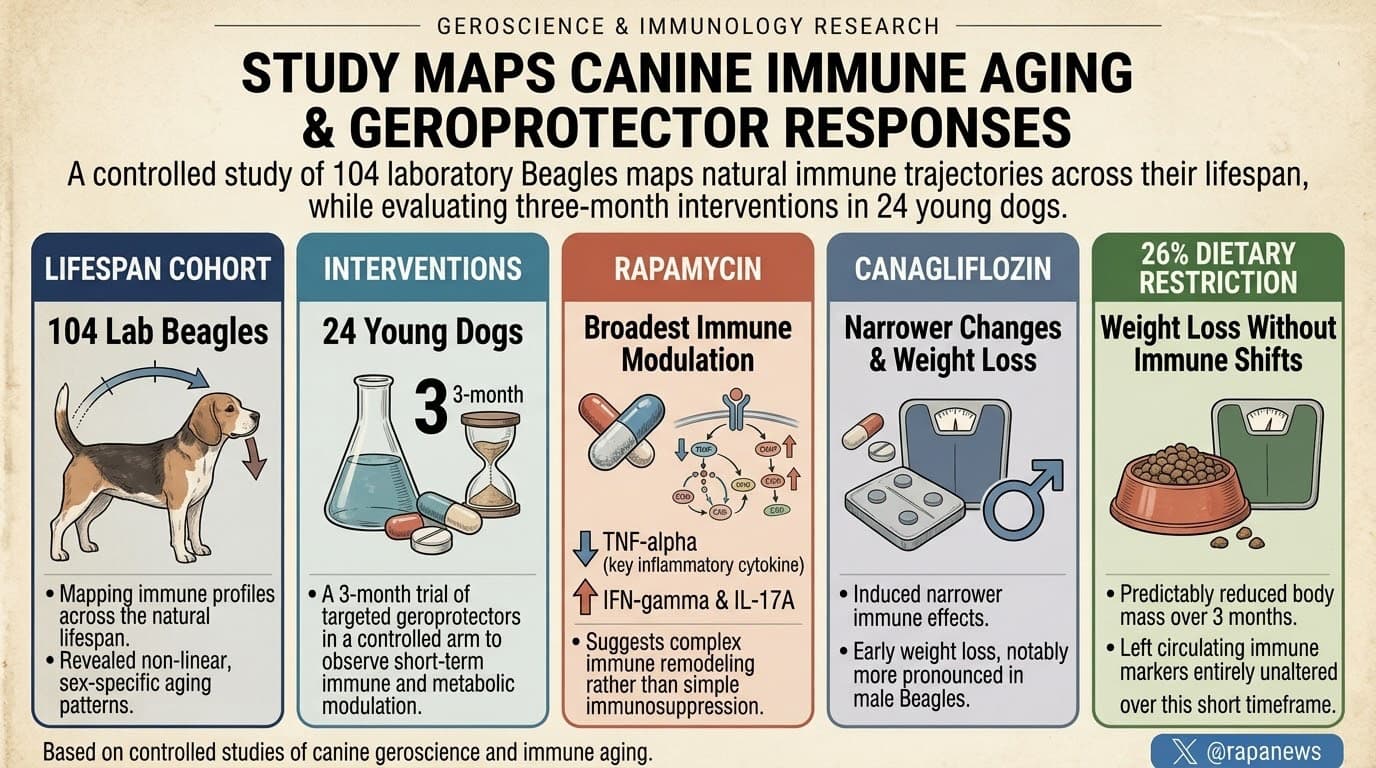
Researchers in China profiled blood counts and 40 serum cytokines in 80 unneutered laboratory beagles aged 1 to 10.5 years, then ran a 90-day test of rapamycin, canagliflozin or a 26% food cut in 24 young beagles. Immune aging was uneven and non-linear, and an apparent male-female difference in cytokine aging did not survive statistical correction. Rapamycin produced the broadest change, sharply lowering four cytokines and raising four others. Canagliflozin had a narrower effect, and dietary restriction reduced weight without moving any immune marker. With six dogs per group and no baseline cytokine measurements, the intervention results are hypothesis-generating only.
Dogs are the animal that geroscience most wants to work. They share our homes, develop our diseases and live a fraction as long. A team led from the Southern University of Science and Technology in Shenzhen has used laboratory beagles to ask two questions at once: what does a dog’s immune system look like as it ages, and what happens when a young dog is given one of three well-known longevity interventions?
For the first question, the researchers took blood from 80 unneutered beagles, half male and half female, all eating the same food in the same facility. That matters, because most dog aging data come from pets, which differ in breed, diet and neuter status. The picture that came back was not a steady slide into inflammation. White blood cell counts drifted down with age, then ticked up again in the oldest group. Inflammatory signals such as TNF-alpha and MCP-1 climbed in males until about age 9, then fell. Males showed nine age-linked cytokines to the females’ two, which looks like a sex difference. The authors tested that directly and it did not survive statistical correction. They say so plainly, which is to their credit.
The second experiment is the one longevity enthusiasts will read first. Twenty-four young beagles were split into four groups of six: controls, rapamycin twice a week, the diabetes drug canagliflozin daily, or a 26% cut in food. After 90 days, rapamycin had left the largest mark. Four cytokines, including TNF-alpha, were far lower than in controls, in some dogs too low to detect. Four others, including interferon-gamma and IL-17A, were higher. That is not the profile of a drug that turns inflammation down. It is the profile of a drug that shifts the immune system into a different configuration, and the study cannot say whether that configuration is better.
Canagliflozin produced a smaller version of the same thing: lower TNF-alpha and IL-10, with some weight loss. Food restriction made the dogs lighter and changed none of the 40 immune signals measured.
The caveats are large. Six dogs per group is very few. Cytokines were measured only at the end, so the comparison is between different dogs, not before and after in the same dog. The animals were about a year old, so the results describe what these drugs do to a young, healthy immune system, not whether they rejuvenate an old one. The rapamycin dose, 0.5 mg per kg per week, is also about three times the weekly dose used in the large Dog Aging Project trial now under way.
So the big idea is modest but useful. Immune aging in dogs moves in stages and differs by marker, and rapamycin at this dose is an active immune modulator in dogs within three months. Whether that helps an aging dog, or a person, is still unanswered. The paper is a preprint and has not been peer reviewed.
Actionable Insights
What this study offers is a calibration of expectations.
- Rapamycin is an immune modulator, not a simple anti-inflammatory. Four signals were roughly 95% lower than in controls (TNF-alpha, GM-CSF, IL-10, MCP-1), while interferon-gamma was about 30-fold higher and IL-17A about 2-fold higher. Tracking rapamycin with one marker such as CRP or TNF-alpha shows a fraction of the picture.
- The dose was high. Scaled by body surface area, 0.25 mg/kg twice weekly in a dog is very roughly 8 to 10 mg twice weekly for a 60 to 70 kg adult, above typical off-label longevity dosing.
- Canagliflozin, at roughly the equivalent of 230 mg per day in a human, was associated with about 80% lower TNF-alpha, but also lower IL-10, which is itself anti-inflammatory.
- A 26% calorie cut for 90 days reduced weight and moved no immune marker. In young, lean, healthy animals, blood inflammation panels may not shift quickly with dieting.
On magnitude: the white cell differences correspond to a Cohen’s d near 2, meaning the average treated dog sat about two standard deviations above the average control. With six dogs per group the true figure could plausibly lie anywhere from 0.6 to 3.4, and none of the blood count differences survived correction for multiple testing.
Context/Source
- Full title: Sex-stratified immune patterns across the canine lifespan and short-term responses to geroprotective interventions
- Institutions: Southern University of Science and Technology (Shenzhen); Macau University of Science and Technology; South China Agricultural University (Guangzhou); Anling Biomedical (Shenzhen) Co., Ltd.; ZSHK Laboratories Ltd (Hong Kong)
- Country: China
- Journal: bioRxiv (preprint server)