chatGPT:
Below is a cleaned-up (“tidy”) version of your transcript, followed by a summary and a critique that checks the key factual hooks (the preprint + the Life Biosciences announcement) against primary sources.
Tidy transcript (cleaned, with light edits)
Title: Why 300 aging theories might be wrong (The Physics of Universality)
0:00–0:46 — Setup
- On the Shiki Science Show, I try to explain things simply.
- I got excited reading a recent preprint on a minimal model of aging—not maximal—trying to explain aging with just three variables.
- I’ll explain the variables and the implications for (1) how we should research aging and (2) how we should evaluate anti-aging interventions—especially why most therapies may have a ceiling, and what might be needed for larger longevity gains.
0:47–2:14 — “Universality” framing
- Aging research is booming, but we have ~300 theories of aging; it’s hard to integrate them.
- The preprint (Peter Fedichev/Fedichev-like name in the narration; also “Yang Gruba” as spoken) takes a physics approach: aging is universal across species, and physics has a concept called universality.
- Near a critical point (like water boiling), microscopic details matter less; macroscopic variables govern behavior.
- Likewise, yeast/worm/human aging differ in details, but maybe the changes can be collapsed into a few emergent variables.
2:15–3:33 — Variable 1: cumulative entropic damage (linear)
- Variable 1 is cumulative entropic damage, which increases linearly with time.
- The idea: damage events are statistically independent (like coin flips).
- Evidence mentioned: DNA methylation clocks—principal component axes where a major component is linear with age; methylation sites contributing to the linear signature have low mutual information, implying independence.
- Other examples: extracellular matrix cross-linking; somatic mutations.
3:33–6:56 — Variable 2: dynamic stress response (resilience; “critical slowing down”)
-
Variable 2 is dynamic stress response (harder to define): genetic/program-like responses to stress (heat-shock, oxidative response pathways, senescence, etc.).
-
Example: immune response recovery—young people return to baseline quickly; older people take weeks or months.
-
Proposed measurement: temporal autocorrelation (TAC)—how similar you are today vs. yesterday.
- Young: TAC decays quickly (fast recovery).
- Old: TAC decays slowly (stays perturbed longer).
-
This is “critical slowing down,” suggesting a system approaching failure; in humans this extrapolates to ~120 years as a theoretical maximum lifespan where recovery goes to zero.
5:05–6:56 — Humans vs mice: “stable” vs “unstable” species
-
The video claims humans and mice differ:
- Humans show TAC decay worsening with age.
- Mice show TAC essentially flat across life in some datasets → interpreted as lacking a restoring force; biomarkers diverge exponentially.
-
Mice are called “unstable species”; humans “stable species.”
6:56–7:21 — Implication: translation from mice to humans
- If mice are inherently unstable, interventions that “stabilize” them could look dramatic in mice but modest in humans.
- This is suggested as a possible reason drugs like rapamycin have large mouse lifespan effects but smaller human effects.
7:21–7:58 — Variable 3: noise
- Variable 3 is noise: stochastic fluctuations / unpredictable stressors that can push a stable system into failure.
- Described mathematically as the amplitude of white noise.
- Claimed evidence: stochastic “clocks” where dispersion alone explains a large fraction of prediction.
7:58–10:19 — Implications for interventions: three “levels”
-
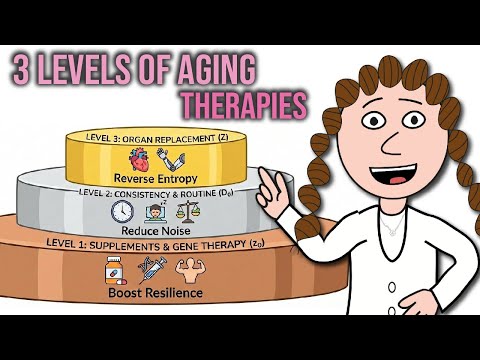
Level 1: therapies that mostly act on dynamic stress response (resilience): senolytics, calorie restriction, NAD+ boosters, and (the narrator argues) cellular reprogramming.
- Reason for reprogramming being Level 1: observed methylation “rejuvenation” looks like the dynamic/reversible component, not the entropic/linear component; doesn’t address mutations rising linearly with age.
- Parabiosis example: stress markers improve; “entropy markers” don’t.
-
Comment on translation: most reprogramming work is in mice; if mice are “unstable,” adding stability back could look bigger in mice than humans.
-
Mentions: Life Biosciences entering human trials for an eye reprogramming treatment (narrator hopes it works, but predicts it will have limits).
9:43–10:19 — “Organ replacement”
- If you want much longer health and life, you may need organ replacement.
- This is impractical; so the hope is to mimic replacement in vivo.
- Maybe rejuvenated cells could remove environmental damage—but evidence is lacking.
- Bottom line: reprogramming = valuable for healthspan, likely not maximal lifespan.
10:19–10:52 — Level 2: reduce noise
- Level 2 targets noise: stable routines, consistent sleep, steady blood sugar.
- Narrator is skeptical about evidence, but says the model predicts reducing noise could add 30–40 years by helping people get closer to the max lifespan (without raising the max).
10:52–13:20 — Level 3: reverse “irreversible” damage
- Level 3 is the only way to extend maximal lifespan: address cumulative entropic damage via molecular repair, clearance of irreversibly damaged components, organ replacement, genome editing, large-scale cell/organ replacement.
- CRISPR can fix mutations, but there are trillions of cells with diverse mutations; reversing all precisely is daunting.
- Entropic changes are linear; more accumulate again.
- Replacement may be more feasible than perfect in situ repair, but immune compatibility is a challenge.
- Concludes: aging debates (programmed vs random vs damage) may all be partly right; this framework is a useful vocabulary, but measuring TAC and “noise” well is still hard.
- “We should level up aging.”
Summary (what the video is arguing)
-
Aging can be modeled with 3 macroscopic variables (instead of hundreds of micro-mechanistic theories):
- Linear “entropic” damage (irreversible-ish accumulation).
- Dynamic stress response / resilience (recovery dynamics; critical slowing down).
- Noise (random perturbations pushing you into failure).
-
Humans vs mice may sit in different “regimes.” The video claims humans are “stable” (have a restoring force that weakens with age), while mice are “unstable” (more runaway divergence), implying mouse results may systematically overstate benefits of interventions that “stabilize.”
-
Intervention tiers:
- Level 1 (resilience/dynamic): many popular anti-aging approaches (senolytics, CR, NAD+, reprogramming) mainly improve reversible/dynamic aspects → healthspan gains but limited effect on maximal lifespan.
- Level 2 (noise reduction): lifestyle stability reduces stochastic pushes toward failure → helps more people approach the ceiling (big claimed gains, but doesn’t raise the ceiling).
- Level 3 (damage repair/replacement): only deep repair or replacement of accumulated damage can raise maximal lifespan.
Critique (what’s strong, what’s shaky, what to watch)
What’s strong / useful
-
A legit “physics-style” compression attempt exists. The bioRxiv preprint the video is gesturing toward is real and explicitly frames stable vs unstable regimes and a minimal-variable view of aging. (BioRxiv)
-
Resilience / critical slowing down has peer-reviewed footing. The “loss of resilience” / autocorrelation / recovery-time idea appears in the literature (e.g., Pyrkov et al. 2021, using longitudinal blood markers to argue recovery rate trends toward a critical point at advanced age). (PMC)
-
A practical value: even if you disagree with specifics, the framework forces you to ask:
- Is an intervention changing reversible state vs irreversible accumulation?
- Does it change variance/noise or mean trajectory?
- Are you measuring recovery dynamics (not just static biomarkers)?
Key weaknesses / leaps
-
“Universality” analogy risks being more metaphor than mechanism.
In physics, universality near critical points is mathematically grounded (renormalization, scaling laws, exponents). In aging, the mapping is suggestive, but you’d want to see:- explicit scaling relations,
- robust cross-species collapse onto the same reduced variables, and
- sensitivity analyses showing micro-details truly wash out.
Otherwise it can become a rhetorical shortcut: “complex → therefore 3 variables.”
-
“Entropic damage” is underspecified and may be conflated with methylation drift.
The video treats a linear methylation component as evidence of independent, entropic damage events. But methylation changes can reflect regulated remodeling, cell-composition shifts, drift, selection, and measurement artifacts—not just “coin flips.”
Without careful decomposition (cell types, longitudinal within-person, causal links), “linear methylation PC” ≠ “thermodynamic entropy of damage.” -
The stable vs unstable species claim is provocative—but easy to over-interpret.
“Mice are biologically broken” is a strong framing, but species differences in:- sampling frequency,
- biomarker choice,
- husbandry/environmental variance,
- strain effects,
- mortality selection,
can all change observed autocorrelation patterns.
The underlying idea (different dynamical regimes) is plausible, but the translation conclusion (“therefore rapamycin modest in humans”) is not established by the model alone.
-
The “120-year limit” is not a settled fact.
Pyrkov et al. argue for an asymptotic limit based on resilience metrics, but it’s model-dependent and debated. (PMC)
Treat “~120” here as a hypothesis from a specific dynamical model, not an empirical constant of nature. -
Classifying reprogramming as “only Level 1” may be prematurely pessimistic.
The video’s logic is: reprogramming shifts reversible/dynamic methylation marks, not linear/entropic damage (e.g., mutations). That’s fair as a current limitation, but:- some “irreversible” things become reversible with the right machinery (repair, replacement, turnover),
- and reprogramming could change damage handling rates (proteostasis, immunity, fibrosis dynamics), potentially affecting the trajectory indirectly.
The right critique is: show whether reprogramming changes the slope of long-term hazard / functional decline, not only clocks.
-
The “noise reduction adds 30–40 years” claim is extremely weakly supported.
Even if noise influences who reaches the ceiling, a 30–40 year effect size from routines/sleep/glycemic steadiness is extraordinary; you’d expect strong epidemiology and interventional evidence, which the video itself admits is lacking. -
“Organ replacement” is a real direction, but the video undersells hybrid paths.
It frames the choice as repair-everything vs replace-organs. In reality, plausible “Level 3-ish” routes include:- targeted removal of high-impact damage classes (some crosslinks, aggregates, senescent cell burdens in certain contexts),
- improving clearance/turnover and tissue remodeling,
- periodic cell therapy / engineered immune clearance,
- partial replacement (patches, scaffolds, decellularized matrices),
which don’t require perfect, cell-by-cell mutation reversal.
Factual cross-checks on two concrete claims in the video
- The “minimal model” preprint exists on bioRxiv (Aug 2025) and does describe regimes and reduced-variable framing. (BioRxiv)
-
Life Biosciences entering human trials for ocular reprogramming is real and very recent: Life Biosciences announced FDA clearance of an IND for ER-100 for optic neuropathies (Jan 28, 2026). (Life Biosciences, Inc.)
(There’s also secondary coverage echoing this.) (lifespan.io)
How I’d “stress test” this framework (quick checklist)
If you want to use the model productively, the best questions are empirical:
-
Can you measure TAC/recovery robustly in humans with dense sampling (wearables + blood panels) and show it predicts hard outcomes?
-
Does an intervention change:
- the mean aging trajectory,
- the recovery rate after perturbations, and/or
- the variance/noise amplitude?
-
Across species: do humans, dogs, primates, mice show consistent “regime signatures” when measured the same way?
-
For reprogramming: does it only reset clocks, or does it also reduce future incidence of dysfunction (slope changes), and does it interact with “damage” proxies?
If you want, I can also turn this into a claim-by-claim table (claim → what evidence would support/refute it → best current proxy measures), using the three-variable/three-level structure.