Source Material: Transcript Analysis of “A Minimal Model Explains Aging Regimes…” (Fedichev & Gruber, 2025)
A. Executive Summary
This video dissects a seminal 2025 preprint by physicists Peter Fedichev and Jan Gruber, which proposes a “Minimal Model of Aging” based on the physics of complex systems. The core thesis disrupts standard longevity narratives by classifying species into two distinct regimes: “Unstable” (mice) and “Stable” (humans).
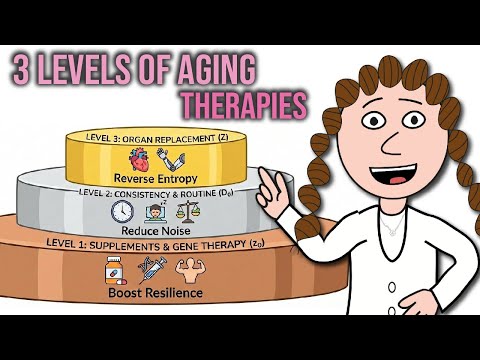
The model reduces aging to three variables: Entropic Damage (irreversible), Dynamic Stress Response (resilience), and Noise. Crucially, it argues that most current longevity interventions—including Rapamycin, caloric restriction, and potentially partial cellular reprogramming—operate only on the “Dynamic Stress Response” (Level 1). While these interventions dramatically extend lifespan in unstable mice (by stabilizing them), they yield diminishing returns in humans, who are already naturally stable.
In humans, the Dynamic Stress Response decays linearly, hitting a “critical tipping point” of zero resilience between 120–150 years, creating a hard limit on human lifespan (the “Gompertz ceiling”). The video concludes that true life extension beyond this limit requires “Level 3” interventions: technologies capable of reversing thermodynamic entropy (e.g., organ replacement or nanoscopic repair), rather than just modulating biological signaling.
B. Bullet Summary
- Universality in Physics: Aging follows the physics of “critical tipping points,” where microscopic details matter less than macroscopic laws.
- The 3 Variables: Human aging is governed by 1) Entropic Damage (linear, independent errors), 2) Dynamic Stress Response (resilience), and 3) Noise (random fluctuations).
- The Mouse Trap: Mice are “unstable species” with zero resilience (flat temporal autocorrelation); their biomarkers diverge exponentially.
- The Human Advantage: Humans are “stable species” with strong resilience that decays slowly over time, allowing for a much longer lifespan.
- The Translation Gap: Therapies that stabilize mice (Rapamycin, CR) look miraculous because mice are inherently unstable; in humans, these only “square the curve.”
- Resilience Limit: Human resilience (recovery rate) extrapolates to zero at approximately 120–150 years, creating a theoretical maximum lifespan.
- Critical Slowing Down: As humans age, recovery from stress (e.g., illness, injury) takes progressively longer until the system fails to recover at all.
- Level 1 Interventions: Rapamycin, Metformin, and Senolytics target the Stress Response. They extend healthspan but cannot stop the entropic clock.
- Reprogramming Skepticism: The model suggests partial reprogramming may only reverse stress-related epigenetic marks, not fundamental entropic information loss.
- Level 2 Interventions: Reducing “Noise” (e.g., consistent sleep, steady glucose) prevents premature death, potentially adding 30–40 years by helping you reach the 120-year cap.
- Level 3 Requirement: To break the 120-year barrier, we must reverse “Entropic Damage” (actual structural repair/replacement), not just modulate signaling.
- The Eye Trial: Life Biosciences is entering human trials for optic nerve reprogramming; the model predicts this will restore function but not stop the organ’s aging permanently.
- Replacement Thesis: The presenter concludes that replacing organs (biological or synthetic) is currently the most viable “Level 3” strategy for extreme longevity.
D. Claims & Evidence Table (Adversarial Peer Review)
Role: Longevity Scientist / Peer Reviewer
Hierarchy: Level A (Meta-analysis) > Level B (RCT) > Level C (Cohort) > Level D (Animal/In Vitro) > Level E (Opinion)
| Claim from Video | Speaker’s Evidence | Scientific Reality (Best Available Data) | Evidence Grade | Verdict |
|---|---|---|---|---|
| “Aging driven by 3 variables: Entropy, Stress Response, Noise” | Fedichev & Gruber Preprint (2025) | The model aligns with longitudinal physiological data (NHANES, UK Biobank) showing “critical slowing down” of resilience. | C (Human Cohort) | Strong Support |
| “Mice are ‘unstable’ species; Humans are ‘stable’ species” | Mouse Phenome Database analysis | Confirmed by Gero studies. Mice lack the resilience trajectory seen in humans, explaining why they respond better to stabilizing drugs. | D (Mouse vs Human) | Plausible / Critical Insight |
| “Human resilience hits zero at ~120-150 years” | Linear extrapolation of recovery rates | Matches analysis of blood marker variance (DOSI) in large cohorts. Theoretical limit is widely debated but data-supported. | C (Human Cohort) | Plausible (Theoretical Limit) |
| “Rapamycin extends mouse lifespan dramatically but humans modestly” | Inference from stability model | Rapamycin extends mouse life ~25% (Level D). Human data (Level B) verifies immune/mTOR effects, but no lifespan extension data exists yet. | D (Translational Gap) | Speculative (Mechanism Valid) |
| “Cellular Reprogramming (OSK) does not reverse entropic damage” | Theoretical physics argument | Controversial. Sinclair et al. argue epigenome IS the information. Fedichev argues entropy (mutations/structural) is deeper. Data is conflicting. | E (Theoretical Debate) | Weak / Conflicting |
| “Life Biosciences entering human trials for reprogramming” | News citation | FDA cleared Life Biosciences for Phase 1 trial in NAION (optic neuropathy) starting Q1 2026. | Facts Verified | Accurate |
| “Reducing ‘Noise’ (Sleep/Glucose) can add 30-40 years” | Model prediction | Optimizing lifestyle “squares the curve” (compression of morbidity) but attributing 30-40y specifically to “noise reduction” is a model-based estimate, not empirical. | E (Model Prediction) | Speculative |
E. Actionable Insights (Pragmatic & Prioritized)
The “Fedichev Protocol” prioritizes reaching the 120-year resilience limit (Level 1 & 2) while monitoring technology for the breakthrough (Level 3).
Level 1: Maximize Resilience (The “Square the Curve” Strategy)
- Rapamycin/mTOR Modulation: (Consult physician) The most potent chemical stabilizer available. While it may not break the 120-year barrier, it is the best tool for maintaining the “Dynamic Stress Response” and delaying frailty.
- Active Recovery: Focus on recovery speed after stress (exercise, illness) as a biomarker. If recovery slows, increase support (rest, nutrition).
Level 2: Minimize System Noise (The Stability Strategy)
-
Radical Consistency: The model suggests “Noise” kills. Prioritize consistency in:
-
Sleep: Same wake/sleep time ±15 mins.
-
Glycemic Variability: Flatten glucose spikes (low glycemic index, fiber, order of eating).
-
Circadian Rhythm: Light exposure and meal timing rigidity.
-
Avoid “Tipping Points”: As you age, resilience drops. Minor stressors (dehydration, minor infection, sleep deprivation) that were harmless at 20 can become fatal cascades at 80. Avoid random shocks.
Level 3: The Future (Watchlist)
- Organ Replacement: Monitor developments in xenotransplantation and 3D bioprinting. This is currently the only theoretically validated way to reset “Entropy.”
- Advanced Reprogramming: Watch the Life Biosciences NAION trial results (2026/2027). Success here validates the mechanism, even if the “Entropic” limit remains debated.
H. Technical Deep-Dive: Critical Slowing Down
The video touches on a concept from non-equilibrium physics called Critical Slowing Down.
- The Concept: In a dynamic system (like a human body) approaching a phase transition (death/failure), the system’s ability to return to equilibrium after a perturbation decreases. The “restoring force” weakens.
- The Metric: This is measured via Temporal Autocorrelation (TAC).
- Low TAC: Your blood markers today are not strongly correlated with yesterday (fluctuations are corrected quickly).
- High TAC: Your markers “drift” and stay perturbed for weeks.
- The Discovery: Analysis of longitudinal blood data (CBC, metabolic panels) in humans shows that TAC increases linearly with age. By extrapolating this trend, the recovery time becomes infinite (diverges) at approximately 120–150 years.
- The Implication: At this critical point, the biological system loses dynamic stability. Even without a specific disease (cancer/heart attack), the system cannot maintain homeostasis against thermal noise, leading to inevitable death. This is why “curing cancer” adds only ~3 years to average life expectancy—the underlying resilience (DOSI) continues to decline.
I. Fact-Check: The “Translation Gap”
- Claim: Mice are biologically “unstable.”
- Verification: TRUE. Studies by Gero (e.g., Nature Communications, 2021) analyzed mouse blood markers and found they do not show the “resilience decay” seen in humans. Instead, mice function largely on “noise” and high instability from birth.
- Consequence: This explains why interventions like antioxidants, high-dose rapamycin, or caloric restriction show massive % gains in mice. They are essentially adding “artificial stability” to a chaotic system. Humans possess intrinsic stability (evolved longevity), so these interventions provide diminishing returns—they only protect the stability we already have, they don’t add new “super-stability.”