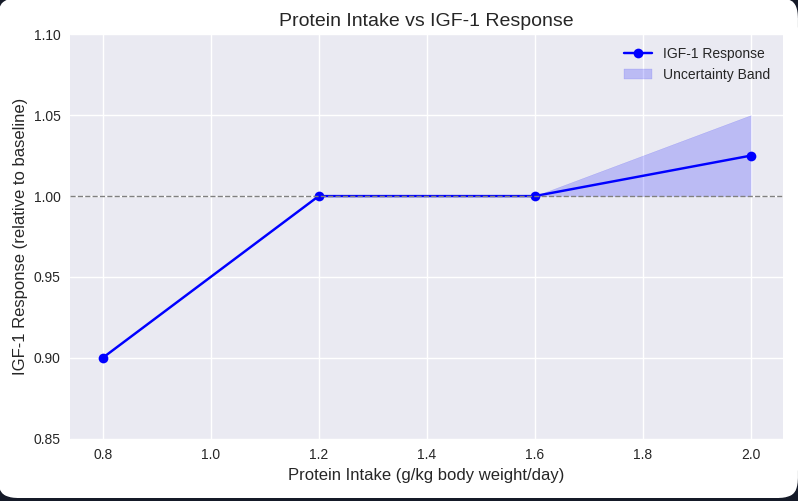
Are we wrong about the perfect protein intake?

Interesting graph. I am not sure what evidence they are using to claim that flat part of the graph is the “optimal” IGF-1 response. Statement seems to describe optimal muscle growth but muscle growth does necessarily equates longevity. In fact the Blue Zones (YES, I know - CONTROVERSIAL) centenarians appear to consume only about 1 gram/kg at most. To anyone that visited the Mediterranean (Italy, Spain, Southern France), Latin countries or Asia and had the privilege to dine with the locals this is pretty apparent. So they would fall on the left side of that graph with IGF under 1.0 relative response. Anabolic response is a double edge sword whether it comes from sex hormone, m-TOR or IGF-1. It promotes growth of muscle, skin, bone…or fibrosis, tumors or tissue hyperplasia (like prostate). This process seems more regulated when we are young but it becomes more chaotic with age. These anabolic levers have to better managed as we get older.

Personally, I end up eating about 1.4 g/kg thru mostly plant based diet with yogurt, some eggs and cheese, occasional fish and rare meat. I do about 10-12 of cardio (cycling, running or pickleball) and 2-3 h of resistance per week. My appetite is pretty high and I end up eating probably a bit too much. Probably if my appetite was curbed a bit, I would end up eating closer to 1.0-1.2 g/kg. This happens when I travel and don’t exercise so intensely. Interestingly this happens almost automatically by following green Med type of diet, I don’t purposely seek out protein.

Here are my AI findings:

Lowering IGF-1 (Insulin-like growth factor 1) may increase longevity, particularly in cases of high IGF-1 levels, based on evidence from animal studies and populations with exceptional longevity. However, the relationship is complex, as studies in the general population show mixed results, with some even suggesting both very high and very low levels are associated with a shorter lifespan. Excessively low IGF-1 can be linked to various health issues, so moderation is key, and the effect appears to be gender-specific in some cases, with females often benefiting more from lower levels.

Evidence for a link between lower IGF-1 and longevity

  • Animal studies: Down-regulating the IGF-1 pathway in mice has been shown to significantly prolong lifespan.
  • Genetics: Individuals with specific gene mutations that cause relative IGF-1 resistance often have exceptional longevity.
  • Population studies: Low IGF-1 levels have been associated with longer survival, better cognitive function, and better overall functional status in some populations, particularly in the very old and those with a history of cancer.* Centenarians: People who live to 100 years or older tend to have lower IGF-1 levels than their offspring.

Complexities and caveats

  • Reverse causation: In the general population, low IGF-1 levels may not be the cause of poor health, but rather a symptom of it. Illnesses can lead to a drop in IGF-1, making it appear that low levels are harmful when it is the disease that is the primary problem.
  • U-shaped curve: Some studies have shown a “U-shaped” relationship, where both very high and very low IGF-1 levels are associated with a shorter lifespan.
  • Gender differences: The positive effects of lower IGF-1 on longevity seem to be more pronounced in females in both human and animal studies.
  • Extreme lows: Chronically low IGF-1 can be a sign of conditions like Laron Syndrome, which is associated with health problems.

Conclusion

While there is evidence that reducing high IGF-1 can increase longevity, a dangerously low level is also a health risk. The ideal IGF-1 level for longevity is likely not the lowest possible, but rather within a healthy, moderate range.
2 Likes

I’d have a few questions on how centenarians IGF-1 levels were evaluated.

Is this in the last 10 years of life? 20 years? over what period of time was IGF-1 monitored? what were the levels between the age of 30 and 100?

Would a snap shot in time, close to the end of life provide enough data to make an informed scientific “fact” ?

Is this just correlation or truly causation?

I keep basically agreeing with your views but at the same time I’m trying to figure out some really effective and thorough way to examine this aspect, and other controversial aspects. Maybe we might upload representative articles onto the LMnotebook platform. The main drawback is that the list should span different schools and narratives. This could be done with some work. Then ask LMnotebook to build a model of imprecise probabilities from the list. I decided this is going to be one of my projects, starting with a few articles, then adding even more.

1 Like

I thought this conversation between Layne Norton and Stu Phillips was phenomenal.

It mostly summarized what many of us have been discussing.

-Most people won’t notice protein over 1.6g per kg.

-Timing of meals is less important than they used to think, but they don’t really think having all your protein in one meal is the way to go.

-Stu brought up the old Longo study that showed high protein correlated to increased cancer rates. He said after over a decade, they are about to print a new summary that shows there was, in fact, no correlation

-if you have enough protein, the source doesn’t matter

-the amount of weight you lift for muscle growth is not important, you just have to lift close to failure

I think video summaries loses a bit of what was actually discussed, but here it is for those of you who find it useful:

This episode is a long-form “muscle growth and protein” deep dive where Layne Norton interviews Stu Phillips about what actually drives hypertrophy and how to apply the science in practice. The core message is that consistent, hard resistance training that creates high mechanical tension on muscle fibers is the primary driver of growth, while nutrition and hormones are important but secondary modifiers.​

Muscle growth basics

Phillips emphasizes that regularly lifting with high effort is the single most important factor for hypertrophy, far outweighing smaller tweaks in diet or programming variables. Acute spikes in hormones like testosterone, growth hormone, and cortisol after training are framed as general stress responses rather than key drivers of muscle gain, and classic ideas like “squats boost whole-body growth via hormones” are downplayed.​

Protein intake and safety

They discuss meta-analyses indicating that protein intakes around roughly double the RDA (about 1.6 g/kg/day) appear close to optimal for maximizing muscle growth, with little added benefit from going much higher for most people. High-protein diets are presented as safe for healthy kidneys, with Phillips arguing that available clinical data do not support kidney damage in healthy individuals at typical high-protein intakes.​

Protein quality and timing

The conversation compares animal, plant, and collagen proteins, noting that collagen is poor for muscle building and that lower-quality plant proteins can be compensated for with higher total intake or blending sources. They also touch on protein distribution across meals, recommending multiple protein feedings with sufficient leucine per meal rather than loading most protein into a single sitting.​

Women, hormones, and training

Phillips pushes back on “hormone hacking” narratives, arguing that menstrual-cycle–based programming and small natural hormone fluctuations are probably far less important than consistent progressive training and adequate nutrition for women. He stresses that women can build muscle effectively without special “female-only” rules, and that menopause and hormone changes are complex issues often exploited by predatory marketing.​

Loads, rep ranges, and supplements

On training specifics, they explain that a wide range of loads can build muscle if sets are taken close to failure, so “lifting heavy” is not mandatory for hypertrophy. Toward the end, they cover muscle for long-term health, critique extreme diets like carnivore, and briefly review evidence-backed supplements such as creatine as useful adjuncts rather than magic bullets

5 Likes

They’re good because they save so much time, and when we know we lose nuance, we can always decide to listen or watch it on our own. In a year or two they will be perfect.

Anyone can create a service today which would be perfect, but the compute costs would be too high.

1 Like

A while ago, I pointed out that on the Attia podcast, Rhonda Patrick said protein intakes are ideally based on lean mass if you use a dexa. Attia did not correct her. Some google results also confirmed as much. I was beyond thrilled.

Because I take what Patrick, Attia, and Google say with a grain of salt, I contacted Stu Phillips because when it comes to protein, he is the one I respect and follow.

I asked him about his 1.2 - 1.6 grams per kg guidance and if he recommends using total weight or if lean mass is enough.

He generously took the time to reply, so I’m sharing it here:

Thanks for your thoughtful question! You’re absolutely right that older adults and those following a vegan diet, benefit from being toward the higher end of the protein range, so 1.6 g/kg is a good target.

As for whether to use total body weight or lean mass: most guidelines and research use total body weight because it’s practical and consistent. Using lean mass can make sense conceptually, but it’s not widely adopted in recommendations because lean mass measurements aren’t always available or standardized (or that good if you use a bathroom scale-type ‘body composition’ monitor). If you’re already hitting 1.6 g/kg based on lean mass, that’s great—but if you calculate based on total weight, you’ll ensure you’re meeting the evidence-based target.

Bottom line: stick with 1.6 g/kg of total body weight for simplicity and reliability.

*SLAM…
the sound of me closing the books on this question, FINALLY

6 Likes

Thank you so much Beth!

1 Like

Knowing what I know about measuring errors in lean mass, I would say that total mass is the most reliable way of getting protein requirements. The gold standard for measuring lean mass is mri (not dexa) , and not many people can afford that. Dexa scans have a error rate of up to 5%, and your hydration status impacts measurements by a lot.

1 Like

@qBx123Yk
Regarding your point… I had a dexa 1/25 and had planned to get another in 1/26 so in order to keep track of my muscles growth (prayer hands). If they vary so much, which I believe, does that mean it’s a waste of time to do one annually?

@Beth , I think annually is good, and I would consider measurements twice a year to be fine too. But measurement frequency also depends on where you are in your muscle building or fat loss phase. If you’re just starting, chances are that you’ll see meaningful changes in lean/fat mass pretty soon after. It’s relatively easier to achieve a >5% body fat loss at that point, which means that any changes you see in dexa will be over the error rate.

It gets harder to get over this 5% threshold if you’re a highly trained individual (assuming you’re not on AAS), or close to ideal weight (5-15 pounds left). This is where waiting 3-9 or more months between measurements might more sense. So that’s what I would do.

Here is an article explaining dexa that I enjoyed: The Pitfalls of Body Fat “Measurement”, Part 6: Dual-Energy X-Ray Absorptiometry (DEXA) – Weightology . It’s part of a much longer series about the different ways to estimate body fat in general: The Pitfalls of Body Fat “Measurement”: Part 1 – Weightology .

2 Likes

I agree with this without a complete understanding of the mechanism. Aside from variability in exercise/ muscle building stimulus, what other reason would cause a variability in protein “need”? I understand that the body gets more efficient in protein usage when protein intake is not excessive, so that would cause the high side to appear less excessive. Can you (or anyone else here) name or speculate on other variables? I hate the “everybody is different” throwaway argument. If that is the answer then why is everyone different? My approach is to eat less and less until I find I am shrinking in the wrong way despite sufficient stimulus (muscle building exercise). Thanks.

1 Like

Thanks for posting this video. I’m it I just learned an answer to a question I just posed: what causes so much variability in protein “requirements” (nitrogen balance)? Muscle building stimulus is the big answer but a new bit I just learned here was that resistance training causes a retention of nitrogen (protein) so the amount of protein needed by resistance training people is less than what appears logical. In this video the statement was older people resistance training were already nitrogen positive at 0.8g/kg. Increasing to 1.6 increased the level but was unnecessary. Only the sedentary people needed more protein intake to get out of negative nitrogen balance.

6 Likes

What comes to my mind are the following variables: amminoacid profile of food ingested ; matrix of food ingested; mechanical disintegration of food (chewing); gastric digestion; ileal digestion; metabolism/ utilization in various tissues (not to the same degree everywhere and for each individual); degree of recycle. There are surely others. DIASS is an index of aminoacid completeness and absorbability. It is different for each food and mixture of foods. Throw all these variables into the equation and the result is a large variability in the requirement. If we restrict the analysis to specific subgroups the variability should decrease significantly. The requirement will never be a deterministic value though (a single number) rather a group of numbers (a random variable) result of all the different combinations of the parameters involved. the requirement may also be subject to variability with time, even within the same individual.

1 Like

Thanks. I think the big news is that older people don’t need more protein if they are resistance training. I guess I had bought into the idea that I was using up my proteins by exercising, but that’s wrong. I had previously revised my target protein to 150 grams / day on average (200 lbs target body weight), but now I’m targeting 100 grams, with the reduction a shrinkage in calories (ie, not replaced by carbs or fat). I’ll see how it goes. I’m not going for leaner but healthier.

2 Likes

I missed your earlier post @mccoy and only learned about DIAAS this week from a Layne Norton Video.

Now that you brought this up, I asked perplexity for the list of top plant options compared to Whey.

It reminds me that potato isolate is also considered to be one of the best options, just as whey is, but alas, I still can’t find it in the US. It is available in some other countries, none of which ship to the US (from my searching).

When looking up potato protein, I noticed they recommend first heating it, so I asked about the preservation of protein in all these isolates if they are baked. It seems as long as you are not frying, most are fine, and in fact, plant proteins might even be better digested which would potentially make up for a small loss of protein.

Now my goal is to find great recipes to use these in baking.

“ Baking Stability
Baking in recipes like cakes (160-190°C for 20-40 minutes) counts as mild to moderate heat, preserving DIAAS quality across these proteins without essential amino acid losses. Protein denaturation occurs but enhances digestibility by unfolding structures for better enzyme access, though whey may aggregate and lose solubility at prolonged high heat. Plant isolates like potato, soy, and pea show stable or improved ileal digestibility post-heating”

DIAAS Rankings

DIAAS measures protein quality based on digestible essential amino acids against human needs, with scores ≥1.00 indicating excellent quality.​

Protein Source Average DIAAS Limiting Amino Acid(s) Quality Category
Whey Isolate 1.09-1.30 None Excellent
Potato Isolate 1.00-1.15 None Excellent
Soy Isolate 0.90-0.91 Methionine High
Pea Isolate 0.82-1.00 Methionine/Cysteine High/None

My search
https://www.perplexity.ai/search/please-show-the-diaas-rankings-BMs7A_XfSBSAE_peonDDUg#0

Plant isolates can be a good idea in case of little hunger, as a safeguard against a possible suboptimal aminoacid intake. Otherwise, soy products are a good natural choice, or mixtures of other foods, which unfortunately have the disadvantage of requiring average or more than average hunger to add up to a safe amino acid intake.
Presently, I chose a diet of only natural food, no isolates, but with dairy protein and very few eggs. But I’m losing some weight. I think I’m going to start a thread for the subgroup of light eaters.

1 Like

I didn’t watch the video. What actual NEW evidence did they present to support their recommendations ? Did they address the legitime concern of increased cancer and decreased longevity due to excessive m-tor activation due to higher protein intake (double the RDA recommendations) ? What about amino acid composition - leucine vs glycine etc. It sounds to me like another regurgitated Attia video without any new actual information added. Just more opinions, aka authority bias. This will take decades of studies to fully resolve IMO.

1 Like

I have a memory like a sieve, but if I recall, there was no new evidence regarding the numbers involved in his protein recommendations. Stu has shared he changed his mind on plant protein… that if you are getting enough protein, and not just skirting the bare minimum, that source doesn’t matter… so that is newer, but not new. I think this was the closest they came to discussing amino acid composition.

For me, the new information was addressing the cancer connection you asked about, and the email Stu was kind enough to send me that his recommendations are on total weight and not on lean mass by dexa (I was disappointed on this one!).

This was the first time I heard that Stu and Lyman and some other researchers sent a letter to the editor about the paper on the protein/cancer connection years ago (Valter Longo was one of the researchers). He said the NHANES analysis was wrong and they have used updated research tools to reanalyze it and now a new paper is out showing this (he actually said it was coming out soon, but I found it, so I just think they recorded this podcast previously).

Stu mentioned something about if that study were in any other journal it never would have been published.

Note the link at the bottom of my paste from Stu’s linked-in page. @Dr.Bart, I’d love to hear your thoughts after you take a look because I don’t really have the ability to analyze research papers/charts. Trust me, nothing would make me happier than to hear I should consume less protein!

The link, but I pasted the main part below Revisiting protein and mortality: new analysis contradicts previous findings | Stuart Phillips posted on the topic | LinkedIn

Sometimes even the bigs get it wrong: new analysis reveals no association between protein and mortality In 2014, a high-profile Cell Metabolism paper by Levine et al. https://lnkd.in/gdvf3RRf reported that adults aged 50–65 with high protein intakes had an astonishing 75% increase in overall mortality and an incredible four-fold higher cancer mortality risk (four-fold!). Our team of protein metabolism researchers saw serious flaws in the NHANES analysis and drafted a letter to the editor in response. It was never published, but you can still read it here: https://lnkd.in/gzxgWDig (Thanks to Dr. Layne Norton for keeping that letter alive). I hasten to add that there are a few good people in the field who added their names to that letter! Including Donald Layman, Arne Astrup, Heather Leidy, Peter Clifton, and the late Doug Paddon-Jones. I won’t fault the molecular-level data in the paper, but the analysis of the NHANES data - which garnered headlines “Protein as bad for you as Smoking,” trumpeted the US and UK tabloids - was really poorly done. In fact, the narrative that protein kills you up to age 65 and then protects you from death is still a popular podcast tagline! People measure their IGF-1 levels with the notion that it’s predictive of cancer risk. The human data from that paper is still discussed in reverent tones as ‘fact.’ It’s wrong! Fast-forward to 2025: using the exact same NHANES III dataset, but applying improved “usual intake” statistical methods and a more rigorous analytical approach, our new paper in Applied Physiology, Nutrition, and Metabolism shows no association between total, animal, or plant protein intake and all-cause, cardiovascular, or cancer mortality. In fact, higher animal protein intake was modestly protective for cancer mortality https://lnkd.in/g7FczdAu

2 Likes