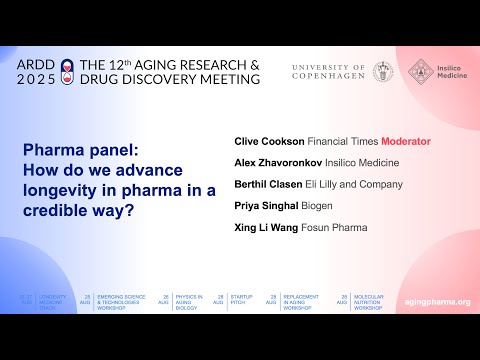
Andrea Heinz: Aging of Elastin: From Structural Decay to Therapeutic Potential
AI Summary:
Executive Summary
Andrea Heinz, an associate professor at the University of Copenhagen, presents a compelling yet “depressing” case for elastin as a primary bottleneck in human longevity. Elastin is the highly conserved, non-renewable protein responsible for the elasticity and recoil of essential organs, including the aorta, lungs, intervertebral discs, and skin.
The central thesis of the presentation is that human lifespan is physically limited by the mechanical durability of elastin fibers. Unlike most proteins, elastin has virtually zero turnover in adulthood; humans are born with a fixed pool that peak production finishes by the teenage years. After the mid-40s, production is negligible. As elastin fibers accumulate damage from extrinsic factors (UV, smoking, pollution) and intrinsic factors (glucose/glycation, calcification, proteases), they undergo mechanical failure.
Crucially, the degradation of elastin is not just a loss of function; it initiates a vicious cycle. The cleavage of elastin by approximately 20 specific proteases (elastases) releases bioactive peptides (elastokines) into the bloodstream. These peptides induce chemotaxis, angiogenesis, and the production of reactive oxygen species (ROS), which further accelerate the progression of cardiovascular and pulmonary diseases. Heinz suggests that the ultimate limit of human life—approximately 120 years—is likely defined by the point at which elastin failure renders the cardiovascular and respiratory systems non-functional.
Bullet Summary
- The Non-Renewable Resource: Elastin is one of the few components of the human body (alongside the genome) that is not replaced. Production peaks at birth and ceases almost entirely after adolescence.
- Mechanical Endurance: The human heart beats ~2.5 billion times in a life; elastin must expand and recoil with every beat without mechanical failure.
- The 120-Year Ceiling: Theoretical calculations suggest human life expectancy is capped at ~120 years because that is the maximum mechanical fatigue limit of human elastin.
- Organ Importance: Elastin failure in the skin causes wrinkles; failure in the aorta or lungs causes death (atherosclerosis, emphysema, aortic stenosis).
- Vicious Cycle of Degradation: Damaged elastin releases “elastokines” (GXXPG motives) which signal the body to produce more proteases and ROS, accelerating further damage.
- Stability Properties: Elastin is insoluble in almost all solvents and can withstand heat up to 200°C, yet it remains vulnerable to specific biological enzymes and lifestyle factors.
- The Assembly Problem: While “tropoelastin” (the precursor) can be expressed, the body loses the ability to assemble it into functional, cross-linked elastic fibers after a certain age. assembly requires ~50 specific helper proteins.
- Glycation (Sugar) Damage: Dietary sugar binds to elastin, making it stiff and brittle, directly compromising cardiovascular function.
- Bioactive Peptides: While most elastokines are harmful, some “matrixins” have positive therapeutic potential for skin repair and cancer reduction.
- Evolutionary Comparison: Long-lived species like Greenland sharks or whales have slightly different elastin structures and are not exposed to “junk food” or human-style lifestyle stressors.
- Genetic Proof: Patients with Williams-Beuren Syndrome (missing one elastin gene) suffer from accelerated aging and early cardiovascular death.
- Actionable Protection: Since you cannot make more, the only strategy is preservation: use sunscreen, avoid smoking, and strictly limit sugar intake.
Claims & Evidence Table (Adversarial Peer Review)
| Claim from Video | Speaker’s Evidence | Scientific Reality (Best Available Data) | Evidence Grade (A-E) | Verdict |
|---|---|---|---|---|
| Elastin is not replaced in adulthood | Peak production at birth/teenage years; negligible in 40s. | Carbon-14 dating of tissues confirms elastin in the aorta and lungs is as old as the individual. Shapiro et al., 1991. | B (Human Tissue Analysis) | Strong Support |
| Lifespan limit (120 yrs) is due to elastin aging | Cites a group’s extrapolated calculation/extrinsic limit. | Theoretically plausible based on material fatigue, but mortality is multifactorial. Robert et al., 2008. | E (Modeling/Extrapolation) | Plausible (Theoretical) |
| Sugar (glycation) makes elastin stiffer | Biochemical logic of lifestyle advice. | Advanced Glycation End-products (AGEs) create irreversible cross-links in long-lived proteins like elastin/collagen. Aronson, 2003. | C (Biochemical Study) | Strong Support |
| Assembly of new elastin requires ~50 proteins | Mentioned in Q&A regarding why upregulation is hard. | Elastogenesis is a highly complex process involving chaperones like FBN1, LOX, and fibulins. Wagenseil et al., 2007. | D (Mechanistic Speculation) | Plausible |
| Bioactive peptides (GXXPG) induce cancer/aging | Cites group’s research on elastokines. | Elastokines are known to bind to the Elastin-Binding Protein (EBP) and trigger inflammatory cascades. Scurchi et al., 2021. | C (In Vitro/Observational) | Strong Support |
Technical Deep-Dive
The Problem of Elastogenesis
The primary challenge in longevity medicine regarding elastin is not the lack of tropoelastin (the soluble precursor), but the failure of elastogenesis (the assembly process). In aging, tropoelastin often aggregates into non-functional “elastotic plaques” (solar elastosis) rather than organized fibers. This is because the coacervation and cross-linking (mediated by lysyl oxidase) require a precise scaffold of microfibrils (fibrillin) and other glycoproteins that are no longer present or functional in aged tissue.
Elastokines as Pro-Aging Signals
The GXXPG motif (Glycine-X-X-Proline-Glycine) is a repeated sequence in elastin that becomes exposed upon proteolytic cleavage. These fragments act as DAMPs (Damage-Associated Molecular Patterns), binding to receptors like GLB1 (Galactosidase Beta 1), which is part of the elastin receptor complex. This signaling triggers a “senescence-associated secretory phenotype” (SASP) in fibroblasts, making them produce more proteases—hence the “vicious cycle” Heinz described.
Actionable Insights (Pragmatic & Prioritized)
Top Tier (High Confidence):
- Strict Glycation Control: Minimize spikes in blood sugar. High glucose levels lead to the formation of “Advanced Glycation End-products” (AGEs) which permanently cross-link and stiffen the elastin in your arteries.
- UV Protection (The 80/20 Rule): 80% of skin elastin damage is caused by UV radiation. Use broad-spectrum sunscreen daily to prevent “solar elastosis.”
Experimental (Risk/Reward):
- Lysyl Oxidase Support: Ensure adequate copper and Vitamin B6 intake, as these are essential co-factors for the Lysyl Oxidase (LOX) enzyme responsible for any residual cross-linking of elastin.
- Anti-Inflammatory Protocols: Since inflammation drives the production of elastases (enzymes that eat elastin), systemic anti-inflammatory measures (Omega-3s, exercise) help preserve the existing pool.
Avoid:
- “Elastin-Boosting” Creams: Most topical creams containing elastin are useless for structural repair because the elastin molecule is too large to penetrate the skin and, even if it could, cannot be assembled into a functional fiber network by aged cells.
- Smoking/Vaping: Tobacco smoke induces high levels of MMP-9 and neutrophil elastase, which are the primary enzymes that degrade lung and vascular elastin.