I use .05 as often as I can tolerate it without getting flaky. It’s always at least a minimum of 3-4x per week, but lately, because I can, it’s almost nightly.
1 Like
Use as often as you can. I can use adapalene nightly but tret nightly causes redness. I’m going to be trialling microsphere treteinoin and tarzarotene soon.
Certain areas of my face are more prone to redness so I’m trialling using adapalene in these areas and tret where I tolerate it better.
I’m very red at the moment though lol
1 Like
I use tazarotene occasionally for treating rough dry spots that usually develop into actinic keratosis if not treated. Tazarotene works much better for this than tretinoin.
I am not sure if I would want to apply tazarotene to large facial areas. It seems much stronger than tretinoin 0.5%
1 Like
Yes, be very careful with tazarotene on the face unless you love the peeling tomato look 
3 Likes
When Tazorac came out, I tried to use it for a couple of years… could never adjust to it! I am a sensitive thing though
@AustraliaLongevity I’ve since learned there is no reason to go stronger than you can easily tolerate. If what I’ve heard is correct, you wind up in the same exact place, but it’s just a matter of how long it takes to get there.
1 Like
Galantamine really got me curiously interested and unlike Donazepil it is OTC. I used to get and relish lucid dreams and have somehow lost the ability.
I ordered galantamine. How do you take it? Before going to bed or later in night?
GPT and Gemini both tell me to set up an alarm 4.5 hrs and take it middle of night.
If you’re using it for lucid dreams, I would follow Gemini’s advice. But if you just want vivid dreams take it right before bedtime, right before you go to sleep. You can also enhance the effect, at least in my experience,by taking some vitamin B6 along with it. Galantamine effects are individual and dose dependent. Best to titrate up to find the smallest effective dose.
1 Like
Beginning microsphere tretinoin 0.04% tonight.
1 Like
I started dosing Tyrosine 1000 mg with P5P at 6 a.m, right before I work out. I dose 1/2 a 5 hour energy a half hour later. Then an hour later I do a protein drink with 400 mg of sulbutiamine. Then I take a smaller dose of 200 mg of sulbutiamine and caffeine at around 2 in the afternoon to carry me through the rest of the day. My mornings have NEVER been more productive and my focus is scary good the entire day. I do it on weekdays and cycle off on weekends, holidays and vacations. Sulbutiamine is a prescription med in Japan, but here I get it through DoubleWood as a supplement. The days of brain fog and being tired are a thing of the past.
5 Likes
Currently have a red face after using 0.05% tazarotene 2 nights in a row 
1 Like
Could you post the link of the one you are buying from DoubleWood. I tried to find it but not sure I got the correct one.
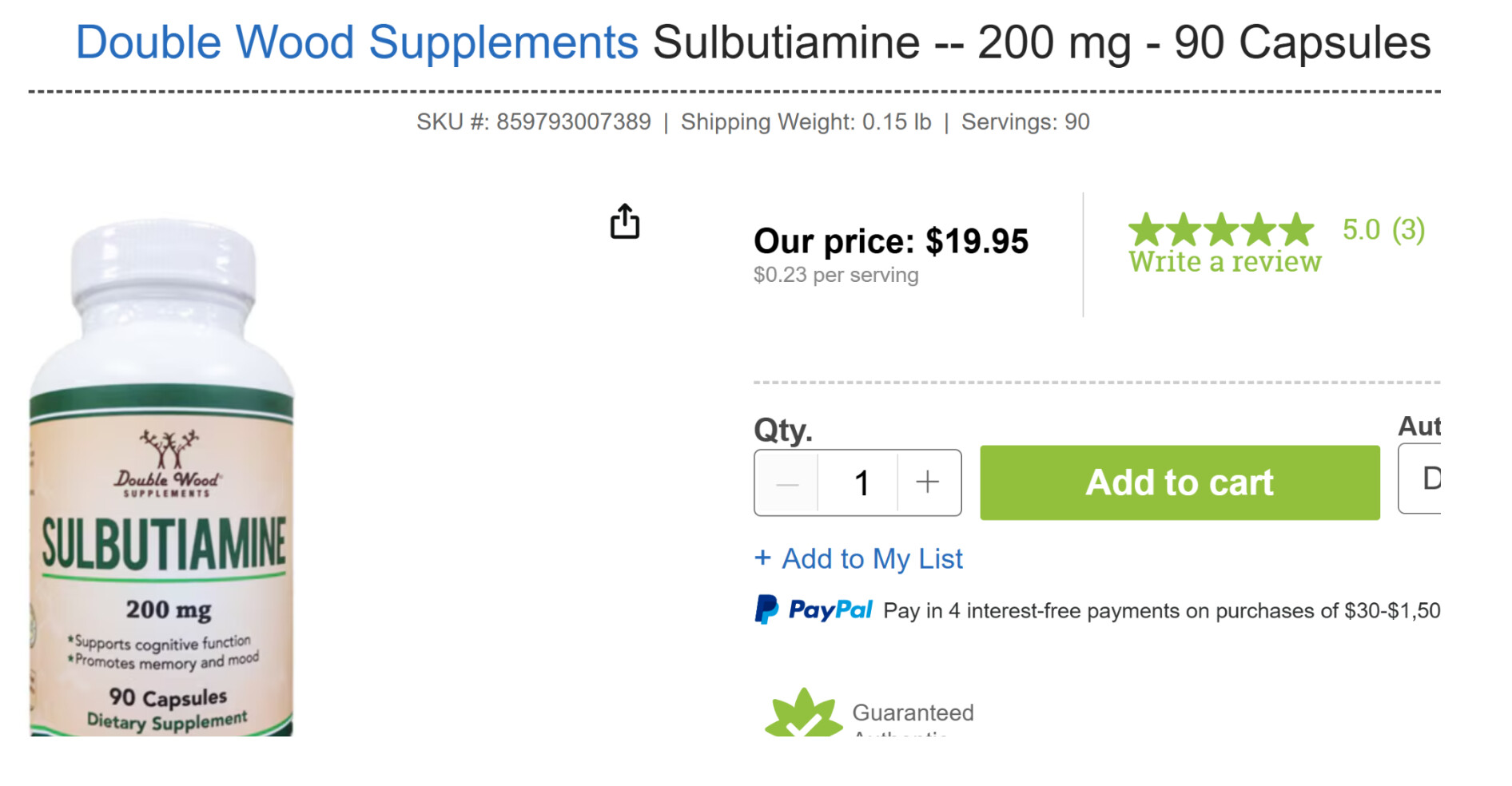
Thanks much. I was literally going to place an order to India today or tomorrow.
Yep, that is where I get mine, on Vitacost. Just reordered!
We’re doing several off-the-reservation kinds of things in the hopes of preventing or at least delaying cognitive decline: (1) tadalafil (pde5 inhibitor) to increase blood perfusion to the brain (2) lithium orotate 5 mg (3) intra nasal insulin to improve glucose usage in the brain (4) starting to take some coconut oil and MCT to provide ketones to the brain.
10 Likes
wow our body only makes like 0.2 mg or something of it naturally daily.
i take it daily too before sleep but i take very little only like 0.2mg.
if i take even 1mg i feel groggy the whole of the next day
Really interesting post. Have you kept going Donepezil?
And has anyone tried Huperzine A?
From Gemini: “Potency: In animal studies, it was found to be more potent than donepezil in increasing cortical acetylcholine levels when compared in molar terms”
I have been taking huperzine A for decades. I take it in the morning. I have tried taking it before bedtime, because, like donepezil and galantamine, it is supposed to affect dreams.
It did perhaps produce more vivid dreams, but I did not like the effect it had on my sleep.
As for donepezil, I found I did not like it either taken right before bedtime. Because I failed to take a deep dive or forgot the properties of huperzine A, taking huperzine A with donepezil was redundant, one of the hazards of polypharmacy.
I was surprised to find that huperzine A is a prescription drug in China.
Huperzine A has no immediate subjective effects when taken in the morning, but huperzine A has been one of my go-tos for brain fog. I think it takes about 30 days, from my experience, for it to have a noticeable effect.
Gemini:
Huperzine A is a potent inhibitor of acetyl-cholinesterase. In fact, it is significantly more selective and substantially less toxic than the acetylcholinesterase (AChE) inhibitors currently used in conventional medicine (e.g., physostigmineacetylcholinesterase., tacrine, and donepezil)
- Mechanism: It acts as a potent, highly specific, and reversible acetylcholinesterase inhibitor, increasing levels of acetylcholine in the brain. Usage: It is marketed as a memory and concentration enhancer and has been investigated as a treatment for Alzheimer’s disease and other forms of dementia.
- REF
5 Likes
Update on switching from 0.4% microsphere tretinoin to 0.5% tazarotene:
I’m noticing a more significant anti-aging effect from tazarotene every other night than using microsphere tretinoin as many night as I can.
Every 2nd night that I’m not using tazarotene I’m using 2% salicylic acid on my nose and 8% glycolic acid on the rest of my face. This exfoliates, unclogs pores and stimulates collagen production through a different mechanism.
At first my face was more red than when I was using tretinoin, and I had more dry skin. But this quickly calmed down and now I’m waking up the day after using these things and finding my face isn’t really red, my pores look smaller and my skin looks a bit nicer.
This is the acid products I use, I think these are the best ones available on the market:
Salicylic acid: SKIN PERFECTING 2% BHA Liquid Exfoliant | Paula's Choice Australia
Glycolic acid: 8% AHA Gel Exfoliant | Paula's Choice Australia
Also sometimes instead of those acids I instead mix estradiol gel or estriol gel into moisturizer and put this all over my face. This is reserved for when my skin is particularly irritated (usually from retinoids). Estradiol and estriol are proven to also increase collagen synthesis.
I could probably include this more often if I mix it with moisturizer and put it on before applying retinoids. I might start doing this in the future to get more results.
But I’m just noticing my skin is looking better, and this is in spite of losing body fat. I’m currently on a cut with lower calories.
5 Likes
Since you live in Australia, I think this is a very good idea.
Sun exposure increases your chances of getting actinic keratoses or skin cancer.
I was extremely overexposed to the sun in my youth and suffer from chronic actinic keratosis, so I have always been looking for means of mitigating or eliminating the problem.
Most of the problem went away after I started taking rapamycin, but I still take preventative measures like staying out of the sun. If you are not already aware, things like tretinoin, glycolic acid, etc.
Unfortunately, they increase your risk of AKs by making your skin more vulnerable to the sun. The theoretical benefit only holds true if it is paired with rigorous UV protection.
They increase your risk of AKs by increasing your skin’s photosensitivity. The theoretical benefit only holds true if you use high-SPF-factor sunscreen and avoid any overexposure to the sun.
"In the dermatology world, AKs are treated not just as individual “spots,” but as part of field cancerization—the idea that the entire area of sun-damaged skin is prone to developing precancerous lesions.
Here is the theoretical breakdown of why your 7–10% toner might be doing more than just giving you a glow."
1. Accelerated Desquamation of Atypical Cells
Actinic keratoses are essentially a “pile-up” of dysplastic (abnormal) keratinocytes. Glycolic acid works by reducing corneocyte cohesion—basically, it dissolves the “glue” holding dead skin cells together.
- The Theory: By forcing the skin to exfoliate daily, you are physically removing these atypical cells before they can accumulate into a thick, scaly lesion.
- The Result: You are essentially performing “micro-maintenance” on the stratum corneum, preventing the buildup that characterizes a visible AK.
2. Normalization of Keratinization
Chronic UV exposure messes with how skin cells mature as they move from the bottom layer of the epidermis to the top. This leads to the rough, “sandpaper” texture of AKs.
- The Theory: Alpha Hydroxy Acids (AHAs) like glycolic acid have been shown to normalize the keratinization process.
- The Result: It signals the skin to produce more organized, healthier cell layers. Research suggests that long-term use of AHAs can lead to a more uniform epidermis and a reduction in the “clumping” of damaged cells.
3. The “Field Treatment” Effect
While 7–10% is considered a “low dose” compared to a 70% professional peel, the frequency matters.
- Low-Dose Consistency: Daily application acts as a very mild, ongoing field therapy. While it isn’t as aggressive as prescription creams (like 5-fluorouracil) or photodynamic therapy, it maintains a state of high cell turnover that makes it harder for precancerous clusters to take hold.
Comparison: Daily Toner vs. Professional Peels
| Feature | 7–10% Daily Toner | 30–70% Professional Peel |
|---|---|---|
| Depth | Superficial (Stratum Corneum) | Medium to Deep (Epidermis/Dermis) |
| Mechanism | Consistent “shedding” of early damage | Acute destruction of damaged layers |
| Recovery | None (unless irritated) | 3–7 days of peeling |
| Goal | Prevention & maintenance | Treatment of existing lesions |
2 Likes