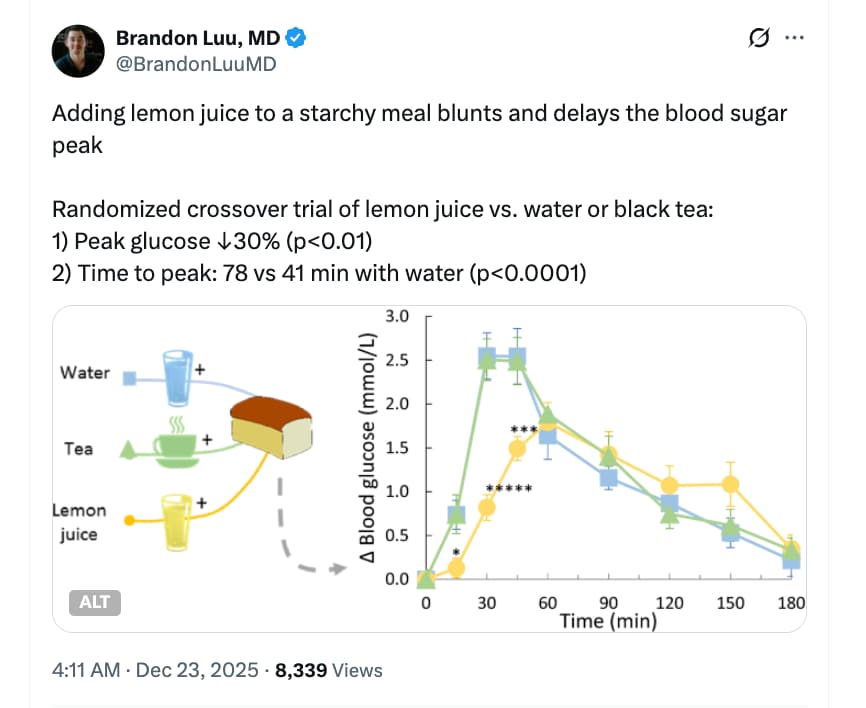
I reposted an article here about the allulose. Allulose seems to have similar benefits to Acarbose in terms of lowering postprandial glucose by inhibiting alpha-glucosidase.
D-Allulose (or D-Psicose) is a naturally occurring rare sugar with some rather unique and tricky attributes. We can learn a lot from the comprehensive 2021 review: “Allulose in human diet: the knowns and the unknowns.”
When we ingest Allulose, it is absorbed into the bloodstream through the epithelial cells of the small intestine via sugar transporters (such as GLUT5 and GLUT2), just like fructose. However, the critical difference is that the human body lacks the specific enzymes to phosphorylate or cleave Allulose (such as hexokinase or aldolase). Although scattered studies mention that hexokinase might phosphorylate Allulose in vitro, the resulting product cannot enter the mainstream glycolysis pathway. Instead, it may accumulate intracellularly and inhibit metabolism. Consequently, the review cites a massive amount of in vivo research confirming that Allulose is essentially not metabolized by the liver and does not participate in energy generation.
This is a completely different pathway from artificial sweeteners!
We know from the milestone 2019 review “Effects of Sweeteners on the Gut Microbiota: A Review of Experimental Studies and Clinical Trials” that artificial sweeteners can destroy glucose metabolism by altering gut flora (e.g., the Bacteroidetes/Firmicutes ratio). I covered this in detail in my “Harmful Sweeteners” article, so I won’t repeat it here.
However, according to the latest research from this July, “Gut microbial utilization of the alternative sweetener, D-allulose, via AlsE,” Allulose is metabolized by a specific gut enzyme, AlsE, into fructose-6-phosphate, without triggering dysbiosis (flora imbalance)! Furthermore, about 70-84% of absorbed Allulose is excreted unchanged through the kidneys into urine. The unabsorbed portion enters the large intestine, where a small amount may be fermented by gut flora into short-chain fatty acids (which is actually beneficial), or excreted in feces.
“Huh,” you might ask, “since Allulose can competitively inhibit alpha-glucosidase in the small intestine…”
Since this enzyme is key to breaking down complex carbohydrates (like starch and sucrose) into glucose, inhibiting its activity should theoretically delay carbohydrate digestion and absorption, thereby turning high-GI foods into low-GI foods?
It sounds tricky, but it’s true. According to the review “Allulose for the attenuation of postprandial blood glucose levels in healthy humans: A systematic review and meta-analysis” (citing massive studies on page 17), whether in mice or people with diabetes, supplementing with Allulose (commonly 5-10g) while consuming carbohydrates significantly lowers postprandial blood glucose peaks and the area under the curve (AUC). This effect has been verified across healthy populations, overweight/obese groups, and Type 2 diabetes patients!
Actually, if we look at animal evidence, we can find even more synergistic principles. For instance, Allulose can stimulate intestinal L-cells to secrete Glucagon-Like Peptide-1 (GLP-1). We often emphasize GLP-1 as an important incretin that promotes insulin release, suppresses glucagon secretion, and delays gastric emptying—it can even be considered an anti-aging target. Additionally, animal model studies found that Allulose can upregulate glucokinase activity in the liver, promoting hepatic glycogen synthesis, thereby helping to lower blood glucose levels.
Other details from animal studies are also quite “fantastical.” For example, Allulose can reduce plasma triglycerides and free fatty acid levels. While human trial results on this aren’t fully consistent yet (so I won’t list them), the trend toward improving overall metabolic health is clear. Additionally, in animal models, Allulose has been proven to significantly alleviate hepatic steatosis (fatty liver), which may be related to its regulation of gene expression regarding liver fatty acid synthesis and oxidation.
So, does it work for humans?
According to “A Preliminary Study for Evaluating the Dose-Dependent Effect of D-Allulose for Fat Mass Reduction in Adult Humans: A Randomized, Double-Blind, Placebo-Controlled Trial,” a 12-week RCT on overweight/obese adults found that, compared to the placebo group, subjects ingesting Allulose showed significant drops in body fat percentage, body fat mass, as well as abdominal and visceral fat.
The most important part of this study is actually the reduction in visceral fat, which strongly implies that the results seen in humans correspond to the principles suggested by animal experiments… Of course, we can’t draw a rigorous conclusion yet; we await more research.
But you might say: “Okay, visceral fat reduction might be related to liver regulation, but what’s the deal with total weight loss? This isn’t a Calorie Restriction (CR) mimetic, is it?”
Actually, the mechanism is quite comprehensive. Theoretically, Allulose may act through the central nervous system, activating appetite-suppressing neurons in the hypothalamus (like POMC neurons) while inhibiting appetite-promoting neurons (like NPY/AgRP neurons), thereby lowering food intake. Its induction of GLP-1 secretion also has appetite-suppressing effects…
At this point, does it feel like you’re not loving yourself if you don’t buy it immediately? …Is there a plot twist?
No. Although unabsorbed Allulose entering the large intestine increases osmotic pressure, drawing water into the intestinal lumen (causing diarrhea), and bacterial fermentation produces gas (causing bloating and rumbling), multiple studies have determined the maximum “no observed adverse effect level” for humans. It is generally believed that a single intake of less than 0.5g per kg of body weight, or a total daily intake within a certain range, usually does not cause significant gastrointestinal symptoms.
What about toxicity?
Although some short-term studies (e.g., 12 weeks) observed transient mild elevations in liver enzymes (like ALP, ALT) in individual subjects, these changes usually had no clinical significance and returned to normal in follow-up observations. Researchers determined there was no clear causal link with Allulose, so I won’t list those citations.
However, according to a very robust safety study, “Safety and efficacy of a 48-week long-term ingestion of D-allulose in subjects with high LDL cholesterol levels,” a 48-week randomized controlled trial (RCT) showed that long-term intake did not have negative effects on liver function (ALT, AST) or kidney function (eGFR, Creatinine). This is actually expected, as animal toxicology studies found no obvious liver or kidney toxicity even when rats and dogs were given high doses far exceeding normal human intake.
Put simply: The core reason for this “epic” difference is that although they are all “sugar substitutes,” the metabolic pathways of artificial sweeteners and natural sweeteners (represented by Allulose) are diametrically opposite. There are still some things within the realm of natural sweeteners considered safe (I’ll introduce them slowly later). Strictly speaking, Allulose should be singled out and called a “Natural Rare Sugar” to avoid the misunderstanding caused by lumping it in with artificial sweeteners.
Conclusion: Go for it hard. It improves metabolism and gut function—you can even take it as an anti-aging supplement.