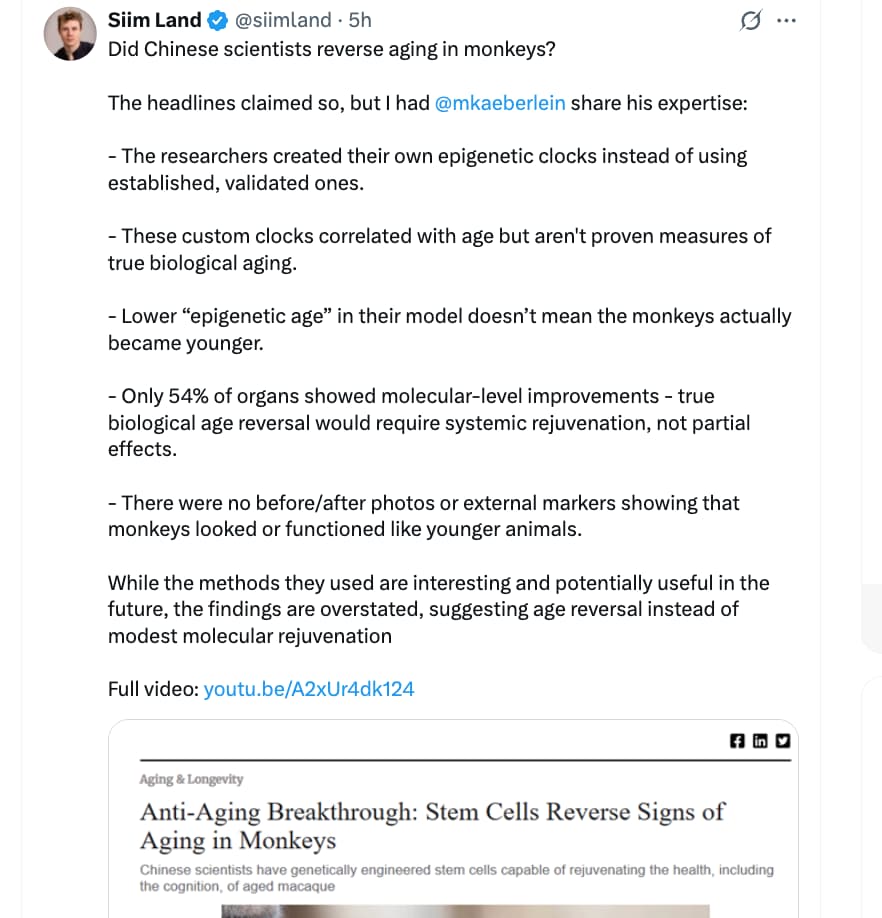
Anti-Aging Breakthrough: Stem Cells Reverse Signs of Aging in Monkeys

Chinese scientists have genetically engineered stem cells capable of rejuvenating the health, including the cognition, of aged macaques.

Key Points:

  • “Super stem cells” improve the memory of monkeys while protecting against neurodegeneration.
  • The super stem cells prevent age-related bone loss while rejuvenating over 50% of the 61 tissues analyzed.
  • Treatment with stem cells reduces inflammation and senescent cells (cells that accumulate to promote aging).

While small in number, our adult stem cells play a crucial role in regenerating our lost or damaged tissues, rebuilding our body cell by cell. However, with age, our bodies become riddled with inflammation, hardly providing an environment capable of keeping our stem cells healthy. Eventually, our stem cells lose their regenerative capacity, contributing to degenerative aging.

Full article:

Paywalled paper:

Senescence-resistant human mesenchymal progenitor cells counter aging in primates

This study provides initial evidence that genetically modified human mesenchymal progenitors can slow primate aging”

https://www.cell.com/cell/abstract/S0092-8674(25)00571-9

12 Likes

This is the coolest thing I’ve seen in a loong while. Because the therapy sounds very practical and was already tested on primates. I do hope Chinese will crack the problem of aging. Because the rest of the world, in particular USA, is doing horrible in this area. Our gerotechnology research is a joke.

3 Likes

Lots of monkey business.

1 Like

How’s it practical? They injected stem cells every 2 weeks. That would cost sooooo much money to do as a treatment.

4 Likes

AI Summary

Introduction to the Study

  • The video discusses a study published in September 2025 in the journal Cell, which has generated significant media attention regarding the potential rejuvenation of aged monkeys.
  • The study involved aged Macaca vascularis, also known as crab-eating macaques, aged 19 to 23 years, roughly equivalent to 57 to 69 years in human terms.
  • Younger monkeys were included as a control group to compare the effects of the treatment.
  • Macaques were chosen due to their physiological and genetic similarities to humans, sharing approximately 93% of human DNA.

Methodology of the Treatment

  • The aged monkeys received injections of senescence-resistant human mesenchymal progenitor cells derived from human embryonic stem cells.
  • The stem cells were genetically edited to enhance the expression of the FOXO3 gene, which is associated with longevity and stress resilience.
  • The treatment consisted of bi-weekly injections over a period of 44 weeks, equivalent to three years in human terms, with a dosage of 2 million cells per kilogram of body weight.
  • Comprehensive testing was conducted before and after the treatment, including blood tests, cognitive assessments, and medical imaging, analyzing 61 tissues across 10 systems.

Results of the Study

  • Post-treatment, the biological clock scores of the monkeys decreased by 2 to 7 years, which translates to an approximate 6 to 15-year reduction in human biological age.
  • Improvements were noted in brain function, with accuracy and latency showing a 30 to 40% enhancement.
  • Cortical thickness was observed to be 3 to 5 years younger, and myelin density increased by 25 to 30%.
  • There was also a reduction in amyloid and tau proteins, which are related to neurodegeneration.
  • Other improvements included a 10 to 20% increase in bone mass, a 20 to 40% enhancement in reproductive health, and a 35% reduction in skin senescence.
  • Overall, 54% of the analyzed organs showed improvement, and the treatment was deemed safe and well-tolerated.

Skepticism and Limitations of the Findings

  • Despite the promising results, it is important to approach the findings with caution, as the study did not conclusively demonstrate a reduction in biological age.
  • The researchers created their own epigenetic and transcriptional clocks to measure biological age, which raises questions about the validity of these measures due to small sample sizes.
  • Previous studies have shown that epigenetic age can be reversed through various means, indicating that lower epigenetic scores do not necessarily equate to actual youthfulness.
  • The lack of external validation, such as before and after images, leaves uncertainty regarding visible changes in the monkeys’ appearance.

Speculations on Longevity and Future Research

  • Questions remain about whether the treated monkeys will experience an increase in lifespan, with speculation suggesting any potential increase may be minimal.
  • The video suggests that while improvements in health metrics may be more significant, the study’s design did not include trials on mice, which could have provided further insights into lifespan impacts.
  • The necessity for larger sample sizes and more thorough functional assessments in future studies is emphasized to enhance confidence in the findings.
  • The video concludes that while the study is a significant step forward, it is crucial to distinguish between mere improvements in biological markers and actual rejuvenation or reversal of aging.

Implications for Future Aging Research

  • The potential of stem cells, exosomes, and gene therapy in promoting health span is acknowledged, with optimism for future advancements in these areas.
  • Although the study’s results are preliminary, they represent a critical advancement in understanding biological aging and the role of stem cells.
  • The speaker encourages adopting lifestyles that minimize health risks while awaiting breakthroughs in aging research, emphasizing the importance of longevity strategies.
  • The video promotes further exploration of methods to extend human lifespan and health span, stressing that substantial medical breakthroughs may emerge in the coming decades.
1 Like

Starfish brain can be regrown from non-neural differentiated cells. Scientists are studying this to find out how:

“In the larval state, starfish have a distinctive head that contains their brain,” says Dahl. “If the head is removed or damaged, the differentiated cells that are definitely not neural cells will de-differentiate, crawl up to the head region, and regrow into neurons. To not only do this in the larval state, but to regrow something as complex as a brain — this is an amazing regenerative capability.”

Supported by funding from the DSF Charitable Foundation, Hinman and Dahl are working to understand just what in the starfish causes their cells to do this. While Hinman is focused on the fundamental science, Dahl’s lab is delving into the structure of the cells, cell crawling, and the biomechanics of cellular regeneration.

“While regenerative medicine is great, there’s still a lack of understanding of the fundamentals that govern how cells respecify themselves,” says Dahl. “The hope is that by studying a model organism like the starfish, and combining what we learn with our knowledge of human stem cells, we can use comparative genomics to understand the gene expression that allows starfish cells to respecify their programming.”

To do this, Dahl is creating an artificial model of the starfish’s larval system to map the cells as they crawl to their new destination. With this artificial model, Dahl and her team can manipulate the chemical and mechanical factors that exist in the starfish embryo, blocking them one at a time until they find exactly what it is that tells the cells to de-differentiate back into stem cells, crawl up to the brain region, and become neuronal tissue. Once this factor has been isolated, the goal is to then be able to apply it to human cells, to tell those cells to de-differentiate so they can become whatever the patient needs.

Current therapies require stem cells to be harvested from a patient, then cultured over the course of days, in order to have enough to be reinjected back into the patient to help speed healing. But with this method, cells could be taken from any part of the body, de-differentiated back into stem cells, then re-differentiated into therapeutic cells. This could make the process of preparing stem cell therapy faster, easier, and most importantly, cheaper.

“If you could reduce stem cell therapy from $200,000 to $1,000 — it would touch nearly every person’s life,” says Dahl. “Surgeons could include a stem cell injection with every major or minor surgery, helping patients heal 100 times faster. It’s quick healing; it’s reduced scarring. This could be like penicillin. I see it becoming the standard of care in the next 10 years.”
https://www.cmu.edu/news/stories/archives/2020/march/dahl-starfish.html

1 Like