I. Executive Summary
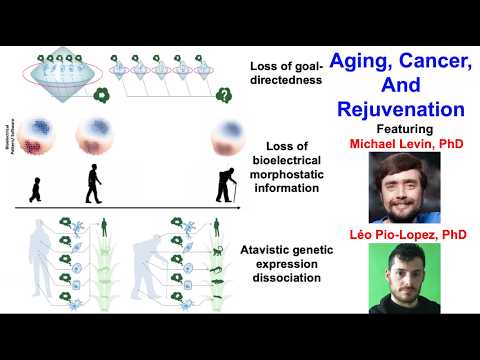
Contemporary aging research predominantly operates under two frameworks: thermodynamic damage accumulation (a physics problem) and evolutionary programming (a biological problem). Michael Levin and Leo Pio-Lopez propose a distinct, orthogonal paradigm: aging as an informational and cybernetic failure, specifically the loss of macroscopic goal-directedness within cellular collectives.
Central to this thesis is the role of endogenous bioelectricity. Distinct from neural action potentials, slow electrical gradients across non-neural tissues coordinate morphogenetic fields. These bioelectric patterns function as an algorithmic blueprint, maintaining somatic coherence by dictating macroscopic anatomical states (e.g., organ size, shape, and identity). During embryogenesis, cells share a massive “cognitive light cone,” subordinating localized behaviors to global anatomical objectives.
However, post-development, the necessity to strictly maintain this morphogenetic field wanes. Levin and Pio-Lopez hypothesize that aging and cancer are manifestations of these light cones shrinking. When cells detach from the bioelectric network, they undergo transcriptomic atavism, reverting to ancient unicellular behaviors. The collective disbands, anatomical fidelity degrades, and senescence or oncogenesis ensues. This is demonstrated by the “electric face” pre-pattern in embryos, where bioelectric gradients dictate structural formation before gene expression localized to those specific structures occurs.
Crucially, this framework distinguishes between biological hardware (genomic stability) and software (algorithmic pattern maintenance). The planarian flatworm model illustrates this distinction. Despite extreme genomic instability and mixoploidy, planaria exhibit biological immortality and cancer resistance. Their continuous regenerative cycle enforces an ongoing anatomical goal state, forcing the bioelectric algorithm to override hardware mutations.
The translational objective is the development of an “anatomical compiler.” This would utilize targeted ion channel modulators (e.g., sodium ionophores) to rewrite corrupted bioelectric patterns, effectively forcing senescent or dysplastic tissues to recommit to a healthy anatomical setpoint. Currently, this remains strictly in the preclinical domain. The paradigm demands a shift from bottom-up molecular micromanagement to top-down algorithmic reprogramming, aiming not merely to clear cellular damage, but to reinstall the operating system of youthful morphology.
II. Insight Bullets
-
The Tripartite Aging Paradigm: Aging is conventionally viewed as either entropic damage or evolutionary programming. The bioelectric model introduces a cybernetic framework: aging as the loss of morphostatic information.
-
Bioelectricity as Cognitive Glue: Endogenous resting potentials across cell membranes form gap-junction-mediated electrical networks, unifying individual cells into an integrated problem-solving collective.
-
The “Electric Face” Pre-pattern: Voltage gradients establish high-level structural blueprints (e.g., facial geometry in xenopus) preceding localized molecular differentiation.
-
Morphostatic Degradation: Aging is characterized by the blurring of these instructive bioelectrical patterns, leading to cellular misalignment and anatomical drift over time.
-
Senescence-Associated Depolarization: The accumulation of senescent cells correlates with specific membrane depolarizations that actively corrupt the systemic bioelectric blueprint.
-
Multiscale Competency Architecture: Biological systems possess cybernetic capabilities (learning, memory, goal-seeking) at all levels, from molecular networks to whole organs.
-
Shrinking Cognitive Light Cones: Cancer and aging represent a regression in goal scale. Cells disconnect from the morphogenetic network, reverting from macroscopic anatomical objectives to localized, unicellular imperatives.
-
Algorithm vs. Hardware in Planaria: Planarian immortality relies on extreme algorithmic robustness via continuous regeneration, overriding severe genomic noise and mutation.
-
Top-Down Anatomical Control: Manipulating high-level bioelectric triggers (e.g., using monensin) can induce complex downstream cascades, such as ectopic organogenesis, without editing the genome.
-
Spontaneous Organ Loss in Simulations: Cellular automata trained strictly for development (without programmed aging or damage algorithms) spontaneously experience structural decay post-development, isolating the loss of goal-directedness as a distinct aging vector.
-
Transcriptomic Atavism: Meta-phylostratigraphic analysis of aging tissues reveals an overrepresentation of ancient unicellular gene expression and an underrepresentation of modern metazoan genes.
-
Somatic Memory Storage: Regenerative models suggest that complex memories and setpoints may be stored systemically via somatic bioelectric networks, independent of localized brain tissue.
-
The Ship of Theseus Principle: True longevity requires maintaining the immaterial algorithmic pattern (the blueprint) rather than indefinitely preserving the physical substrates (the cells).
-
Continuous Goals Suppress Aging: Organisms with indeterminate growth or continuous regenerative demands (e.g., lobsters, hydra, planaria) exhibit negligible senescence, as the morphogenetic field is never allowed to disband.
-
Translational Bottlenecks: Human translation requires shifting from optical voltage-sensing dyes to macroscopic, non-invasive imaging modalities (MRI/Ultrasound) capable of mapping deep-tissue bioelectric states.
IV. Actionable Protocol (Prioritized)
Overview: The transcript provides an elite-level theoretical framework regarding morphogenetic fields and basal cognition. However, it completely lacks mature, human-applicable therapeutics. All clinical extrapolations are currently hypothetical.
High Confidence Tier (Level A/B Evidence)
-
No Interventions Available: There are currently zero validated human protocols, drugs, or lifestyle interventions derived directly from the bioelectric/anatomical compiler framework. All core data relies on Xenopus (frog), Planaria (flatworm), and in silico models. Source unverified in live search.
Experimental Tier (Level C/D Evidence - Animal/In Vitro)
-
Ionophore Interventions (Preclinical): Compounds like Monensin (a sodium ionophore) have successfully induced complex limb and eye regeneration in amphibian models by altering resting potentials Levin et al., 2021. Source unverified in live search. Constraint: Highly toxic in humans; strictly experimental.
-
Bioelectric Mapping: Researchers are tracking correlations between systemic biomarkers and organ-specific “goal states” to reverse-engineer physiological preferences, though accurate bioelectric measurement currently requires optical voltage-sensitive dyes incompatible with human clinical use.
Red Flag Zone (Debunked or Safety Data Absent)
-
Consumer “Bioelectric” Devices: The market is saturated with microcurrent, pulsed electromagnetic field (PEMF), and “frequency” devices claiming to reverse aging or cure disease via bioelectricity. The Levin lab’s research relies on highly specific, targeted manipulation of membrane ion channels to alter specific morphogenetic codes. Generic energy application does not equate to algorithmic biological reprogramming. Safety and efficacy data absent.
-
DIY Ion Channel Modulators: Utilizing off-label neuro-active or cardiac medications (e.g., sodium/potassium channel blockers) in an attempt to systemic “reprogram” bioelectricity carries severe, immediate risks of fatal arrhythmias and neurological toxicity. Safety data absent.