Gemini:
Here is the tidy transcript, summary, and critique of the video “Aging As a Software Design Flaw” by João Pedro de Magalhães.
Tidy Transcript
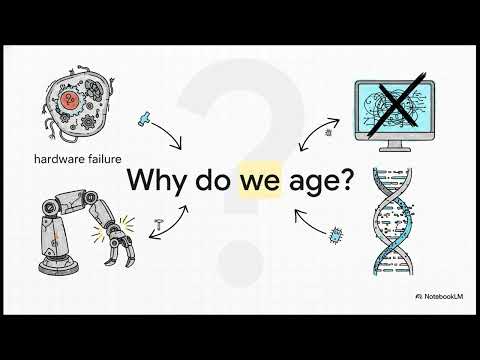
You know, for as long as we can remember, we’ve thought of aging as this inevitable thing. Our bodies just get old. They wear out. It’s a fact of life. But what if that’s not the whole story? What if aging isn’t really a hardware failure, but more of a glitch in our biological software? A design flaw we’re only just starting to figure out?
I mean, it is one of the biggest questions in all of biology, right? Why do we age? Is it really just our bodies breaking down—our cells and organs finally giving in to all that wear and tear? Or is there something else going on? Something deeper, a bug maybe in the very code that builds us and keeps us running.
So, you’ve got these two big ideas. The “hardware problem” is the one we’re all familiar with. It’s the idea that our bodies just accumulate damage over time, like a car slowly rusting away. But this “software view” suggests something way more radical. It says aging isn’t random at all. It’s actually written into our biological code, a direct result of the very program that creates us in the first place.
To really get this whole software flaw idea, we’ve got to first understand how our body’s operating system actually works. So, for a minute, let’s just think about our biology as if it were a computer. First up, you have the hardware. Pretty simple, right? This is the physical stuff: your organs, your tissues, your cells, even the DNA molecule itself. This is the machine, the physical rig that’s running the whole show.
And then, of course, you’ve got the software. This is the amazing genetic program written into the code of our DNA. It’s the master set of instructions that can take one single cell and build a whole complex person out of it. It’s both the blueprint and the step-by-step assembly guide all rolled into one. But here’s the thing: software code doesn’t just run itself. It needs an operating system, right? A platform to execute on. In our bodies, that’s the epigenome. You could think of it like a layer of little chemical tags sitting on top of our DNA, and their job is to tell our genes when to turn on and when to turn off. It’s the manager that’s actually running the program.
So, think of it like this: your DNA code is the same in every single one of your cells, but the epigenome is what makes them different. It’s what’s constantly telling a heart cell to run the “heart program” while telling a brain cell to run the “brain program.” It is, for all intents and purposes, the system’s memory. And this is key: it’s where the passage of time gets recorded.
Okay, so if we’ve got this incredible, super-sophisticated system, where is the flaw? Well, the problem is that the software was never designed for long life. It was optimized for one job and one job only: getting us to adulthood, ready to pass on our genes. And our software is absolutely brilliant at it. But after that happens, evolution kind of loses interest. See, there was never any real pressure to create code that turns the developmental program off. So, the exact same genetic subroutines that helped us grow strong become destructive.
It’s a trade-off called Antagonistic Pleiotropy. Basically, a gene that helps you when you’re young can come back to bite you when you’re old. And it just makes so much sense when you think about it. If aging were just random damage, it would look completely different for everyone. But it’s not, is it? It follows these incredibly predictable patterns. We all get gray hair, our skin wrinkles, our thymus shrinks. The fact that it happens in such an orderly, predictable way strongly suggests it’s being driven by a program, not just by pure chance.
And listen, this isn’t some fringe idea. As leading researchers in the field like Raj and Horvath have put it, aging is a direct consequence of development. You can’t separate them. The two processes are fundamentally, totally linked. And maybe the most powerful piece of evidence for this comes from just looking at different mammals. There’s this incredibly clear link: the faster an animal develops, the faster it ages. A mouse is ready to reproduce in just a few weeks and only lives for a couple of years. We, on the other hand, take almost two decades to mature. It really seems like their developmental software is just running on fast-forward, maybe about 30 times faster than ours.
Okay, so this all leads to a massive question, doesn’t it? If aging is a program, can we change the settings? Can we slow it down? Or—and this is the big one—could we actually hit a reset button?
What’s really fascinating is that the best tools we have for extending lifespan in the lab all seem to be doing the same basic thing: they slow down growth and development. Things like dietary restriction, or blocking certain growth pathways, or using the drug Rapamycin. They all tap into the body’s systems that regulate growth. This is a huge clue that they’re working by basically throttling down the runtime of that developmental software.
But slowing down is one thing. What about a full reboot? This is where things get really wild. Scientists can actually take an old cell from your body and, using a special mix of proteins, they can reprogram it all the way back to a youthful, embryonic-like state. And when they do this, the cell’s biological age—its epigenetic clock—resets completely all the way back to zero. It’s like doing a full software restart and wiping the slate clean.
Now, look, this theory isn’t perfect. There is one major disease of aging that doesn’t seem to fit the software model very well, and that’s cancer. But understanding this exception actually tells us something really deep about how we’re built. You see, cancer is mostly a hardware problem. It’s caused by random mutations—damage to the DNA code itself. So to fight this, our biological software evolved these incredibly powerful anti-cancer programs. The catch is how they work: they basically put the brakes on our cells’ ability to divide and regenerate. Now, this is fantastic for stopping tumors when we’re young. But that very same loss of regenerative power? Well, that’s what we call “aging” later in life. It’s a fundamental trade-off that’s baked right into our source code.
So, where does all this leave us? Well, if aging really is a software problem at its core, that completely changes how we should think about medicine and longevity. And this perspective offers a really hopeful takeaway. Unlike a rusty car where the metal is physically gone and you can’t get it back, a software problem means the original youthful information is still there. It’s not lost or erased; it’s just being read incorrectly by the epigenome. And the success of cellular reprogramming proves it: the blueprint for youth is still saved on the hard drive.
And that leaves us with one last fascinating question. For any piece of flawed software, developers work tirelessly to release an update, a bug fix, a patch. So if human aging is just a design flaw in our biological software, what would it take for us to write the very first patch?
Summary
The video presents the argument that aging is not merely the result of random physical “wear and tear” (a hardware failure) but is instead a consequence of our biological programming (a software flaw). Using the analogy of a computer, the speaker identifies the DNA as hardware, the genetic code as software, and the epigenome as the operating system.
Key Points:
- The Flaw: Aging is described as a “glitch” caused by Antagonistic Pleiotropy—evolutionary trade-offs where genetic programs that are beneficial for development and reproduction in youth become destructive in later life because evolution did not select for longevity.
- Evidence: The orderly, predictable nature of aging (e.g., graying hair, thymus shrinking) and the strong correlation between the speed of development and the rate of aging across species (e.g., mice vs. humans) suggest a programmed process rather than random chaos.
-
Potential Solutions:
- Slowing Down: Current life-extension methods like caloric restriction and Rapamycin work by slowing down developmental pathways.
- Rebooting: Cellular reprogramming (using factors like Yamanaka factors) can reset the “epigenetic clock” of a cell to zero, effectively rebooting the software.
- The Exception: Cancer is identified primarily as a “hardware” problem (DNA mutations). Ironically, the body’s mechanisms to prevent cancer (stopping cell division) contribute to the loss of regeneration that defines aging.
- Conclusion: The theory offers hope because, unlike a rusting car, the biological information for youth is not lost; it is simply being misread. The challenge for future medicine is to write a “software patch” to correct this design flaw.
Critique
This video acts as an accessible primer on the “Information Theory of Aging” and “Hyperfunction Theory,” distilling complex biogerontology concepts into a digestible narrative. The speaker is Dr. João Pedro de Magalhães, a legitimate academic authority in the field (Professor of Molecular Biogerontology), which lends significant weight to the arguments presented.
Strengths:
- Powerful Analogy: The “Hardware vs. Software” metaphor is excellent for explaining the difference between genetics (the code) and epigenetics (how the code is read). It makes the abstract concept of the “epigenome” concrete for a lay audience.
- Scientific Grounding: The video correctly references key scientific pillars, such as Antagonistic Pleiotropy (George Williams) and the Epigenetic Clock (Steve Horvath). It moves beyond the outdated “rate of living” or “simple wear and tear” theories that many people still believe.
- Optimistic Framing: By framing aging as an informational problem rather than a physical disintegration, it logically leads to the conclusion that aging is treatable or reversible, which is a compelling narrative hook.
Weaknesses & Nuance:
- Hardware/Software Overlap: The video posits a clean separation between hardware (DNA mutations/Cancer) and software (Aging/Epigenetics). In reality, this boundary is blurry. DNA damage (“hardware” issues) is a known driver of epigenetic drift (“software” issues), suggesting the two are causally linked rather than separate distinct categories.
- Cancer Simplification: Describing cancer purely as a “hardware” problem is a slight oversimplification. While mutations are central, epigenetic silencing of tumor suppressor genes is also a major driver of cancer, meaning cancer has “software” components too.
- The “Patch” Complexity: The conclusion suggests writing a “patch” is the next step. While exciting, it glosses over the immense danger of such patches—specifically, that “rebooting” cells in a living organism carries a high risk of inducing cancer (teratomas), a hurdle that is currently the biggest bottleneck in translation to humans.
Verdict:
An excellent, scientifically sound introduction to modern aging theories. It successfully challenges the fatalistic view of aging as simple entropy, though viewers should be aware that the “software patch” for humans is likely decades more complex than the video’s optimistic ending implies.