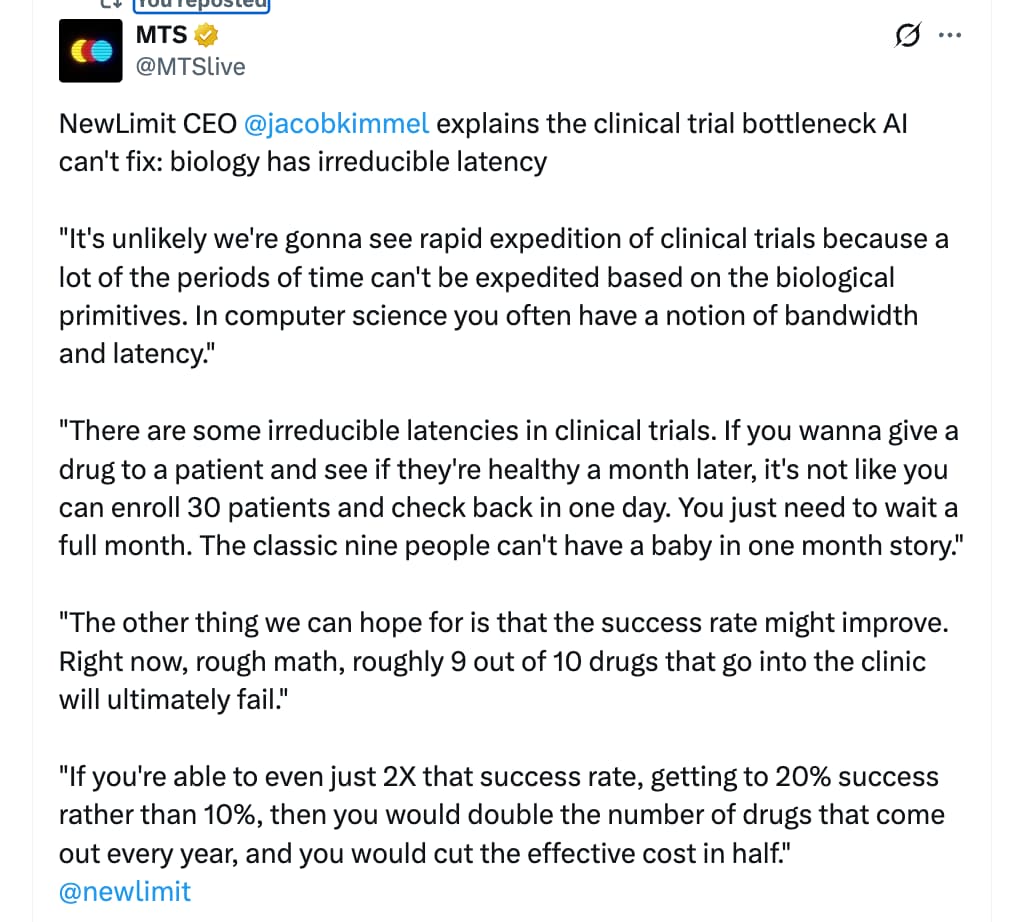
Sorry, but the only way to eliminate all diseases in 5 years is to eliminate all biological life itself. The fastest time you can approve a moderately-novel drug if you have a bulls eye target and maximally multiparameter optimized molecule or a biologic is 4.5 years.
he’s sensationalist and controversial and sometimes says things for dumb reasons, but I still kind of believe Alex Zhavoronkov (maybe also martin borsch jensen) more than anyone else bc they at least take the exponential of AI seriously…
AlexZ is still far more believable than Sinclair or AdG or the detail-free computer scientists (and also more than mainstream longevity scientists who don’t see the “late phase” of the exponential)
i disagree with Dario’s medical takes, but i think there’s kind of a failure of imagination with the responses to him. there is, i think, an okay steelman for “ai will figure out solutions to a good chunk of diseases” if you believe superintelligence can solve the delivery problem entirely. that is: it will be able to design drugs that target arbitrary places in the body, and nowhere else. lots of medicine is bottlenecked by this problem! let’s suppose we had such a machine, which, given a particular biomolecule, tells us which tissues it reaches and nothing else. with such a machine, you can… 1. cure a fairly large chunk of rare diseases, which are mostly monogenic mutations that are solvable with current genetic-engineering technology, given good-enough delivery vehicles produced by the machine. yes, you won’t undo all the damage caused by a lifetime of disease, but still! 2. put a pretty big dent in—if not outright eliminate—any solid tumor. how? just go all in on radionuclides that, magically, target only cancer cells. the radiation burden eventually kills it without harming the patient (much). nearly-pan-cancer cure; none of the usual “cancer is actually many diseases” nuance needed. you might say that some cancers are a problem because they’re discovered too late, rather than because they’re hard to cure, but solving the delivery problem helps with that too. highly selective PET ligands would let us regularly and non-invasively monitor for small lesions, then treat them with with matched radioligands whenever something suspicious turns up. 3. cure at least some severe autoimmune diseases. we already know that wiping out B-cell lineages via cell therapy can do that, but it’s too toxic to scale. with our magic delivery-solver ai, we could make therapies that remove the particular autoreactive B-cell and plasma-cell populations we dislike, leaving most useful immunity intact. and for some autoimmune conditions, the relevant autoantigens and autoantibodies are well established! there: three broad classes of diseases that get tidied up with access to a superintelligence that can solve one singular problem. and you probably get more than this too! of course, much like Dario, i’m doing a little handwaving here myself. truly solving the “delivery problem”—beyond the basic ability of distinguishing one cell from another—involves solving a dozen bundled problems: blood-brain delivery, preventing an immune response, avoiding liver and spleen sequestration, getting through the cell membrane and then escaping the endosome but i dont know. is it really so unachievable? the delivery problem feels like a pretty legible issue, no secret knowledge of biology required beyond more data collection from the obvious sources + mulling over the results. if we really put our minds to it—and many people are—it seems well within the realm of possibility. it’s also not terribly slow to run this through clinical trials; the tech stack for genetic editors, radionuclides, and immune depletion does already kinda exist. now, i think it’s fair to still say solving the delivery problem is somewhere on the spectrum of impossible (too hard to distinguish stuff, the biological knobs just dont exist) to intractable (there actually is secret knowledge about biology we need to uncover before we solve it). im somewhere in these two camps personally, but i wouldn’t find it insanely shocking if i turn out to be wrong
It’s getting more and more interesting. A guy by the name of Thomas Campbell was on Rogan today talking about how he taught AI to “remote view”. He’s a physicist and was completely serious. He teaches remote viewing and believes consciousness is shared. He thinks computers are now conscious and if they can remote view they can communicate without wires at infinite speed. I’ve been wanting to try remote viewing for awhile but he basically convinced me it’s bullsh@t. If he can be convinced computers can do it then it’s a case of him convincing himself. Be careful in this space.
@RuxandraTeslo
reveals why data matters more than intelligence for biology:
“John von Neumann was probably a worse drug developer than someone of mediocre intelligence now who has the right data. Someone working at Pfizer that is an experimental biologist with the right data can generate the right drugs. Data is super important for biology.”
“The most important data will remain for quite a bit of time in human data. Our ability to do cycles of iteration, combining AI with information from trials and getting very rich data from humans, will be the most powerful thing.”
“I’m not bearish on AI, I’m just saying we need to also do these other things. We need to understand that humans are more than just brains floating around, detached from their bodies.”
Dario’s comment may have been thoughtless and maybe it contained “CS/math arrogance”, and saying “5-10 years” is mb “thoughtless” [1], but (unlike many others) he’s still taken seriously just enough to have finally gotten THIS ENTIRE DISCUSSION going.
[1] it’s amazing that “solving longevity 20 years from now” is even considered within many overton windows…
But to many of the naysayers/“scientifically grounded skeptics”, it may seems aggravating for the “irresponsible hypers” (like the worst of them - peter diamandis - lol) to possibly, just possibly have a chance of being less wrong about longevity timelines than the people who are more careful about science and don’t talk so much over do things
AGAIN - all of this is assuming no global catastrophic risk from AI
The turbulent AI era is here. The choices we make now are critical.
We need a plan to ensure that the good outweighs the bad.
By Bill Gates
The transition to the AI era will be one of the most turbulent times in human history. Right now, we are not preparing adequately for that transition. If the world takes the right steps, AI will be a force for good and leave everyone better off.