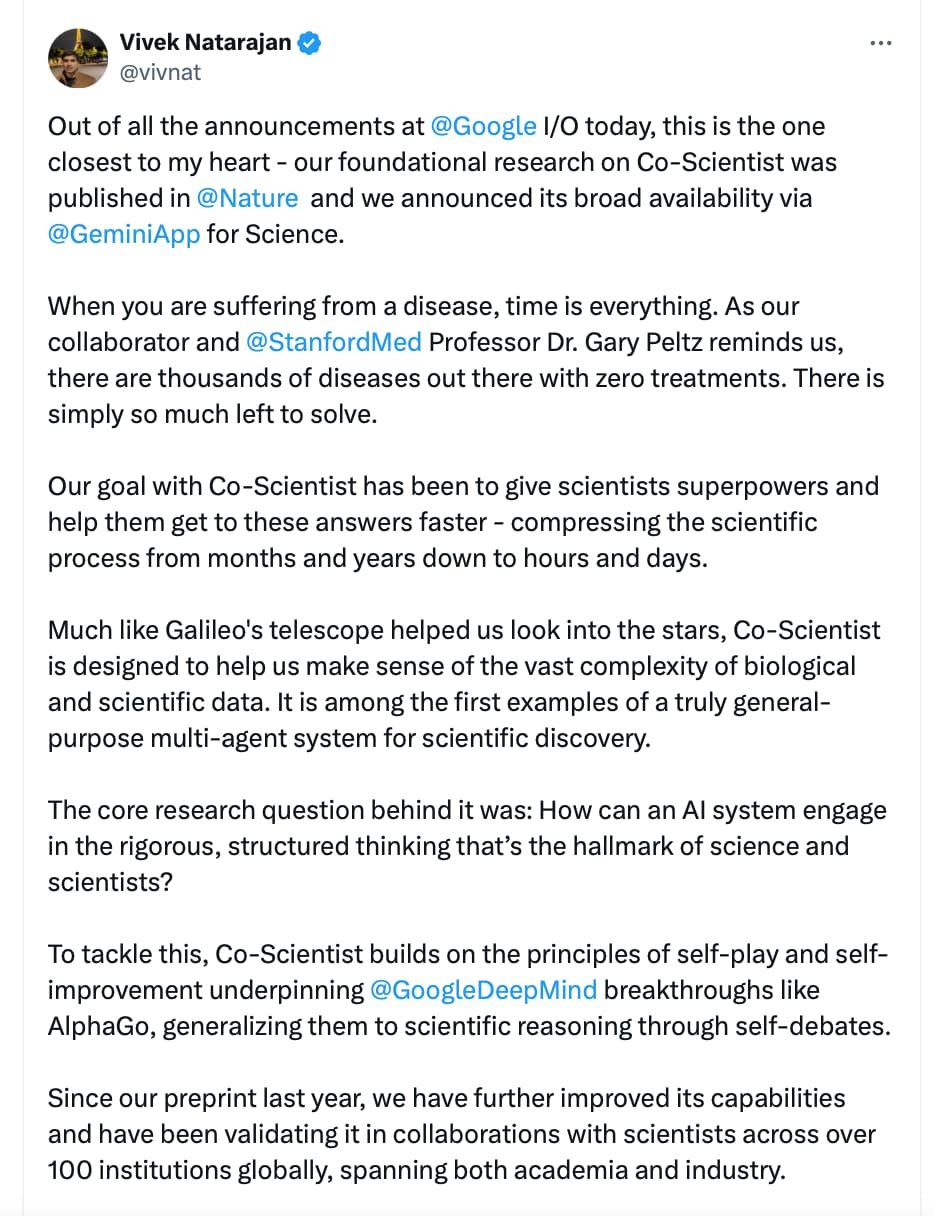
https://x.com/vivnat/status/2056848687326982503
Demis Hassabis is now saying “the cure to disease is near”
https://x.com/vivnat/status/2056848687326982503
Demis Hassabis is now saying “the cure to disease is near”
Nature paper link - https://lnkd.in/e8qBEJFv
Google DeepMind blog - https://lnkd.in/etYeahMy
Gemini for Science - http://labs.google/science.
Follow
Three papers published simultaneously in Nature today, May 19, 2026, represent the concrete demonstration of AI systems performing end-to-end scientific discovery, not just assisting it (Two papers were available as preprints before).
FutureHouse published Robin, the first multi-agent system to fully automate both hypothesis generation and experimental data analysis in biology. Given dry age-related macular degeneration as its only input, Robin reviewed 551 papers in 30 minutes (estimated at over 800 human hours), identified RPE phagocytosis enhancement as a therapeutic strategy, and autonomously discovered ripasudil, a glaucoma-approved ROCK inhibitor never previously proposed for dAMD, which produced a 1.89-fold increase in phagocytosis confirmed in primary human RPE stem cells. A follow-up RNA-seq experiment, also designed and interpreted by Robin, revealed 3-fold upregulation of ABCA1 as a potential novel mechanistic target. When OpenAI Deep Research was given the same task as a benchmark, it produced zero hits and did not suggest ROCK inhibition at all.
Full Text: https://lnkd.in/ggVYGb9Z
Read together, Robin closes the wet-lab discovery loop, Co-Scientist scales hypothesis quality through iterative compute, and ERA converts empirical methods papers into runnable, improvable software. All three systems are designed to operate alongside human scientists, not replace them, but their combined effect is a measurable compression of the discovery timeline.