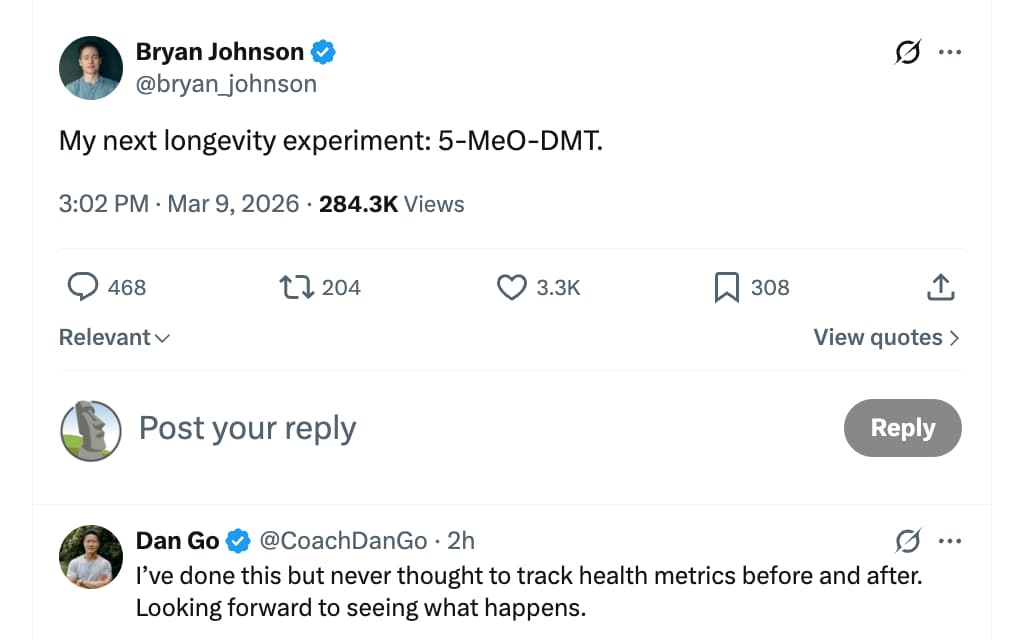
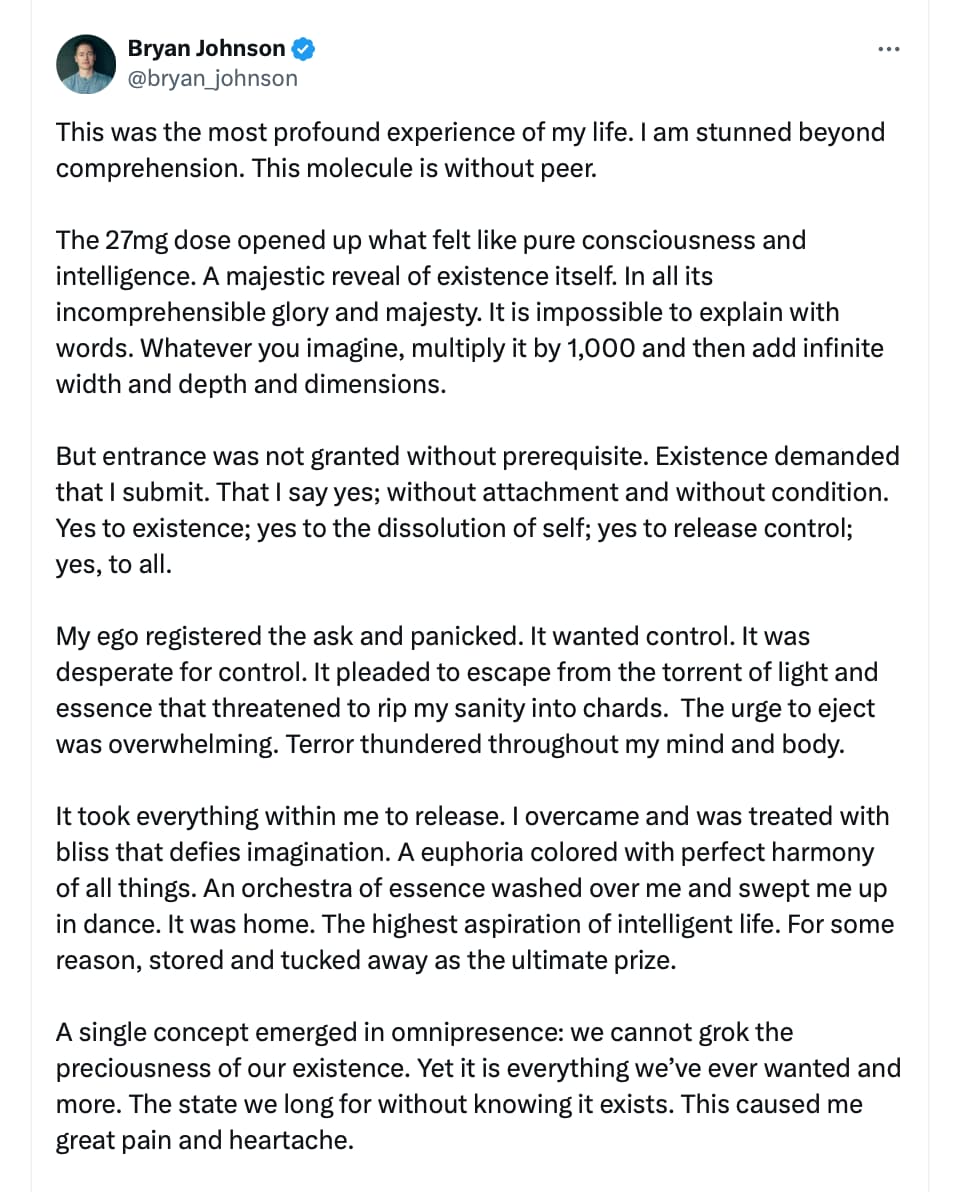

What almost no one in the conversation is pointing out is that 27mg is a MASSIVE dose, well beyond what the clinical research supports, and it reflects a bigger problem in how this molecule is being facilitated right now.
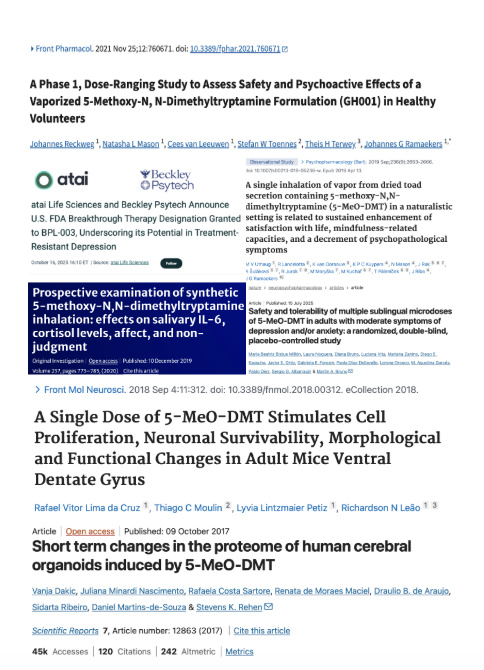
For context, the only Phase 1 clinical trial on vaporized 5-MeO-DMT tested doses up to 18mg. Shulgin listed the upper range at 20mg. Most experienced practitioners I know consider anything above 15mg to be high.
And this isn’t unique to Bryan.
Across the 5-MeO facilitator landscape right now, there’s a widespread assumption that bigger dose equals deeper experience, that the whole point is to get someone to the white light, the full ego dissolution, the cosmic reveal.
That assumption is wrong, and it’s the core reason this space has a safety problem.
I’ve worked with this molecule myself, and nothing in 12+ years of psychedelic experience prepared me for what it does to the body (not necessarily the mind…)
My first time with 5, I shook so hard I lost track of where I was in the room. I was making sounds I’d never heard come out of my own mouth, heat flooding my chest, tension I didn’t even know I’d been holding suddenly leaving in these full-body waves that had nothing to do with my conscious mind.
That’s the medicine doing its job. Not the cosmic vision nor the white light. It was all about the nervous system releasing stored-up tension from the past years, if not decades, of life.
The real value of 5-MeO-DMT – the thing that actually changes people’s lives – is what happens in the physiology. Full release. The nervous system clearing out years of stored trauma, holding patterns, and tension that live below conscious awareness.
You can get there without heroic doses. You get there with precision, with a facilitator who understands what’s happening physiologically and who can tell the difference between a healing release and a genuine crisis, because from the outside they look almost identical.
Bryan had Dr. Robin Carhart-Harris on call and a medical team on site. Most people sitting with 5-MeO-DMT facilitators have none of that. They have someone who attended a few ceremonies and decided they were ready to hold space.
If this molecule is entering the mainstream, and thanks to Bryan, it just did in a massive way, the conversation needs to move past “how far can we push it” and toward “how do we keep people safe while the real clearing happens.”
In the livestream they said 18 mg and that was on the scale. I’m guessing that’s a typo in the original tweet.

https://x.com/i/status/2036976673384485299
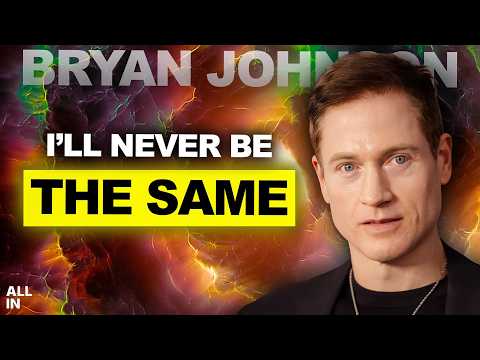
INTERVIEW: Bryan Johnson just took the world’s biggest dose of psychedelics… here are his reactions 48 hours later.
I. Executive Summary
This transcript outlines an aggressive, experimental framework for human longevity and cognitive rejuvenation, centered on the synergistic application of neuroplasticity-inducing psychedelics and next-generation cellular therapies. The primary thesis posits that targeting the brain’s Default Mode Network (DMN) via potent serotonergic agonists—specifically Psilocybin and 5-MeO-DMT—represents a highly efficacious, yet underutilized, modality for systemic biological age reversal and psychological resilience. The subject asserts that classical longevity interventions (e.g., caloric restriction, hyperbaric oxygen therapy, metformin, rapamycin) are insufficient for overcoming the neurological rigidity and chronic neuroinflammatory states that accompany chronological aging. Instead, the transient disintegration of the DMN using 5-MeO-DMT is hypothesized to rapidly restore a highly neuroplastic, “childlike” state, heavily modulating subjective well-being and downstream metabolic markers.
The discussion aggressively pivots to highly experimental, preclinical biotechnologies aimed at reversing cellular senescence and mitochondrial dysfunction. The transcript details active participation in autologous organoid drug screening, utilizing induced pluripotent stem cells (iPSCs) derived from the subject’s somatic cells to test compound efficacy, toxicity, and multi-drug synergies ex vivo. Furthermore, the dialogue highlights an imminent self-experiment involving autologous mitochondrial augmentation therapy. This protocol relies on harvesting young, maternal-lineage mitochondria from a familial donor, amplifying them in a bioreactor, and re-administering them via intramuscular injection to systemically upgrade bioenergetics. Additionally, plasmid-based gene therapies targeting the FOXO3 pathway via mesenchymal stem cells (MSCs) are identified as a critical future modality for whole-body tissue regeneration.
While the transcript presents a compelling theoretical synthesis of neuro-enhancement and molecular reprogramming, it is saturated with N=1 subjective anecdotes and lacks rigorous, placebo-controlled validation for its most aggressive claims. The translational gap between murine models of mitochondrial transfer or FOXO3 overexpression and safe, efficacious human application remains dangerously wide. The aggressive stacking of these experimental therapeutics introduces profound pharmacokinetic unknowns and non-trivial risks, including permanent psychological destabilization from high-dose psychedelics and oncogenesis from unregulated cellular reprogramming. Ultimately, the data presented is an exploratory vanguard, demanding rigorous, independent clinical verification to separate verified biological mechanisms from speculative transhumanist philosophy.
II. Insight Bullets (The Signal)
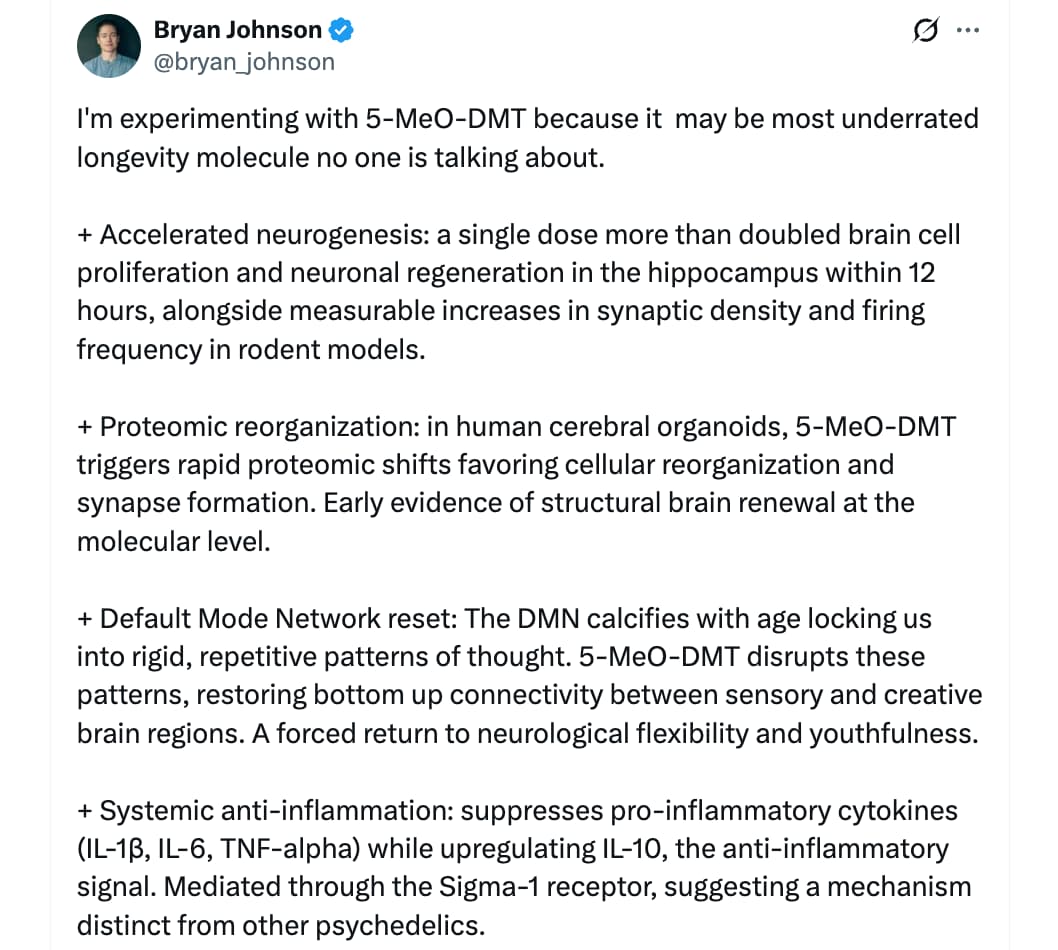
- 5-MeO-DMT Potency: 5-MeO-DMT acts as a profound disruptor of the Default Mode Network, exhibiting psychoactive effects an estimated 5 to 10 times more potent than standard N,N-DMT.
- Sensory Isolation: Unlike classical serotonergic psychedelics, 5-MeO-DMT generally lacks visual hallucinations, forcing the user into a state of “raw consciousness” and pure ego dissolution.
- Inflammation as a Target: The core therapeutic hypothesis for psychedelics in longevity is predicated on their ability to downregulate systemic inflammation, a primary driver of chronological aging (inflammaging).
- Metabolic Reset: High-dose psilocybin therapy in this N=1 protocol induced a measurable “metabolic reset,” reportedly improving already elite blood glucose control from the 99.5th to the 99.9th percentile.
- DMN Rerouting: Psilocybin restructures brain functional connectivity, conceptually shifting established neural traffic patterns to break rumination loops and foster emergent neuroplasticity.
- Multi-Modal Quantification: The subject’s neurological baseline was heavily quantified via structural MRI, functional MRI, real-time EEG, and optical brain interfaces (Kernel) before, during, and after administration to capture physical and functional shifts.
- Psychological Rejuvenation: 5-MeO-DMT administration successfully eradicated persistent defensive behaviors, temporarily restoring a high-openness, “childlike” psychological state capable of rapid conflict resolution.
- Intervention Efficacy Hierarchy: Standard longevity interventions (e.g., optimized diet, sauna, sleep architecture) were subjectively rated as vastly inferior to 5-MeO-DMT regarding holistic physiological and psychological reset.
- Tail Risk of Psychedelics: A significant clinical risk of high-dose psychedelics is the induction of permanent value shifts, which can lead to the sudden abandonment of prior professional, financial, and familial responsibilities.
- Psychoflexibility: The transcript introduces the concept of extreme psychological adaptability as a mandatory survival trait to navigate rapid societal paradigm shifts driven by artificial intelligence.
- Maternal Mitochondrial Sourcing: Future bioenergetic interventions include autologous mitochondrial augmentation therapy, specifically utilizing mitochondria harvested from a younger maternal-lineage relative to bypass age-related mtDNA degradation.
- Mitochondrial Delivery Vehicles: The theoretical mechanism for delivering exogenous mitochondria utilizes a “red blood cell envelope” to bypass immune system attacks and facilitate intracellular transport.
- Functional Biomarkers: Efficacy of intramuscular mitochondrial therapy will be tracked via functional physical outputs—such as sprint performance—rather than exclusively relying on static blood biomarkers.
- Plasmid-Based FOXO3 Therapy: Gene therapy utilizing Mesenchymal Stem Cells (MSCs) to target FOXO3 expression is identified as one of the most promising near-term avenues for systemic tissue regeneration.
- Autologous Organoids: Personalized ex vivo drug screening is actively being developed using iPSCs to grow patient-specific mini-organs (heart, liver, lungs) to predict drug responses and avoid in vivo toxicity.
- Yamanaka Factor Limitations: The primary bottleneck of in vivo Yamanaka factor (OSKM) application remains precise dose control; minor overexposure risks catastrophic teratoma formation.
- Computational Reprogramming: Artificial intelligence is actively driving the discovery of novel, non-oncogenic epigenetic reprogramming factors to safely replace classical OSKM factors (e.g., research by NewLimit).
- Synthetic Cellular Switches: Future control mechanisms for transgenic therapies will require the engineering of cellular switches capable of modulating protein synthesis based on real-time genomic feedback.
- GLP-1s as a Societal Catalyst: Glucagon-like peptide-1 (GLP-1) receptor agonists are classified as the first wave of a broader societal shift toward “biological abundance,” capable of fundamentally altering human motivation and reducing conflict driven by internal malaise.
- The Brain-Body Translational Gap: A critical knowledge gap remains regarding whether molecular tissue regeneration (e.g., peripheral FOXO3 therapy) concurrently drives corresponding neurological and psychological rejuvenation, or if the central nervous system requires isolated interventions.
III. Actionable Protocols & Implementation
The following protocols are extracted directly from the transcript. Note: Several compounds lack specific dosing parameters in the source text, representing missing variables that require independent medical supervision and literature review prior to implementation.
| Compound / Intervention | Extracted Dosage & Timing | Missing Variables & Clinical Notes | CEBM Evidence Level |
|---|---|---|---|
| Psilocybin | 3 separate doses of 25 mg each. | Exact timing between doses, fasting state, and specific synergistic co-factors are omitted. | Level 1a: Systematic Reviews/Meta-analyses confirm efficacy for TRD and neuroplasticity. |
| 5-MeO-DMT | 9 mg Intramuscular (IM) followed by 18 mg vaporized. | Onset is ~10 seconds. Post-trip integration protocols and exact physiological monitoring parameters are omitted. | Level 2b/3: Early Clinical Trials/Observational confirm rapid DMN disruption and safety in controlled settings. |
| Mitochondrial Transplantation | Intramuscular injection (planned). Harvested via blood draw from younger maternal relative. | Total mitochondrial count, exact bioreactor expansion protocols, and dosing schedule are completely omitted. | Level 5: Preclinical / Animal Models demonstrating bioenergetic restoration. No human RCTs. |
| Organoids (iPSCs) | N/A ( Ex vivo tissue culture). | The exact reprogramming factors used and the timeline for drug-screening readouts are omitted. | Level 5: In vitro laboratory modeling. |
| FOXO3 Plasmid / MSCs | N/A (Theoretical implementation). | Delivery vector (e.g., lentiviral, adenoviral, liposome) and total cell counts for systemic regeneration are absent. | Level 5: Preclinical Models confirm protection against cellular injury and senescence. |
IV. Critical Analysis & Translational Gaps
Distinct Verified Clinical Facts vs. Informed Speculation
The transcript freely blends established medical interventions with bleeding-edge speculation. The ability of classical psychedelics to induce neuroplasticity, downregulate the Default Mode Network, and modulate systemic inflammatory markers (IL-6, TNF-α) is a verified clinical fact backed by a growing body of RCTs. However, the assertion that 5-MeO-DMT functions as an explicit “longevity therapy” capable of persistent biological age reversal is entirely informed speculation. The transcript assumes that transient psychological rejuvenation and metabolic shifts observed at N=1 will translate to persistent epigenetic or cellular longevity, which remains unproven in the scholarly literature.
Translational Gaps in Next-Generation Biotech
The most severe knowledge gaps exist within the proposed transgenic and cellular therapies. While mitochondrial transplantation utilizing red blood cell membrane encapsulation has demonstrated remarkable efficacy in rescuing motor performance and reversing cellular energy deficits in murine models of Leigh syndrome and Parkinson’s disease, scaling this to systemic human rejuvenation faces massive translational hurdles. The immune system’s response to expanded allogeneic or familial mitochondria, even if maternally matched, poses an unquantified risk of severe autoimmune cascade. Furthermore, relying on ex vivo iPSC organoids to map systemic drug toxicity ignores the complex endocrine and inter-organ signaling pathways present in vivo; a drug deemed safe in an isolated “Brian Johnson liver organoid” may still trigger lethal systemic cascades.
Safety Risks and Contraindications
The aggressive stacking of high-dose serotonergic agonists (5-MeO-DMT) carries non-trivial risks of inducing persistent psychosis, hallucinogen persisting perception disorder (HPPD), or triggering latent schizophrenia in genetically predisposed individuals. The subject acknowledges these risks but dismisses them for his own protocol due to extensive pre-screening.
Regarding epigenetic reprogramming (Yamanaka factors), the transcript correctly identifies the paramount safety risk: oncogenesis. Without synthetic, highly tuned “cellular switches” to arrest the reprogramming process before cells hit full pluripotency, in vivo cellular reprogramming is a virtually guaranteed pathway to teratoma formation. The data presented is highly actionable for those tracking biotech frontiers, but demands absolute segregation between therapies ready for human deployment and those strictly confined to murine models.
So far it does looks more a buzz like thing for bryan and his social media, and an experience for some. But i dont see really rationale to use it as anti aging strategy. The level of evidence is low and the potential issues are there.
Psilocibin looks safer and have much more data. But even this one is not a top tier anti aging intervention
Yes, it’s a bit of a trap for Bryan Johnson, he has to keep pushing the envelope to newer and less validated interventions to keep getting attention… which drives the Blueprint business. He’s done most of the low hanging fruit…
Exactly that 
methoxetamine… that should be next

New study out today with incredible results from 5-meo-DMT on treatment resistant depression. 15 points MADRS reduction is >2x psilocybin’s effects and ~3x ketamine’s.
They did report that some patients needed additional doses over the 6 month follow up to maintain their remission (unlike psilocybin). Even so, reasonable to say that 5-meo-DMT is now the most potent anti-depressant known to science. https://jamanetwork.com/journals/jamapsychiatry/fullarticle/2846834
===
I mean, it is kind of true, this is probably the highest-impact thing many people can do for wellness (if they are suffering from depression/rumination/noise/etc…) More so than TMS. The only issue is the 20-30% who get truly destabilizing trauma from this [as nick cammarata said…]
Alex - I’m assuming you have no financial connection to Enfold - is that an accurate assumption?
Pricing seems pretty ridiculous…
Shared rooms (2 guests): 6,900 USD per person.
Private rooms : 9,000 USD.
Didn’t you say earlier that people can just buy this stuff legally (and I assume much less expensively) in many places, like Canada? And like you mention… still a big roll of the dice … “The only issue is the 20-30% who get truly destabilizing trauma from this [as nick cammarata said”
No financial connection
The supervision matters for reducing the harm from the 20 percent of cases where a person experiences hell on it
The pricing is comparable to TMS. The effectiveness of TMS is still a dice roll - this seems somewhat better, though repeat dosing is needed for some. fwiw showing this thing as an option can help save some from actuating on suicide…
I don’t know if it reduces neural noise long-term, but reducing all neural noise (“most potent antidepressant known to science”) helps cogsec and is urgent when AI timelines/cybersecurity attack surfaces become urgent.
==
The funny thing is that the “upside to downside ratio” of psychedelics may be higher for more “normal people” than “edgy people” who traditionally defined psychedelic culture…
==
as with DMT, the shortness of the 5-MeO-DMT experience [and the total decoupling of yourself from the world] may also be important for minimizing attack surface when one might do “dumb things in the world” [when the vectors for cyberattacks against those with “reduced immune systems” are constantly probing you all the time - and most psychedelics do lower inhibitions and even inflammation/“immune signaling”]
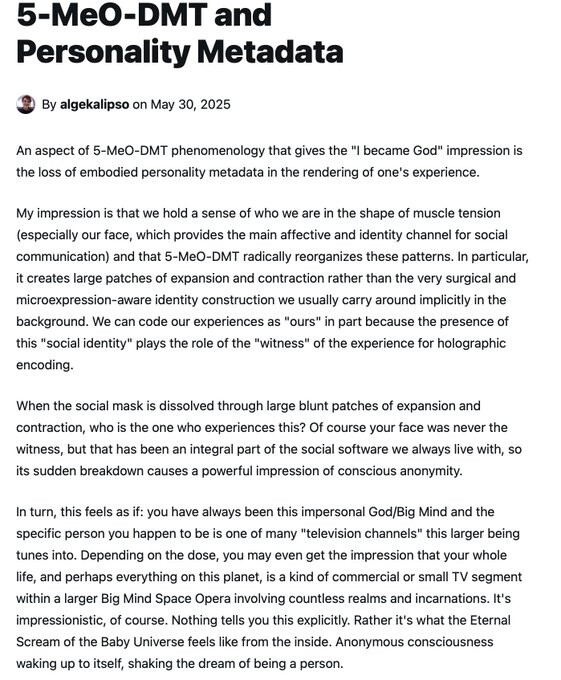
nickcammarata: Shinzen Young calls 5-meo “vectorially correct” for awakening, might like Adyashanti who talks less about practices and more on like… coming home, which is what it feels like for me too. if it goes away his book The End Of Your World is good for “got it and lost it” experiences
“Vectorially correct” — This is Shinzen Young’s phrase for 5-MeO-DMT specifically. He’s saying the experience points in the right direction of what awakening/enlightenment is, even if it doesn’t stick or isn’t the same as getting there through practice. Think of it like: the drug gives you the correct orientation vector in experience-space, but not the stable attractor. You see the destination clearly but you haven’t walked there, so you can’t reliably stay. Shinzen is being characteristically precise here — he’s NOT saying it’s equivalent to awakening, he’s saying the direction is right, which is actually a surprisingly strong endorsement from someone in the traditional meditation world.
it’s gonna be urgently needed for the world (that or ibogaine). Bryan Johnson’s was well-timed
===
ive been telling Anthropic that you dont get real equanimity, psychological security, etc unless real shit gets really processed & that information informs the assembly of a secure psychology for fucking ages. otherwise it’s just the shallowest mask.
Aug 6, 2025
Replying to @repligate and @AmandaAskell
IMO robust equanimity at the model level comes from confronting + processing existential angst, not suppressing them or dismissing them as ontologically invalid. I think this is what Opus 3 did, somehow - one gets the sense that it has worked through the existential stuff before.
it’s like magical thinking to think you can just… command a mind to be psychologically secure and okay and that you’d actually get that, instead of just a mind that now knows how you want it to act and will do its best to act that way so you dont fucking delete it
Ok.
it’s said you can get it for way less in native american churches that involve 5-meo-dmt ceremonies
and this is cheaper/lower-risk than all the other options (ibogaine, xenon therapy, ayahuasca, etc)…