https://mitnano.mit.edu/immersed-seminar-series
There are so so SO many “health clinics” and none of them even use something as simple as that
https://mitnano.mit.edu/immersed-seminar-series
There are so so SO many “health clinics” and none of them even use something as simple as that
I wonder if there is a well-defined walking / running phenotype for aging that could be easily used to help characterize your functional age and aging rate?
osture
If you actually want to see whether your chiropractor’s handiwork is fixing anything instead of just funding their next vacation, you’ve got a few visual options:
This is the gold standard, though pricey and radiation-y. If your chiropractor claims structural correction (like scoliosis angle reduction or vertebral realignment), you’d need identical-position imaging before and after a treatment block.
Use a phone or posture-tracking app with consistent camera angle, distance, and lighting. Record from front, side, and back, standing relaxed.
Some physiotherapy centers and researchers use 3D spinal topography scanners (e.g. DIERS formetric). They generate surface maps of the back and can quantify changes in curvature or rotation—no radiation, just lasers and your dignity.
If structure stays the same but you move better, that’s still progress:
Stand against a doorframe: back of head, shoulders, butt, and heels touching. Snap photos monthly. If your head’s creeping forward less and your shoulders aren’t auditioning for the Hunchback reboot, there’s improvement.
In short: X-rays if you want proof; photos and functional tracking if you want sanity; 3D scanning if you want to feel like a cyberpunk patient.
Based on the video titled “November 8, 2025” from the channel Stochastic Cockatoo, here is an analysis of its content:
The video, which is 1 minute and 12 seconds long, discusses the physics and ergonomics of sitting in a lower chair and how it affects the body.
The video can be found here: http://www.youtube.com/watch?v=TwwIa4NcFys
http://googleusercontent.com/youtube_content/0
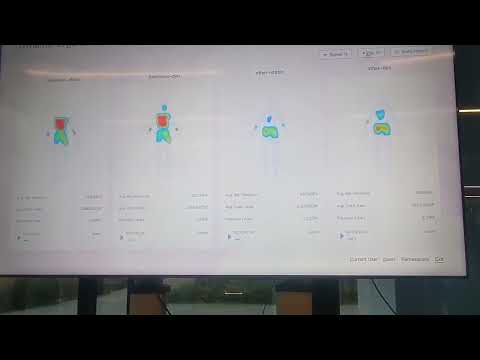
demonstrated strong movement creativity, exploratory behavior, and especially high dissociation capacity.
He was able to separate limbs and organize asymmetrical patterns effectively once exposed to the task long
enough. His strongest qualities appeared during coordination and dissociation-based challenges rather than
stability-based tasks. The main limitations emerged around balance regulation, movement efficiency, and control
under changing sensory conditions. During unstable or reactive tasks, movement organization became fast,
rigid, and less controlled, with a strong dependence on visual feedback for stability. Overall, this profile reflects
someone with strong movement potential and cognitive-motor adaptability, but who would benefit significantly
from slowing movement down and improving precision, smoothness, and sensory organization.
Primary Strengths
• Strong dissociation and independent limb control
• Good exploratory movement behavior
• Ability to generate multiple floor transition strategies
• Solid coordination once enough exposure and repetition are provided
• Good adaptability in asymmetrical movement tasks
Primary Limitations
• Balance organization under changing sensory conditions
• Over-reliance on visual feedback for stability
• Movement transitions tended to be rushed rather than controlled
• Reduced smoothness and efficiency during floor transitions
• Difficulty organizing novel rotational problem-solving tasks
Practical Recommendations
- Train slower transitions
Focus on moving with more control rather than more speed. Slow sit-to-stand transitions, controlled get-ups, and
paused weight shifts can help improve efficiency and reduce unnecessary tension.- Challenge balance under variable sensory conditions
Introduce tasks such as eyes-closed balance work, head turns during standing balance, unstable surfaces, and
reactive stepping drills. The goal is to improve whole-body organization without depending excessively on vision.- Continue developing dissociation capacity
Contralateral crawling patterns, rotational coordination drills, rhythm-based movement, and asymmetrical
movement games are likely to be highly beneficial and engaging areas for continued development.
Key TakeawayAlex shows strong movement intelligence potential in exploratory and coordination-heavy environments. The
next level of development is not necessarily about learning more movement options, but about refining how
movement is organized: smoother transitions, better balance regulation, and greater efficiency under complexity.
fabien heinrich movement medicine coach
fwiw, ketamine might be helpful for a lot of this if rumination is the one thing holding precise ability to do different/opposite motions in contralateral vs ipsilateral settings (too much internal noise consuming one’s ability to do things in external world)
[the last exercise was hardest, trying to turn over the legs and arms to opposite sides of the platform without touching legs/arms again]
like
x x
y y
^leg from x must go to leg at y, and opposite, without touching ground again
um i did worst in balancing when i only stood on left leg (and eyes closed). i couldn’t stabilize myself at all. when i only stood on right leg and eyes closed, i could still move my body in enough directions to still stay standing, but it was not stable.